Kyle Jackson anxious to make mark at Silver Knights manager
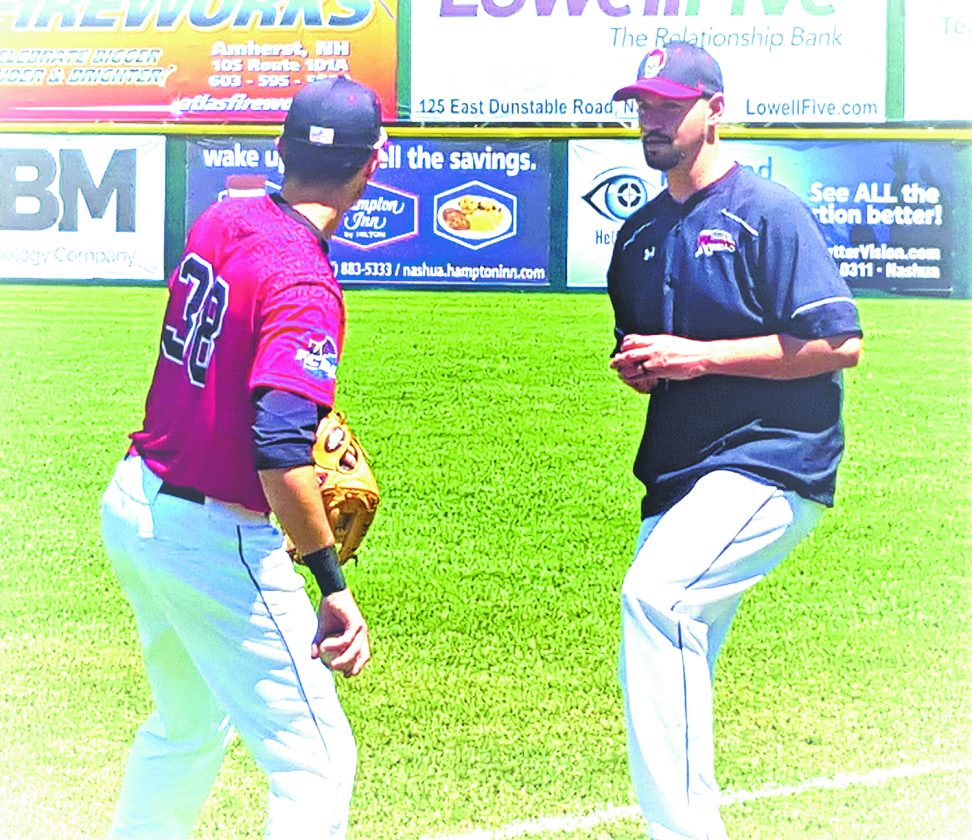
Telegraph photo by TOM KING Kyle Jackson, right, trades in his pitching coach duties for the Nashua Silver Knights managerial job, and hopes to begin his tenure this summer if the FCBL can give it a go.
NASHUA – Whether it’s this summer or next, the new manager of the Nashua Silver Knights may be named Kyle Jackson, but what you will see in the dugout is someone who’s work is a combination of a lot of names.
Jackson as a manager will be a conglomeration of all the coaches and managers the former Alvirne High School standout and Red Sox pitching prospect has leaned on over the years.
“The list goes on,” Jackson, who is hoping to make his managerial debut if the Knights and the Futures Collegiate League can get all the necessary approvals to start a season in early July. “I’ve learned things from all the multiple coaches I’ve had, throughout the minor leagues, from high school, my Dad, Mike Lee. … Every coach has brought a different aspect of coaching, and I’m trying to take little bits and pieces from each coach, and then put my twist on it to make it my own.”
Jackson, 37, is part of the new guard of coaches and managers taking over in the area. The Silver Knights job is perfect for him – he lives right near Holman Stadium, his summer office.
“It’s been exciting,” Jackson said. “I think Rachel (his wife) gets more of a kick out of it when she says ‘My husband’s the manager.’ It’s cool. It brings me back to playing.”
But meanwhile, Jackson is dealing with the uncertainty of the Futures Collegiate League season thanks to COVID-19. He’s had players leave the roster, as well as, after other college leagues have canceled, college coaches pounding on his door trying to get their players a spot.
“I’ve kept it straight with every coach,” he said. “I’m being loyal to every kid who has stayed (on the roster). I’m not going to cut you because I’ve got college coaches calling me about their kid who was supposed to be on the Cape.
“These kids I’ve committed to, and I’m not going to go back on my word. That’s how I was brought up.”
Pro experience
Jackson was also brought up on the school of ups and downs in the minor leagues.
Being drafted by the Red Sox in the 32nd round in 2001, Jackson said, “was a surreal moment.” He was, as he said, “the small kid from Litchfield,” thrilled to be celebrating his future pro career with his Bronco teammates. “Who would have ever thought?” he said. “And by your own home team? It was mind boggling.”
And a great lesson for his young son Corbin Richard, “that anything can happen.” The other lesson Jackson learned was that in baseball, the most important thing is health. He was injured when he signed, in 2003 he was Pitcher of the Year in rookie ball, going 6-3, 1.72 in 14 starts, but in 2004 he struggled to a 3-13,4,64 mark in full season A ball in Augusta. “I was seeing that what I did in high school did not work,” he said, noting that there was a lot more that went into it.
He calls 2005 his “worst and best season.” He got hurt with a line drive to the elbow on the last day of spring training. But once he got going, nothing clicked. It took a couple of things to salvage that season – a move to the bullpen and a talk with then Sox minor league coach Bob Kipper.
“He told me ‘They’re not going to move you up, they’re not going to move you down,'” Jackson recalled. “‘They’re just going to cut you (if he didn’t improve).’ That was an ‘Oh, crap’ moment for a young 22-year-old. Your career could be over in an instant.”
He was 3-5, 4.91 in long season A/AA but 24 of his 29 appearances were out of the pen. Eventually, in the next couple of years, Jackson became a staple at Double A Portland (Maine).
But in 2008, he developed arm trouble but kept quiet, trying to follow the advice he had gotten of “Stay out of the training room” unless ice or stretching. “I kept hoping it would work itself out,” he said, “and it didn’t. The velocity slowed and everything just spiraled.”
And he got released from Double A after a seven-season Sox minor league career of 30-34, 4.91. “I don’t regret it,” he said of trying to pitch through injuries, not telling the trainers that he lost feeling in one of his fingertips, etc., as he felt he was fighting for his job.
But he wouldn’t recommend it to his Silver Knight pitchers, that’s for sure.
“I would honestly say it will never hurt to say you have something wrong or you’re feeling something different,” Jackson said. “It could be something simple to if you let it go, it could be something major. Or it could be too late. … It’s one of those things.”
Jackson’s pro career ended with a stint in the Atlantic League, and that was that.
Coaching material
Jackson’s coaching career had actually started with a stint as the Nashua High School South JV coach under head man James Gaj. But an unfortunate circumstance in 2014 led to his hiring as the Silver Knights pitching coach. The team’s pitching coach at the time, Tom Bowles, unfortunately passed away suddenly – just days before the season was to start. Neverett, a bench coach at the time with the Knights under then manager Ted Currle, approached Jackson about the job.
“My wife was like, ‘When do you have to decide?'” Jackson recalled. “And I told her, ‘Tonight. The kids show up in two days.'”
Neverett had called saying his name was “William”. But when he called Neverett back to tell him he’d take the job, Jackson then realized he was speaking to B.J. Neverett, the former Nashua coach whose team beat him on the mound in the 2001 Class L title game. “Ohhhhh,” he said. “That’s who I lost to in the championship.”
Currle left after the 2015 season and Jackson stayed on under the promoted Neverett. The two would bounce game strategies off each other, not always agreeing.
“We just took each other’s advice,” Jackson said. “I think he respected what I’d been through and how many coaches (he had), and we’d be doing different things. It was always ‘What do you see.’ I think I probably helped him out and he helped me out.”
Neverett was keen on statistics, but Jackson is not. He says he’ll be more of a “feel” manager. “I look at each pitcher is different,” Jackson said. “You want to pull somebody, but this guy’s stuff runs away. I’m a ‘This is the pitcher’s stuff, let’s run off of that.'”
The scenario will repeat itself, Jackson said, as his pitching coach, Ariel Ramos, is a statistics man.
“How many coaches (in the FCBL) had been together this long?” Jackson said, referring to he and Neverett’s six years together. “You’ve always had success, you’ve always had a winning record, you’ve always been to the playoffs. Those are big shoes to fill for me. But now I’ve got even bigger shoes – I’ve got a pandemic going on on my end.”
Lessons learned
Whether there is an FCBL season or not, Jackson will always review what he has learned from that long list of those he’s played for or coached with.
From Lee, who just retired after 38 years as the Alvirne coach:
“Never show up one of your teammates,” he said, recounting one day when he told a fellow outfielder to get out of his way as he called for the ball. “The next day we were getting dressed, Lee was there, and said, ‘Don’t come to the game, don’t dress, do nothing.’ It was a tough pill to swallow, but it doesn’t matter how good you are, you are equal to your teammate.” And he will tell that to his players.
What did he learn from B.J. Neverett, as the pair won two titles together?
“He’s very old school,” Jackson said. “Expects you to know what you need to do. But knowing the college thing. That was all new to me. Dealing with the college coaches, how the system worked. He had nine years of it. I soaked it all in. I’m grateful for the opportunity he gave me for the (Knights) pitching job.”
And from his father, AAU coach Mike Jackson?
“How to handle a group of kids,” Jackson said. “He ran three or four teams a season, but how he handled all four teams, and all the managers who coach those teams. … He’s my role model.”
And Jackson appreciates that Mike Jackson and Kyle’s mom Connie come to every Silver Knights game.
From Epperson, the former Nashua Pride catcher who managed him in Class A Wilmington:
“He would say he was a tough guy, expects the best out of you, but he was also a players coach,” Jackson said, comparing him to Terry Francona.
As a pitching coach, Jackson was in an unusual position – he had the pro experience, but he didn’t pitch in college. So somehow he needed to find a way to “teach this kids what I wish I knew when I played, because I was a hothead. … I didn’t care where the ball was going, I was going to try to throw it by you or make you miss it. But if I knew what I knew now as a pitching coach, I’d be a whole different pitcher.
“I learned that most college kids didn’t know where the ball was going.”
Jackson’s plan was to get them to know. To get them to know how to field a bunt play. To know the mental strategy. “After my first year, that was my goal, making these kids see the game the way I wished I had seen it,” he said.
Silver Knights general manager Cam Cook was a player when Jackson was the pitching coach, and remembers how he thought Jackson’s every game walk from the bullpen to the dugout,high-fiving every player, was a good sign. “We played 56 games, and the guy was up and energetic for every single one,” Cook said. “It gave me a sense that I was part of the team than just the new guy.
“He was the keeper of the peace and would keep you level-headed. He’d keep you on track. When he did say something, it carried a lot of weight.
“The things I thought were good about him as an assistant/pitching coach are still there – he’s going to keep a fun but tight locker room.”
Cook felt Jackson had the attention of the pitchers – so much so that college coaches wanted them to pitch at Nashua “so they could be with Kyle Jackson.”
What kind of manager does Jackson think he’ll be?
“Honestly, I don’t know,” he said. “I want to say, my ultimate goal with this league being a manager is to get these kids knowledgeable. Maybe learn something, whether it’s something little, or something big that they didn’t know. That’s my ultimate goal, to make these kids a better player, and a better person in life – respecting the game, and that way they’ll respect others in life. How to be a teammate. Be a good person, be involved in other things between the white lines.”
He plans on “little meetings here and there …Let’s have a conversation. Is the game speeding up on you or slowing down on you? Does the ball look like a beach ball or a golf ball? And pitchers, how’s the ball coming out, is it strong?
“It will make me a better manager to know what these kids are going through, how they’re seeing it.”
And Jackson wants the players to know what their teammates are going through. If a player can play multiple positions, he will do it.
“I want every kids to know what goes on at every base,” he said. “Where’s the cutoff (man) going to be? So when you go back to school, you’re going to know where your second baseman is supposed to be because you had to be there.”
How will he balance that between winning and losing? “I’m confident with the team I have,” he said. “A great group of kids who come from winning background in their school and they’ll take full advantage of this.”
Jackson was stunned when he coached JV ball at South on how the younger players didn’t quite respect the game or understand it. But he enjoyed the experience, won both seasons, but he says he wouldn’t want to go back to coach high school.
Besides his JV coaching, Jackson has run a game as he filled in for Neverett, at last look, some nine times, with an 8-1 record.
Cook recalled that Jackson was calm in the dugout, but could flip the switch to a more intense level. “It’s just that switch was a little further away,” he said.
“I told the kids to just have fun, give me everything you have, win or lose,” Jackson said. “I’m never going to harass you on effort.
“And it’s going to be the same thing this season. … I want them to play hard for themselves, their family, their school, and the fans.”
Of course, there may not be fans, depending on whatever rules for a potential season are set. It’s been an emotional struggle for Jackson as he waits to see if he’ll manage in a few weeks or have to wait a year.
“It’s been pretty even-keel for me,” he said. “This (the pandemic) is just a roadblock. Because eventually whether it does happen this year, or it happens next year, I’m still going to coach. … If it happens on July 1, kudos to this league. This could be the only baseball (other than some youth) you’re going to see.”
So Jackson will be ready to manage, bringing all the baseball minds he’s known with him into the dugout.
“It’s a new chapter in my life,” Jackson said. “I can only hope I get the respect Mike Lee has, my Dad has in baseball, that B.J. has, from any college coach who’s been through it.”