CHOSEN HOLMAN: Author’s recounts Nashua’s role in baseball integration
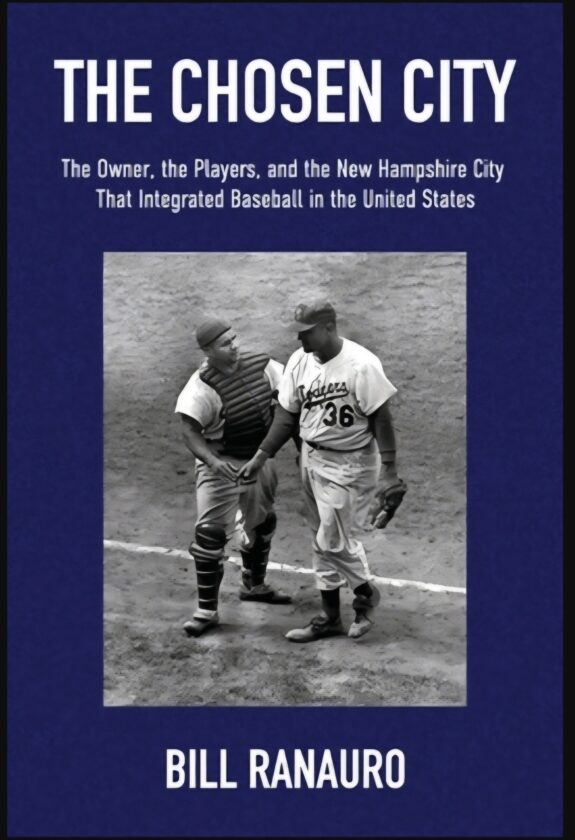
The book written by Walpole's Bill Ranauro about the arrival of Roy Campanella and Don Newcombe to Nashua to play for the Nashua Dodgers in 1946. (Courtesy photo)
NASHUA – The city of Nashua’s role in breaking the professional baseball color barrier in the United States at Holman Stadium is a topic that writers and baseball historians will always explore.
One writer, Walpole’s Bill Ranauro, discussed the topic recently at a book signing and question and answer session for his book, “The Chosen City” at Baldin Books off Amherst Street.
Ranauro’s book is similar to a nationally acclaimed and detailed book on the subject written by former Telegraph assistant sports editor Steve Daly , entitled “Dem Little Bums”.
Ranauro wasn’t aware of Daly’s book when he began his research, but certainly discovered it. But his approach, in his words, was different, as it didn’t go beyond the first year of the Nashua Dodgers, 1946, but went back to explore the history of the baseball color line. Daly’s book details the entire time the Dodgers were here.
“My approach was to go back to the 19th century origins of the color line, and an overview of black baseball in intervening years, what happens during World War II, when so many players were in service and how that changed and opened up the opportunities for the color line to be broken,” Ranauro said. “And howand why, how Nashua came to be the city that really essentially was the centerpiece of integration in the United States whether people realized it or not. … But there’s obviously some overlap with 1946.”
Before Nashua, Ranauro said that a gentleman’s agreement among white baseball owners in 1887 that no one would sign black players, and that lasted until World War II. “Many people say the hypocrisy, here we were fighitng against the authoritatriatism of Nazi Germany and imperial Japan, and yet in some ways we were practicin that,” Ranauro said, noting that baseball owner Bill Veeck tried to break ranks before Dodgers executive Branch Rickey did.
According to Ranauro, the death of Baseball Commissioner Kenesaw Mountain Landis in 1944 also began the integration thaw. His replacement was Happy Chandler, a senator from Kentucky, “and he kind of surprised everybody, he had a more open approach to integration. …
“That opened the door. That definitely opened the door.”
Ranauro, not knowing about Daly’s book, said his inspiration for the book came from reading a book about the Red Sox in 1946 written by Michael Connelly,and it included the social climate of the time, etc. He realized Jackie Robinson was in Montreal in 1946 and that Nashua had the first black players, Don Newcombe and Roy Campanella, in “the white world of professional baseball” in the United States.
Ranauro has been to Holman, and took pictures of the murals outside the stadium and the plaque by the entrance as Holman is a stop on the Black Heritage Trail to include in the book.
Ranauro also discussed how the Telegraph played a role, with Telegraph editors taking part in the Nashua Dodgers administration.
“There was a connection between the team and the paper,” Ranauro said. “In 1946, that’s how people got their information. It was a different world. Frank Stawasz (former Telegraph sports editor) becomes a prominent character in the book.”
Ranauro said the book was fun to write.
“It was incredible,” he said. “I’ve always loved reading about early 19th century baseball. … That’s where I start the book , in the 1860s.”
Ranauro talks about a chapter in his book when Campanella “almost didn’t make it to Nashua.”
How? Rickey started talking about forming a newNegro League, called “The United States League”, and when Rickey was talking to Campanella, the player thought it was for that league and not a spot in the Dodgers organization. He turned down the offer, but had talked with Robinson and realized his misake.
“Long story short, Campanella realized he screwed up, and sent off a telegram to Rickey,” Ranauro said. “Fortunately Rickey was still interested.”
Another note in the fascination of Nashua’s baseball history.