NEVER-SAY-DIE: Nashua boxer Fontanez uses that approach
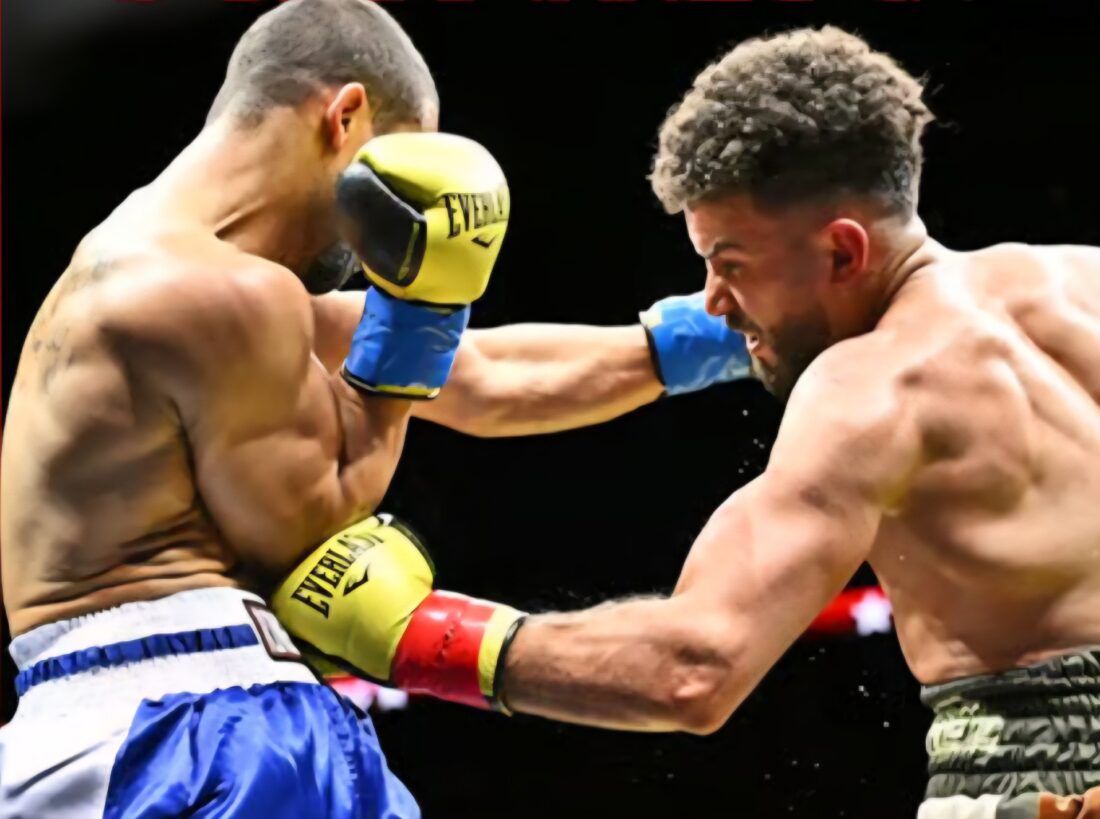
Nashua's Michael Fontanez, right, takes another big step in his pro boxing career this weekend in Lowell, Mass. at the CES event Mill City Mayhem 2. (Photo courtesy of CES Boxing)
NASHUA – Don’t tell Michael Fontanez he can’t do something. He’ll fight you tooth and nail.
It’s likely why, as he says, he spent nights in his car after being kicked out of his parents’ home, defying their wishes that he not pursue a career in boxing.
Well, that’s all water under the ring, because both Maritza and Mickey Fontanez will likely be at the Lowell (Mass.) Memorial Auditorium Saturday night to see Fontanez as the feature eight-round bout vs. Esneiker Correa on the CES Boxing card for the event known as “Mill City Mayhem 2”.
Fontanez,now 29, known as “The Blessed Southpaw”, got the boxing bug as a kid, and defended it to the max.
“I always did,” he said. “You don’t understand, when I fell in love with it, it was ‘This is what I want to do.’ That’s what it is growing up; your parents ask you what you want to do. And it was ‘No, you can’t do that, you can’t be that, you’re going to be punch drunk.
“I didn’t have the greatest relationship with my parents growing up, they’re strict Puerto Rican parents. … But we’re good now. It took 26 years to finally bring them back to my life and get along together.”
Fontanez came to the area some 10 years ago, and wasn’t happy at first growing up in New York, where he had 15 amateur fights. He had a temper; he got kicked out of school for punching a baseball teammate.
“The opportunity of moving over here was a chance to recreate myself,” he said. “When (his parents) said we were moving here, I said I’m just going to find a gym, get a job, and just work, work, work, work and focus on boxing and go from there.”
The gym he found? Nashua PAL, and he worked with PAL’s reknown coach, Muhammad Brooks. “He was the one who really started everything off for me,” Fontanez said.
How did Fontanez get involved in boxing? Simple: as a means of protection, because someone stole his lunch money in middle school in the Middletown, N.Y. area. “I was a kid who got bullied, and I wanted to be with the bullies,” he said. “I was a turn the other cheek type kid, that’s what my parents taught me. It just didn’t work. In public school, man, you kidding?”
When he was 15 or 16, his friends would give him a ride to the boxing gym. “It was a good outlet for me,” he said. “I was respectful. I made it happen, so I really can’t complain.”
Fontanez began street boxing – with gloves – with the other kids on the block. “It was super dangerous when I look back on it,” he said. “We could have gotten hurt.”
His parents finally accepted things, and some of his fights were televised which made a difference.
“Once they started seeing me on TV a few times, it became real for them,” Fontanez said. “They were always looking at me as their kid. But I had two fights on TV, and hearing them say my name, the commentators, it became real for my Mom.”
How does Fontanez handle the mental aspect of the sport?
“You have to talk to yourself, listen to yourself, positive talk,” he said. “I’m big on the Bible, so I kind of lock in, stay focused. It’s not easy. You kind of just push through. I think action is the best way to do it. Instead of just sitting down and dwelling, I’ll go for a run, or just go back to the gym, just to kind of like ease my thoughts. … We’re human. We just happen to do a sport that, well, I guess is barbaric. But it’s still a sport at the end of the day.”
While Fontanez is 12-0 with eight knockouts, his opponent, Correa, is 16-6-1 with 14 Kos, the numbers showing he’s not afraid to mix it up.
“He’s a beast, I know that,” Fontanez said. “He’s tricky. I just think styles make fights, and I know I’m prepared. I put myself through hell in this training camp. I’ve had those mental breakthroughs, I’ve broken down, you train so hard you’re body’s so worn down you start crying. It’s so true. Mike Tyson was crying before his fights before he’d go kill somebody.
“It’s stressful. But I love it, I absolutely love it. The will to prepare to win has to be stronger than the will to win.”
Fontanez in his mind was always a hard worker, and saw success as a teen boy fighting against men. It gave him tons of confidence.
Fontanez used boxing as an outlet to offset the frustration he had with life and the feeling/perception, correct or not, that his parents didn’t believe in him. They likely do now, because as Fontanez said, “I keep winning.”
He read a lot of books on the psychology of life, and it opened up his mind to his parents’ way of thinking.
“I’m grateful for how they raised me now,” he said.
His biggest wins: first was as an amateur capturing his first bout in the prestigious Golden Gloves in Lowell in 2018 against the previous year’s champion after moving up in weight class. “Everyone doubted me, everyone slept on me, I had lost the year before,” Fontanez said. “Everything was set for failure.” And he beat the odds.
As pro, he biggest win was at Mohegan Sun, beating Ray Oliveira, Jr. in six rounds. But his biggest fight is always the next one, so the battle in Lowell is it. His goal is to get into the world rankings.
What’s the difference between fighting as an amateur and as a pro?
“Business,” Fontanez said. “You could love it, but I tell you, I miss the amateurs, because it was all for the fun of it. It (pro boxing) is stressful, but we’re not making millions of dollars or hundreds of thousands, or even $20,000. It might look that way. But we’ve got to sell tickets, the weight cuts are tough…You’ve got to pick the right fights, move economically. In amateurs, it doesn’t matter if you take a loss, you can come back and fight. Now it’s different. But granted, I’ll fight anybody. But this fight is big because I want to show I’m great.”
In some ways, he said, amateur boxing was harder because you don’t know who your fighting in some cases until the day of the bout in national tournaments, etc. He reached the Final Four or Elite Eight a few times between 2018-2021 before turning pro. The three round bouts were still taxing “because you’re fighting Monday through Saturday, everybody in the nation. … You’re only fighting winners, the best of the best.”
Pro boxing, he feels, is a little more dangerous. “The gloves are different,” he said, “and there’s no head gear. … Everybody can punch in the pros.”
Including Fontanez.
“I feel like I’m destined for this,” Fontanez said, “and I know it’s gonna pay off. You only have one shot,so I’m trying to make my mark in boxing while I’m young. … I’m ready to go, ready to go, showcase and put on for Nashua.”
(Mariano Agmi of CES Boxing contributed to this report.)