SPECTATORS: Silver Knight on-field crash still perplexing
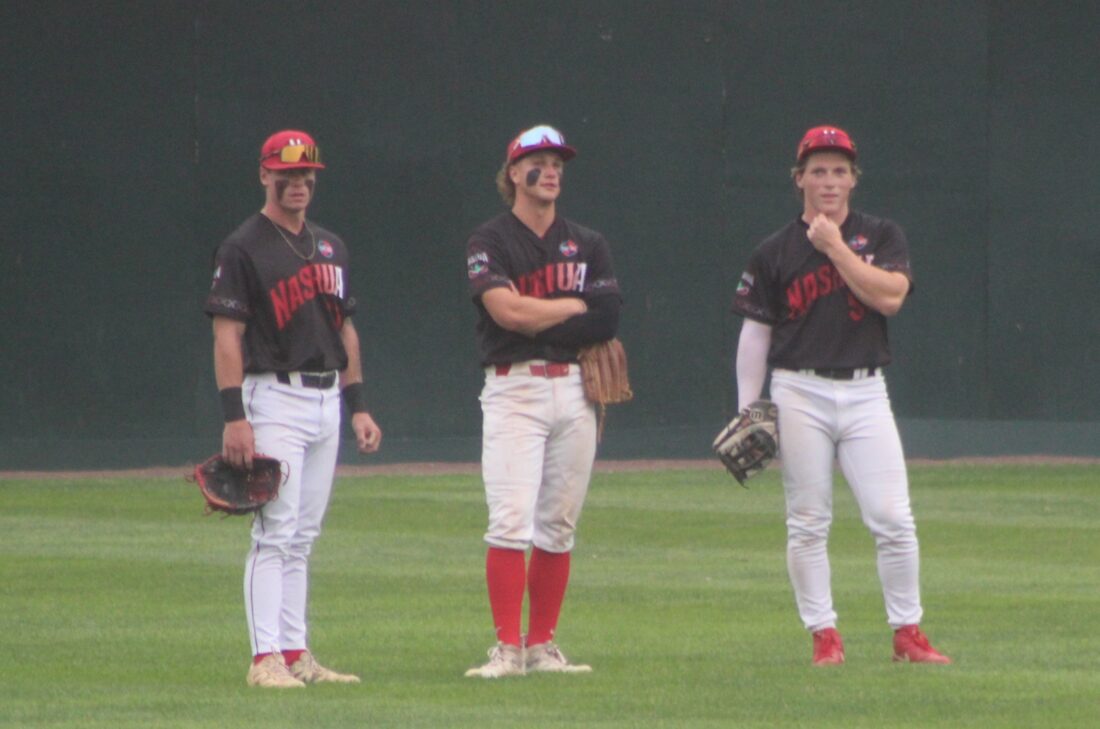
Silver Knight outfielders had to endure a lot of pitching changes during the final month of the season when the team went a shocking 2-17. (Telegraph photo by TOM KING)
NASHUA – What the heck happened?
That’s the question fans, management, and even players are pondering as the lights turned out last weekend on the 15th Nashua Silver Knights season, their unprecedented third straight summer of missing the FCBL playoffs.
In 2023 and ’24, bad starts to the season were clearly the culprit. But the irony is this year, Nashua avoided that problem and in fact after it had beaten New Britain 7-5 on Sunday, July 13 at Holman Stadium, the team was 22-19, securely in third place with less than a month to go. Four teams make the FCBL playoffs, and the Silver Knights had all the makings of a playoff team.
There were basically four weeks left, one of them being really half a week with the All-Star break.
No one could have predicted the catastrophe that was to follow. After a Monday day off, the Knights came back to Holman and laid an egg in a 10-1 loss to Norwich, a team that, like New Britain trailed Nashua in the standings.
It ended up being the first of 10 incredible straight losses and the Knights closed out the season going 2-17. In fact, their 2-1 season-ending win over Vermont last Saturday night was the team’s first win at Holman since….July 13.
“We were kind of firmly entrenched in third place at the time,” Knights GM Cam Cook said. “I’ve never seen anything like it.”
Once the losses mounted, players were leaving right and left, either on their own to get time off before going back to school or because colleges shut them down. Two starting infielders, two starting left fielders, starting first baseman, etc. Then half the team’s starting rotation was pulled because of school imposed innings limits, and some key relievers were gone. The one-two punch atop the lineup of .400-hitting Ernie Little at leadoff and Anthony Grabau right behind him that had been so effective had season-ending injuries.
Despite 10 and 7-game skids, Nashua was still alive until the middle of the final week.
That’s why Guarino said “I don’t have too many regrets with what we’ve done. …We’ve done everything we could do to try to win games. But sometimes it’s easier when you have a Shaun McMillan in the lineup, a Cooper Barry, Jackson Marshall…”
Clearly, three straight years now out of the postseason is something the organization will examine, starting at the top.
“We’re going to take stock,” Silver Knights owner John Creedon, Jr. said. “We’re going to reflect, examine, regroup, and certainly improve the product on the field in 2026, no question about it.”
“It’s a culmination of a few things,” Knights general manager Cam Cook said. “Most glaring one being the guys we lost, an impact they were as ballplayers but also clubhouse guys, culture guys. We lost a handful of guys in late June who weren’t getting the playing time, whatever, then you had injuries. The guys who were supposed to be those plug-in guys aren’t here because they already left.”
And in bringing in new players, as Cook said, “It’s really hard to bring in a guy from another league or hadn’t been playing all summer and expect them to perform. It’s easy to plug one hole and not four or five.”
Worcester won 45 games, but Cook said were “able to keep the carosuel going” when it came time to replacing the few they needed. Vermont the same. And those were the only two FCBL teams that finished above .500, dominating the six-team league.
But the fact remains Nashua simply hasn’t had a dominant offensive player or two since it won it all in 2020 or 2022. On the night of July 15, local product Brandon Metivier shook off a sign for a high fastball to Vermont’s Shaun McMillan, the league’s best hitter, and instead hung a 2-2 off-speed pitch for a three-run homer in the top of the ninth that ruined what could have been a 1-0 Knights win. Nashua then left runners on second and third in the bottom of the ninth. The Silver Knights never recovered.
“It’s hard, right, when stuff doesn’t go right,” he said. “Eventually it’s a week in, two weeks in, and we’re doing the same stuff. … Everything (was) compounding and causing a lot of problems. We (the coaches) felt it before (the players) did.
“Who knows, if we win that game, we might’ve gone 18-2.”
Without a player to hit the team out of its funk, there was nowhere to turn. Cook agrees, Nashua has not had that signature player in three years.
“We haven’t had a Ryan Sullivan or a Dom Keegan, Kyle Wolfe, Jack McDermott, we tried to get Shane McNamara back this year. That’s the kind of guy we were missing. We missed the middle of the lineup.”
Nashua was next to last in hitting, and next to last in homers (just 12) and last in triples (four). The last two weeks, with all the changes, the team fielded a lineup of basically singles hitters. Before July 13, Nashua was hitting .256 with runners in scoring position. After the 13th, they hit .191 in the same situation. Worcester, meanwhile, had three players in their lineup with a combined 55 homers from the college season.
Guarino realized early in the season the team lacked power and gap hitters. “The guys we thought would be those (power) guys ended up getting hurt, leaving, or just not being those guys,” he said.
So the strategy that worked was the old “Get ’em on, get ’em over, get ’em in.”
“You could see it right,” Cook said. “The offense worked to execution where the leadoff guy was getting on. The No. 2 guy was doing his job. Then we were stuck. We couldn’t get them in, no one was doing their job.”
And Silver Knights management was questioning whether it was doing its own.
“It snowballs, now the vibes are off, guys are stuggling, it’s hard to get them up,” Cook said. “I’m sure Guarino kicks himself because it’s impossible to go 1-17 and as the manager not think ‘I have to be doing something wrong’ and it’s hard for me because I’m sure there were moves I could have made before the season or during the season that could have helped.”
Cook says the silver lining – no pun intended – is it has forced the organization as a whole to examine its player procurement and look back at what worked in the past to produce a league best six championships.
And the key: Believe it or not, host families.
“I look back at 2017, it wasn’t the sexiest schools, but here’s what I noticed: Cam Cook was playing third base, he’s from Pennsylvania, a Division III all-region guy, he was staying with a host family. Kyle Bonicki was a Division III All-American, he was staying with a host family. Second baseman Ted Williams was a Division II All-American, he was staying with a host family ….”
You see the pattern.
“It’s kind of a privilege to be playing here,” Cook said. “There are some areas like the Mid-Atlantic, they don’t have anything like the Futures League. They want to go play 60 games …”
Cook said the roster will be smaller next year – this year it was at 40 – so that players and their college coaches can be told they will play. “You’re are guy, you’re going to start three games a week, and if you start the world on fire, you’ll start five or six games a week,” Cook said the conversation will go.
Those who left early clearly won’t be asked back. But at the same time, schools that sent players with instructions for an early departure may not be high on the Knights’ list.
“There’s going to tough conversations with some schools when they want to send guys back here,” Guarino said. “Our bullpen was getting depleted, we were losing starters. Pitchers are different, you’re not going to know about pitchers (being shut down) until after the (college) year. You can work around that. You know in April a guy has 60 innings, he might only have 30 (with the Knights). You’re going to know. That’s fine. You can plan it out.
“But the random shutdowns, when you get put in a bad place – we lost some guys with sub 2.00 ERAs. How are you going to come back from that?
“We want position guys who are going to come here and play, we don’t want them leaving. I want their word. And the schools that kind of stiffed us this year, I’m out on for next year.”
In fact, Guarino says the school list now will cut down on the number of locals on the roster. “We’re branching out,” he said. “Right now it’s very spread out everywhere. Cam and I have been talking about it the last month.”
It’s likely Cook and Guarino will search for experienced college players that are available. Of the original 40 man roster, only 16 were going into upperclassmen years.
Those older players, who have played in other leagues around the country, Cook said, “They get it. They know the grind. They’ve already lived with a host family. They’ve already played a 40, 50, 60-game season. They know the commitment level that summer ball is.”
Guarino and Cook are on the same page with this.
“Maybe the code is you go see guys that have played summer ball and want to be here,” Guarino said. “It’s hard to manage a team when you have 71. It’s hard to build a chemistry when you have guys in-and-out like that.”
They brought in lefty hitter Matt Jackson from Stonybrook in late July, and one player got angry and left. Then the double whammy came when Jackson, who had three homers in a week, left for a family obligation.
“Maybe I could have done a better job talking to the guys beforehand to see whether they’re going to be here all summer,” Guarino said. “But the guys we brough in are the guys we brought in. It’s all random. They all had good springs.”
The natural thought is to push for Division I players, or to think Cook and Guarino because of their Division III backgrounds will want to go that route. Cook says no, a mix is the best way.
“We don’t want to be one-dimensional,” he said, “and say we’re only getting top D-3 guys, or D-I guys, or only guys that have played summer ball.”
Do they need more Division I?
“Different,” Cook said. “Ernie Little was a top, top Division III baseball player (who is transferring to Fordham). Matt Fitzgibbon was from Saint Joe’s in Philadelphia. That’s a new Division I school for us. Last year we had Liam O’Hearn, Lehigh University sent us three very good guys.”
But Guarino agrees the school base needs to be expanded
But what are the other teams doing? Vermont, with manager Matt Fincher, has a lot of Division I connections. Worcester’s Alex Dion, in Cook’s view, “expanded their pipeline. We have, but not at the same rate. I think that’s a big thing.”
And that’s where the host families come in.
“It’s finding housing to be able to do it,” Cook said. “I think that’s a big part of it.”
“I think it’s going to be pretty similar across the board of what guys we went to bring in,” Guarino said. “It’s just the way we’re going to do it is going to be a little different. We’re going to branch out a little more. But same brand of baseball. Same brand of guys. If we had the same team we had Day 1, we’d be pretty good.”
Creedon also notes that “It’s a rapidly changing and evolving college athletics landscape these days. The Futures League and the Silver Knights don’t exist in a vacuum. We are subject to the forces of recruitment, transfer portal considerations, a later baseball draft … There’s a lot of moving parts we have to sort of zoom out and regroup a little bit and be thoughtful and intentional moving on the path forward.
“Today is different than it was three years ago. We have Division I coaches here looking at players. And then other coaches are protective of their players (with playing time and pitching limits for the summer). So there’s a lot of rapidly changing dynamics to account for.”
But one change that won’t be made is at the manager. Guarino wants to return and Creedon said he will.
“Nick Guarino, he’s the kind of guy you want in the dugout,” Creedon said. “He’s a proven winner, he’s gritty, he’s a gamer. Nobody wants to win more than Nick Guarino. I can assure you that.
“It’s more on me to empower him differently and better. Give him tools to succeed, perhaps better than I prepared him for this year.”
But the worst dynamic was what happened the last month.
“It’s definitely surprising,” Creedon said. “And not in a pleasant way, not in a way anybody wants to be surprised. Baseball’s a fickle game, and I don’t fancy myself as the baseball expert around here.”
Creedon says he is going to “reflect more on how I can support my baseball staff more strongly, collect their feedback on things they need differently or better than me.”
“Up untl July 13,” Cook said, “things were going great.”