DIAMOND HISTORIANS: Regional group explores baseball’s past
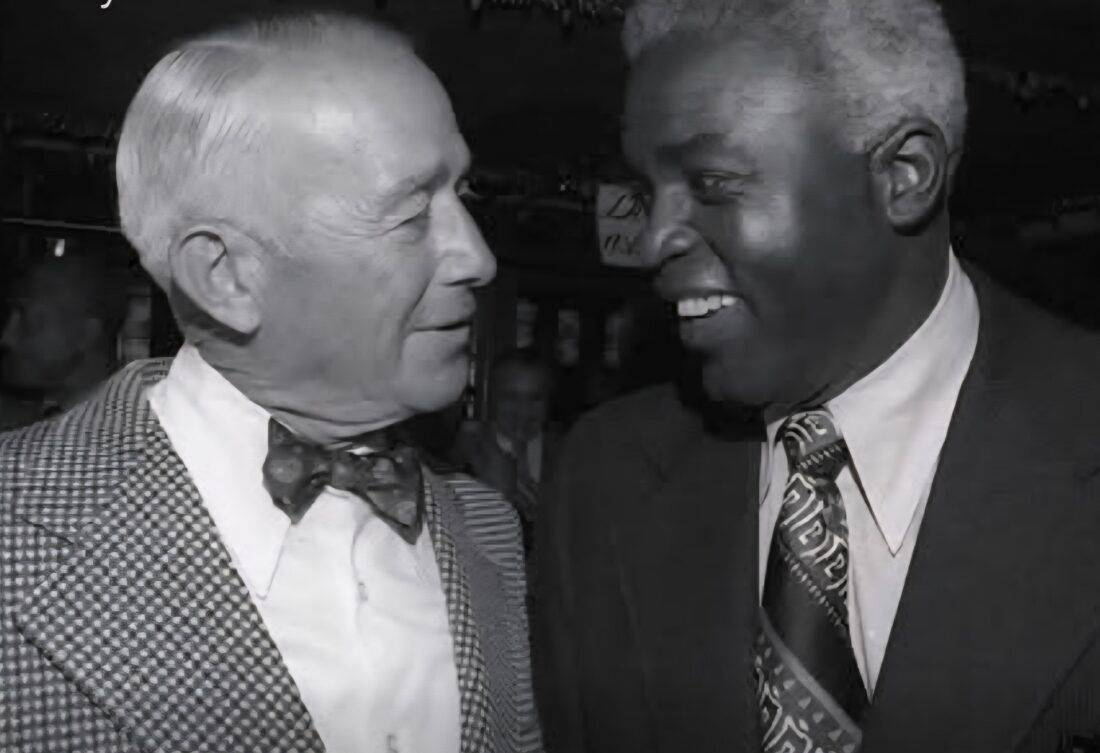
Clyde Sukeforth, left, is the scout who played a major role in bringing Jackie Robinson, right, to the Major Leagues, and that is who the Northern New England Chapter of SABR is named after. (Courtesy photo).
NASHUA – Anyone know who Clyde Sukeforth is? Or that there was once a team called the Nashua Millionaires?
There are thousands around the country who spend a great deal of time finding out those things, including several here in New Hampshire and the Nashua area.
They may be sitting at a table on the concourse of a ballpark like Holman Stadium, eager to welcome you into the fold.
It’s called the Society for American Baseball Research, otherwise known as SABR. And the regional (Northern New England) chapter is known as the Clyde Sukeforth Chapter, and they meet on Zoom every Monday night, usually with a guest speaker. The chairman – and creator – of the Sukeforth Chapter is a New London resident, Bruce McClure, who is also on the national board of directors of SABR.
“When I created the chapter, we started talking about who to name the chapter after,” McClure said. “Clyde’s name kept coming up because of the way we try to operate our chapter with the attitude that ‘Everyone is welcome, nothing matters, you’re a baseball fan, come on in and have fun.'”
McClure, who was urged by those at national conventions to start the chapter, created it at the end of 2022, He went through SABR’s national directory to find all the members from New Hampshire and Maine, and emailed them about creating their own chapter. He was hoping for the minimum needed of 25 responses and got 35. And today it has grown to just over 150, and just shy of 100 are local (New Hampshire and Maine).
SABR itself was founded in 1971 by L.Robert Davids, a regular contributor to, at the time, the popular publication “The Sporting News” and 15 fellow baseball researchers. He summoned them all together for a meeting for the first time at the Baseball Hall of Fame in Cooperstown in August 10, 1971, and SABR was born.Its proclaimed goal is “fostering the study and preservation of baseball history.” It has grown from that little group over 50-plus years to 7,000 members worldwide.
Who was Clyde Sukeforth? A former standout catcher at Georgetown University in the early 1920s, He began his professional career right in Nashua, playing for the Nashua Millionaires of the Class B New England League in 1926, which was property of Cincinnati, where he made his Major League debut. The Millionaires played at the area now called North Common.
He eventually played for the Brooklyn Dodgers, and in his later role working for them as a scout he introduced Jackie Robinson to Dodgers executive Branch Rickey, and later helped create the Nashua Dodgers. That farm club, of course, brought Roy Campanella and Don Newcombe to Nashua, breaking the American baseball color barrier.
“It was Clyde who said that Nashua would be a good town for (Newcombe and Campanella), because it’s a progressive town,” McClure said. “He was thinking ‘We could place these kids there and get them going and eventually bring them to Brooklyn’ and he was right.”
Sukeforth, who passed away in Waldoboro, Me. In 2000, also managed the MLB Dodgers in 1947 for a couple of games while Leo Durocher was on suspension, and was the first MLB manager to play Jackie Robinson.
And thus, because of his relationship with the Dodgers, Sukeforth, a Maine native,has his name on the New Hampshire SABR chapter. He also moved with Rickey to the Pirates and played a major role in the drafting of Pittsburgh great Roberto Clemente.
McLure was contacted by two of Sukeforth’s grandchildren, “who were overjoyed at the fact we are still putting Clyde’s name out there. They kind of felt he was forgotten in the (Jackie Robinson) story. Our goal is to show them and the world that he’s not.”
SABR is perfect for those who want to dive into baseball history.
“Absolutely,” said prominent Nashua member Joe Ross, the former Nashua Pride official scorer, who is a published author/historian and sends out a daily email on “Today in Baseball”, which provides historical facts on baseball happenings and anecdotes from that specific day from years past. “They publish several books a year. There are chapters all over the country.”
McClure says he wants to make sure the Chapter serves shut-ins or those who can’t travel to the national conventions.
“Folks don’t realize how many baseball fans we have up here,” he said. “And the high level of research and interest that’s there. And now it’s a matter of presenting this chapter to baseball fans throughout the two states – and finding them.
“I call it a conversational sport.”
The speakers cover various topics, and may be repeating some of what they’ve spoken about at the organizations national conventions, etc. A few weeks ago a female high school student from Massachusetts was one of the speakers, dealing with analytics. “There is major work required to get that kind of information,” Ross said. Another was an expert on the Negro Leagues in Canada, giving info on the players who made the Majors from them.
According to Ross, SABR national wants some in-person meetings during a year, “and usually they do it in conjunction with a ballgame.”
McClure, in search of spreading the good word of the Sukeforth Chapter and solicit new members, has taken the show to a ballpark near you. They’ve done site visits at various fields/stadiums around the region. They were at Holman in late May during a Silver Knights game,, and were also recently out at Keene at a SwampBats game. At one of their in-person gatherings was journalist Melissa Ludtke, who won a lawsuit back in 1978 for the right to be allowed in Major League clubhouses.
The thing is, with collaboration, the members are always finding out new historical facts about the game they’re passionate about.
“It’s just a love for baseball,” said Ross, when asked what the common denominator is for all who study the game’s past. “That’s really the whole thing.”
The game also lends itself to it. They’ve had Red Sox official scorers as guest speakers.
“You’d be surprised what you learn,” Ross said. “Most of the members are long-time members, there arent’t that many who are new.”
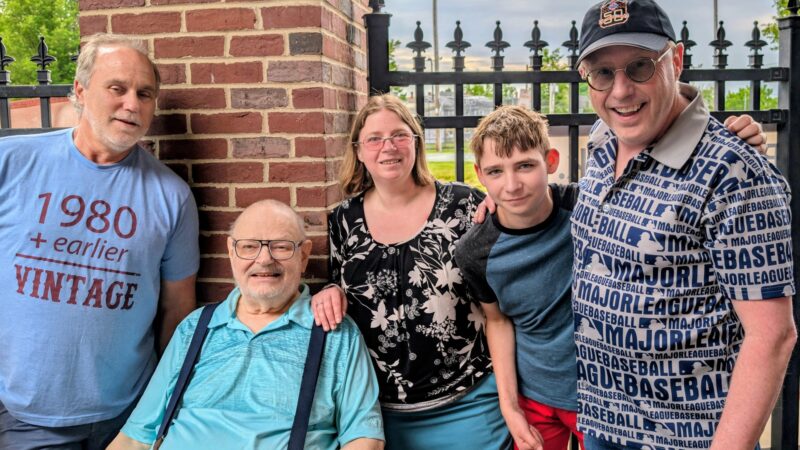
Members and officials of the Northern New England chapter of SABR gather at a local game. From left, Mark Hoyle, Joe Ross, Molly McClure, Ian Dailey and Bruce McLure. (Courtesy photo)
Which is why the organization is making a push to recruit more. The weekly sessions usually attract 15 to 25 people on line. There are various podcasts as well. One topic that has picked up steam surrounds the Negro Leagues because Baseball is integrating the records, statistics, etc.
But the Nashua Dodgers connection is amazing.
“When I first read it, I was ‘Who the heck is Clyde Sukeforth?’,” Ross said. “And then you hear he was the guy in the forefront of breaking the color barrier, he introduced Branch Rickey to all the other guys.”
As one can surmise, analytics is a big part of SABR nationally, and the organization held a national conference devoted to the topic in Phoenix in March of this year. But current topics in the game are also often discussed, including the rash of Tommy John injuries that have become a norm for the game.
As one of SABR’s websites said, “SABR has had a long and storied history with baseball statistical analysis, evidenced by the link between our name and sabermetrics. SABR’s long history in this area of baseball research, coupled with our mssion of advancing the understandingand knowledge of baseball” makes the organization natural for similar events and discussions.
“I see us in New Hampshire and Maine, and nationally, as folks who are in both lanes, the historic lane and the analytics lane,” McClure said. “They will merge at times as we apply analytics to history, or applying history to analytics. I think that analytics has a place in our game of course, but you’re going to see traditional evaluation of talent taking place moving forward because computers, AI, all of that, they’re great. Eyeballs, shaking hands with that kid and talking to him, you can’t replace that.”
McLure said the regional ballpark trips have been productive. “We’re having a great time,” he said. “Talking with dozens of baseball fans, who see the logo, see the books we’re giving away, and it’s ‘Wow, what are you guys?’
“I’ve connected with teachers who are baseball fans who want to expand their curriculum. They’re seeing baseball research in their lessons. Fans are, ‘Wow, there’s a place I can talk about baseball history.’ Yes, that’s us, come on in.”
He said college students who want a job in Major League Baseball approach them often.
“There are so many facets to us, that if you’re a baseball fan, it’s an incredible baseball buffet for you to enjoy.”
The experience at Holman was, in McLure’s words, “fabulous.”
“They (the Silver Knights) gave us a great spot,” he said. “We discussed SABR with dozens of fans … made a lot of great connections there as well.”
The vision is clear.
“I’d like to see us as an example to the baseball community of an open, affirming attitude toward fans getting together and discussing the game,” McClure said. “Not too often do I see in the baseball community a discriminatory attitude. I see us as an example of fighting the discriminatory attitude of many people in sports in general, and make an effort to attract anyone. Anyone who’s got an interest in baseball, c’mon in and celebrate this game with us.”