Old coach getting into officiating
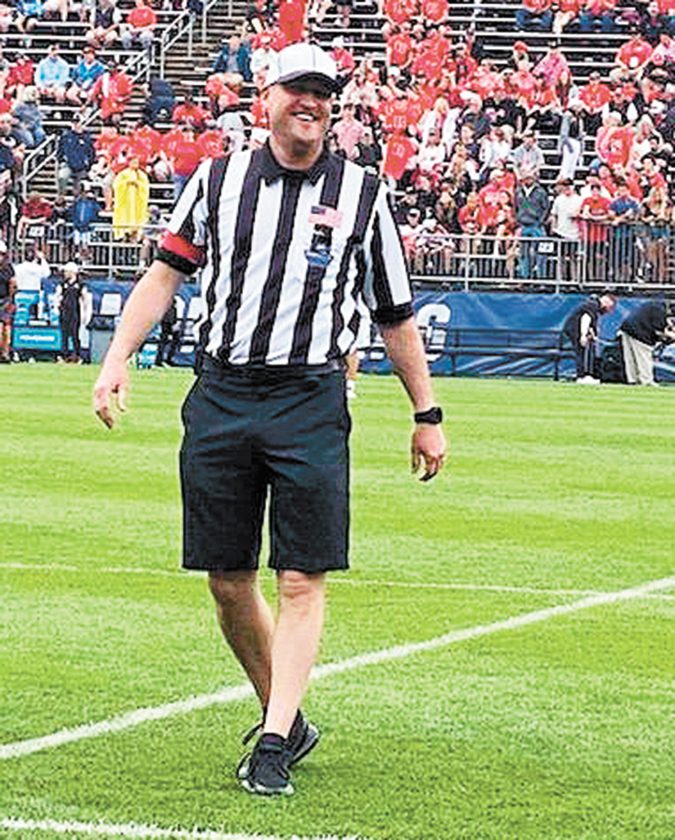
Nashua High alum James Reilly is all smiles before he officiated the NCAA Divison I men's lacrosse semis last weekend in East Hartford, Conn. (Courtesy photo)
James Reilly was a baseball player in his junior high days in Nashua.
Now he’s an established NCAA lacrosse official who worked the Division I men’s Final Four last weekend in East Hartford, Conn..
Who knew?
“I loved baseball,” Reilly said. “Holman Stadium, Babe Ruth (programs), I loved it.”
But a couple of friends, including his brother Shaun, played for the Nashua Blast youth program. And he was in the group that then Nashua High coach Gordie Webb recruited.
“It looked a lot more exciting than waiting for the ball to come to you,” Reilly said.
And that excitement reached its pinnacle last weekend when he officiated the Rutgers-Cornell national semifinal, televised live on ESPN2. Reilly wore a microphone, the whole deal.
Because this was a big deal.
How did this all happen?
Reilly’s day job is in school administration, as he’s the principal of Kingswood Regional Middle School in Wolfeboro. He’s been a lacrosse ref for some 20 years, but before that Reilly was the head coach at Bishop Guertin, a fledgling program before Chris Cameron took over and turned into a dynasty, and Oyster River before that.
In fact, Guertin alum Brian Cameron played last Saturday for Rutgers and his brother Sean played for Princeton.
But Reilly wanted to take grad school courses so he let coaching fall by the wayside. However, a chat with Exeter athletic director and top high school official Bill Ball gave him another avenue in the sport he grew to love.
“He said, ‘Hey, come officiate,’ ” Reilly said.
And a lacrosse referee was born.
The former University of New Hampshire player has done high school state championship games, college games, international games, etc. But last weekend was the highlight, as he was able to experience it with some other officials that are good friends, as well as his wife, Kaitlin, who came to Connecticut with him.
Championship weekend is a gathering of the sport nationally as well as regionally; all three divisions have their title games in the same location.
“It was really cool for me, personally,” he said. “It was my first Championship Weekend, I had never even been as a fan. My brother and my father used to go all the time. But like to be there doing it (not as a fan).”
But this was an honor.
“It’s a humbling thing,” Reilly said. “When you think about the amount of officials in the country, the work everyone puts in, and then to be one of the last 15 officials in the country to be officiating some of the best lacrosse in the world, it’s pretty humbling and pretty remarkable for sure.”
As a coach, Reilly was naturally questioning officials’ calls. Then he was on the other end of the spectrum.
“I’ve never missed (a call),” Reilly said, joking. “I was young, in my early 20s, and didn’t realize that’s a whole other level of the game. I didn’t realize it was its own craft.”
In fact, Reilly doesn’t officiate any other sports, just lacrosse. And in doing so, he realized how competitive officiating is, that the refs compete to get the top high school games in the state, plus college.
“You want a high school state championship (as a player), and I didn’t understand we’re competing for that was well. I just thought it was part of the game. But then you continue to compete…It’s the same thing as competing for a starting job as a player.”
Reilly thinks the way things are structured that New England has the most schooled and mechanically sound officials in the country. So he soaked in everything when he started.
When he started, the biggest thing he discovered was something he learned as a player.
“Gordie Webb always taught the second whistle,” he said. “The first whistle kills the play, but when the whistle blows again, be ready. When the play becomes dead, we (officials) become alive. … A good official manages the game, he doesn’t ref the rules.”
In fact, the game is more physical in college, where Reilly says that most of the body checks at that level are fouls in high school. But in college, “we don’t even think about reaching for a flag. It took a lot to learn and understand. Just because you knew the rules doesn’t mean you could officiate.”
Reilly said he finally made the adjustment about 12 years ago when he did the World Championships in Denver, officiating the Bronze medal game.
“Those games put me personally at a level that I started to not only believe I should be there but the confidence level was that I believed I could be successful at those high levels.”
In 2011 he tried out for the World U19s and was selected as an alternate official.
“I was a kid from Nashua, who was I? I didn’t play big ball lacrosse … When I did that, I kind of got a little taste that the ladder (to climb) wasn’t only there, it was pretty tangible, and if you put the time and the effort into it, you could do something.”
In 2014, he was selected for the Blue Level World Championships.
Tryouts for officials are like this: “You have a bunch of assessors, and they’re watching with their clip books,” Reilly said, noting they watch the refs officiate the scrimmages in which the U.S.players compete for, say, spots on the national team. And for international games, refs are required to pass a physical fitness test. In fact, Reilly had to submit a test last weekend so he he could go over to Ireland and officiate the World U21s Championships this summer.
Reilly has made a great second career in the sport, that’s for sure.
“You put a lot of time into it,” he said. “The guys that love it, there’s some good money in it at the collegiate level, but most of us would probably do it for gas money and the chance to go out for a drink afterward. It’s a tight group, it’s really fun.”
Reilly has done a couple of NCAA Division III semis before, “but Division I is a different market.”
So, obviously, is high school compared to college. “Now you’re managing not just the pace of play but the people in it, more,” he said. “The professional side of it is where you start to craft that (communication).”
How did Reilly get chosen for the NCAAs? He felt he performed well for a Patriot League semifinal at Nickerson Field, Boston University vs. Lehigh, working with some officials who have refereed at a national level.
“If you do well with them, then it gets back to the assigners,” Reilly said. “I think I was able to perform well, with a good crew.”
A couple of weeks later he worked a Brown-Virginia game, so that gave him more notoriety.
In preparing for a game like this, Reilly uses technology, and watches a lot of tape on teams to see tendencies.
“I like to watch the rides and the clears,” he said. “Is the goalie going to come out, is there an off-side situation I need to be aware of? I’ll go back and watch the games and be prepared a little bit better.
“You kind of let it come to you. At this level, every ground ball is critical.”
THE SEMIFINAL EXPERIENCE
Reilly walked the field before the game last Saturday, which was won by Cornell, 17-10. He said hello to Brian Cameron while watching the teams warm up, he checked the location of the shot clocks and other logistics.
“It’s about people,” he said. “It’s an honor and I know there’s a thousand officials literally who would love to be doing that game.”
The game was not that difficult to officiate; the worst part about it was a three-hour rain delay at the half. Reilly and his crew only threw three flags during the game. “Sometimes it’s not the calls you make but the calls you don’t make,” he said. “Each possession is so important; if you take a play off or fall asleep you could be in trouble.
“I thought we were able to manage it very, very well.”
After every goal the officials rotate positions, and there are three officials on the field and one in the box, who is there to answer questions for coaches.
The atmosphere was memorable.
“It’s win and go to the national championship or go home (for the players),” he said. “The fans were great. But once that whistle blows, I don’t hear it. My wife said, ‘The fans were so loud’. But you get in a zone, right?”
And when he got back home, he could still feel the adrenalin pumping.
“That’s when you realize, wow, that was fun,” he said.
HIS NASHUA DAYS
Reilly wasn’t on the 1998 Nashua team that won the state title, graduating the year before; his brother Shaun played on that team and went on to become an All-American in college.
“Back then we were really fortunate with the one high school,” Reilly said.
Most of the high school games he’s done have been in the northern part of the state with the smaller schools, but he’s done a couple of Division I games in the southern part of the state, and Reilly is also the chairman of the state high school officials board.
Reilly is entrenched as an official. He says he doesn’t miss coaching; this is the way he wants to stay in the game.
“I like being active with it,” he said. “Getting up and down a field, I can try to get down a field quicker than some of these Division I kids. There’s a little bit of excitement there, right? At 43 years old.”
But Reilly admitted it’s an adjustment physically working the faster college game, especially in Division I. And some of the players are older thanks to the extra years of eligibility granted them due to COVID and the transfer portal.
“You’ve got 23, 24-year old men, the strongest they’ll ever be, and you’re running alongside them,” Reilly said. “It wasn’t always that in lacrosse.”
But Reilly keeps things in perspective.
“The game’s so much bigger than any one of us officials,” he said. “That’s what’s humbling, too. If I don’t go, they’re still playing, someone’s going to officiate it.”
Now that he’s done a Division I national semifinal, Reilly would love the opportunity to do the national championship game.
“The shot’s there if you want it,” he said. “You’ve got to be able to perform. If I keep getting better and not content, there’s an opportunity for every official, for sure.”
Opportunity knocked, and James Reilly answered it. Not bad for a junior high baseball player, huh?