Coach lands again
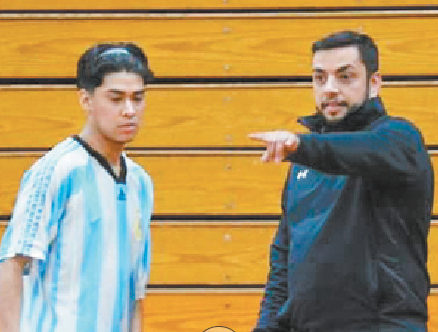
NASHUA – He was once an Eagle, flying high, and is now an Eagle again.
Eusebio Marote was a four-year soccer standout at Daniel Webster College, a captain on the Eagles’ final soccer team that not only went to the NCAA tournament but won a game.
And now he has wings once again, this time with the Eagles of the International Soccer Club of Nashua, as their new coach. He and his team are scheduled to make their debut this weekend in the season opener at Rivier University’s Joanne Merrill Field on Saturday at 6 p.m..
Marte is one of several DWC alums who played under current Salem State coach Matt Correia at the Nashua college which closed in 2017, who is coaching either at the high school or collegiate level. Not only is he the Eagles new head coach, but he’s coached the last four seasons at Northern Essex Community College.
What is it about this group that produced so many coaches?
“I think it’s just, you know, the competitiveness and wanting to be at the top of the league,” Marote said. “And the love for the game, is the main thing. We all share that.”
Marote says he always had an idea he’d want to be a coach. He played as long as he could, but eventually “it didn’t fit my lifestyle, and coaching was a better option for me.” And being a captain at DWC helped him grow into a leadership role.
“Under coach Correia I learned a lot,” he said. “I just brought my playing experience into my coaching. As long as we have the same goal to be as competitive as possible and try to achieve championships, the only way possible it’s going to happen is if you’re committed and work hard.”
Marote isn’t predicting any UPSL titles for his first season in Nashua, knowing it is a young, rebuilding team he’s taking over.
“You can obviously have the most talented team ever, but things may not go their way,” Marote said. “If you have key players that know their roles, everyone plays their role to a ‘T’ and works hard, I think anything can be possible.”
Marote knew that when his college career was done he still wanted to still be a part of the game he loved, somehow, some way.
He’s doing that now.
“I like the fact I get to stay involved in the game,” he said. “Coaching now has been amazing. I like it both at Northern Essex and ISC. I’m grateful to have those opportunities, and it’s been a great experience so far.”
Marote works in the maintenance department at Northern Essex, and even before that job, when the two-year school decided to resurrect its long-dormant soccer program (some 20 years) in 2019, he saw chance to grow his coaching career.
“The biggest thing to deal with is the turnover,” he said. “Kids will try a semester and see if the school is for them. Since it’s such an option that can be dropped quickly, a lot do that. Keeping them there can be difficult, but besides that, we get players that may not have the grades or the money to go to a four year school. They come to me a little bit, they learn a little more, get experience, financially it works, and we have players who have moved on already to other programs.”
Those include Stonehill, New England College, and here at Rivier, all in a short period of time. He believes the NECC experience, plus knowing Eagles team president Jared Barbosa and his Rivier coach, brother Hayden, opened the door to the Eagles job.
He has known the Barbosas since he was in high school at Lowell, and Hayden was recruiting for Lasell College at the time.
But there’s another strong soccer connection. Marote’s father, also named Eusebio, played with Jared and Hayden’s father in Portugal. He played from age 16 to around 40, and has been an inspiration for Marote’s career in the game.
“For sure, he’s always on me to try to do my best, and he taught me a lot as well,” Marote said. “It’s been good, he’s been a good mentor as well. Since I’ve been a little kid, I’ve always loved the game, been driven hard to play at the highest level.
“I was blessed with the opportunity at Daniel Webster to be a four-year starter, two-year captain, play in a national tournament against nationally ranked schools. It’s as much as I probably could have asked for.”
Marote said that his class was a great recruiting class that grew together in the four years they played with each other. Correia set the goal and Marote and his teammates chased it.
“When you’re expected to go to a playoff and make a run at a championship, there are players that are going to want to play for you,” he said.
“That helps as well. Every year we got better and better, people realized it, and wanted to be a part of it.”
Marote said seeing DWC close down was tough because he wanted to go back to the school in some capacity and help out the program.
He lived in Nashua for four years, and loved the area. “Telling us it wasn’t going be no more, it does get you a little bit,” he said. “You think about the good times. … It’s never forgotten.”
He takes what he learned about success and getting players to buy in, as was the case at DWC, and brings it to these Eagles.
“My main goal, anywhere I go, my coaching philosophy is I want to have a group of guys who all believe in the same thing,” he said. “Being respectful and representing the club with pride. We want players that take pride in wearing the badge. You get a good talented group that’s committed and has the same motivation – it’s got to be competitive and want to win.
“From there if we have the community behind us, players who want to work hard for the club, eventually the results will filter through. It starts there.”
Marote knows coaching an adult team , even with recent collegians, will be “a little different than coaching at the college level.”
“Guys who played at the Division I or II level, some of them might be in this league, either on our team or opposing teams,” he said. “Competition is definitely going to be tough. We take it day by day, practice by practice, focus on the game Saturday, don’t think about three games ahead, one game at a time.
“We do have a bit of a younger squad, but I don’t think that should be much of an issue, because talent wise and organization-wise, we’re going to be working on it.”
The key for Marote is for his players to set the proper image, as they are at the top of the ISC chain.
“I want the youth players in the system to say ‘I want to be there one day,'” he said. “That’s my main thing. I want a good rep for the club. With this group of guys we have, we’re in the same boat as wanting to achieve that.”
He knows with a different level from college comes a somewhat different game.
“You’ll have raw talent that has played at a higher level somewhere else and has moved on to this level,” Marote said. “It definitely helps whatever team they’re on. I think a lot of it has to do with being patient and organization.
“If you don’t have it set in stone the way you want to approach a game formation wise, there’s going to be gaps between midfield and defense and good teams are going to put those opportunities away. We try to limit those opportunities the opposing team has … We try to read (opposing team’s style) as quickly as possible, and we can adjust a little bit, try to realize that, and try to minimize their weapons. If we do that, we can get some opportunities.”
Marote has played on teams like this. He played for Greater Lowell United when they were in the MPSL, during the off-season in college, played against the New York Red Bulls Under-23 team, New York Cosmos, Brooklyn Italians. Top notch amateur teams just a step below the pro level.
“I was only 18 at the time but I was the most fit; I came back to (DWC) my junior year and that was probably my best year,”
Marote said.
It was a great experience beating Worcester State in 2016 in the first round of the NCAA tournament for Marote and the rest of the Eagles. They traveled, stayed in a hotel, ate together, etc. “It was,” he said, “a very professional experience. As much as you’re going to get at that college level. Nice coach bus, nice hotels, it was good.”
He’s coached at the youth level for the Hampshire United program in Milford, and his experience runs from “as little as you can be, all the way to the amateur leagues,” he said.
Marote indeed brings a wealth of experience for a player who graduated from college five years ago.
He’s walked that fine line between being a teacher and a coach.
“That’s kind of tough in a way,” he said. “At the younger ages, your main goal is to develop technique and ways of playing with the younger guys.
“In a way you’re always learning. That’s one thing my Dad has always taught me, no matter what level. Wherever you’re at, there’s always room to learn. I don’t believe there’s one person out there that knows everything. There’s always room to improve and room to learn.
“There’s moments when you have to explain a couple of things, what you’re expecting from each player position wise. That’s for the older guys. For the younger guys, development is key, in my opinion.”
How would Marote describe himself as a coach?
“I believe that I’m definitely very competitive; I’ve always been competitive my whole life. It made me even more competitive when I went to Daniel Webster. Being a player who had those successes over there, I expect a lot from my guys now. But sometimes I’ve got to realize that something that special doesn’t come around too often. It comes with time.”
So Marote will take his time with the goals he sets for his current Eagles.
“I expect my first couple of years to be top dog of the league, and come right in,” he said. “Don’t get me wrong, I’d love to. It needs to be a little bit (realistic).”
Marote wants to be a coach who gives respect, and gets respected in return. He makes it a point to always meet with the opposing coach before the game, introduce himself if he doesn’t know them,etc.
“I want to try to be as professional as possible,” Marote said. “That’s my main thing. I just want to be as organized, successful, as competitive as possible. I say (competitive) a lot, because I believe once that’s achieved, good things will come.”
Marote says it’s great to have a high level team like the Eagles in the area, not only for fans but for talented players in the region.
“Once Jared reached out to me, it was a great honor to speak with him regarding being the next head coach for ISC,” he said.
“And knowing the team is in the Nashua area, it brought back memories of my time at Daniel Webster. I’ve grown to like Nashua, always had a special spot for Nashua, especially after Daniel Webster.”
You might say once an Eagle, always an Eagle.