Coaches prepare for high school sports season
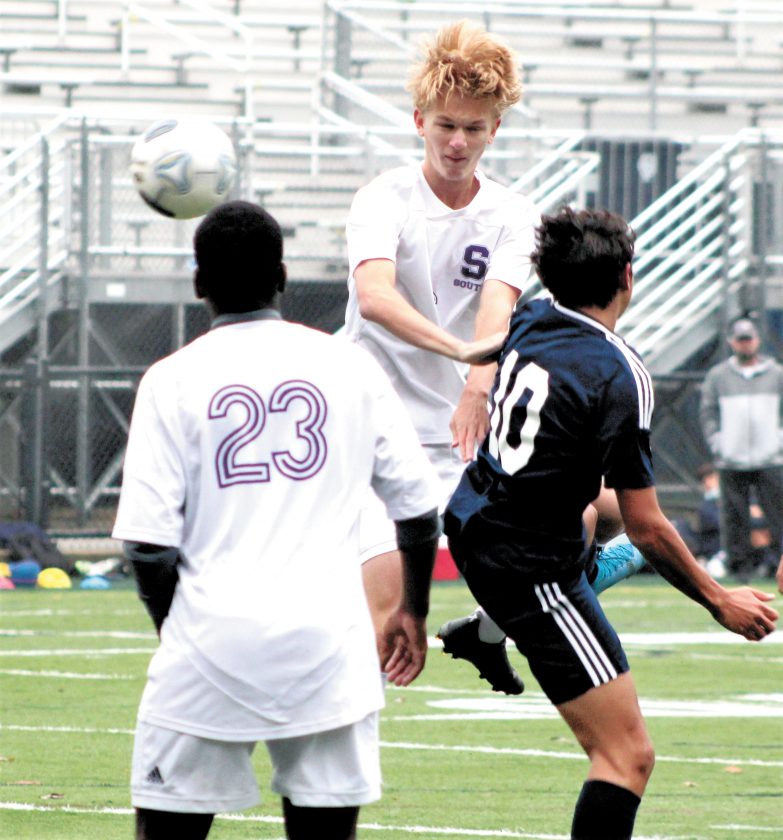
Even a Nashua North-South boys soccer tournament game had near-empty stands at Stellos Stadium due to pandemic restrictions. Most if not all restrictions, as of now, have been lifted as teams begin practices on Monday. (Telegraph file photo by TOM KING)
NASHUA – The final pitch was thrown in the final high school state title softball title game at Rivier University two months ago, and all Nashua Athletic Director Lisa Gingras could do was breathe a huge sigh of relief.
The unforgettable school sports year of 2020-21 was done.
“I’m not going to lie,” Gingras said about a week ago while preparing for the new school sports year. “It was like, ‘OK, I’m done for the year.’ A huge sigh of relief.
“We are always doing it for now, and preparing for next year. … It was hard to start preparing, not knowing.
“I think we’re all excited to have a relatively normal year.”
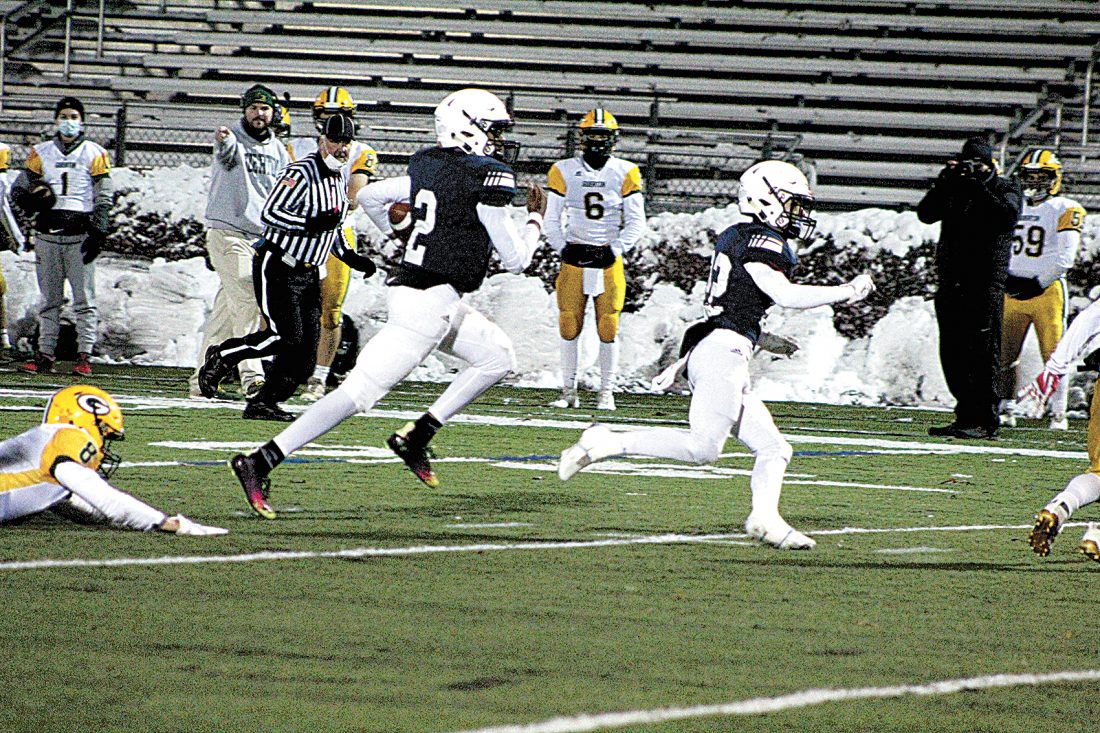
The stands even for a North-BG playoff football game were empty at Stellos Stadium by necessity due to the pandemic last fall. As of now, that won't be the case this season. (Telegraph photo by TOM KING)
Nashua and surrounding school sports communities endured a near 10-month period of masks, contact tracing forms, temperature taking, two week team shutdowns, reduced schedules, fan attendance restrictions, etc.
And now, the 2021-22 school sports year is just about underway. Football practices around the state began Friday, and on Monday all the other sports, such as soccer, field hockey, girls volleyball and cross country, are expected to start their practices before some seasons begin around August 26-27.
Football is set to start its regular season on Friday, Sept. 3.
And what can we expect? An uptick in the last few weeks with COVID has put everyone on alert that the ways of 2020 and early-to-mid 2021 could resume anytime.
“We are going to be as safe as possible,” Gingras said. “We’re going to try to proceed as normal. We’re going to try to do everything we can to keep everybody safe in mitigation, but we’re no longer doing the daily health screenings, we’re no longer wearing masks to start the season. We’re going to allow spectators and students and fans to come back to games and things like that.
“It’s important though, that everybody understands that at a moment’s notice everything could change. At a moment’s notice.”
In fact, during the fall sports registration process that has been ongoing the last few weeks, Gingras said there is an agreement parents of student-athletes have to sign that stipulates things could return to temp checks, masks, quarantines, etc. at any time.
—
WHAT WOULD TRIGGER THAT
“Obviously everybody’s been watching the numbers, the numbers are going up ,” Gingras said. “Honestly, it would just be a matter of communication with Public Health and what’s going on around us.”
Gingras said the players don’t have to be tested, but there is a program being developed with Convenient MD for surveillance screening, the purpose being to identify those who could be COVID-19 asymptomatic.
And there is no requirement, she said, for vaccination on the part of the athletes or coaches due to numerous controversies nationwide on the topic. “That’s personal medical information,” she said, different from the schools needing to know of any allergies, etc.
Gingras is just looking forward to things proceeding the way they did pre-pandemic.
“Obviously, we’re all, whether you’re connected to a school’s athletic programs or just a community member, I think we’re all just ready to get back to “normal”, whatever that looks like,” Gingras said. “But we all have to take precautions. … If you are sick, stay home. And the students and the parents need to be cautious of who they’re around when playing on our teams, like we talked about last year.
“Kind of try to, I don’t say isolate yourself, but have this small little bubble during the season.”
But, as Gingras said, “Everybody is ready to hit the ground running.”
Athletes were able to have summer workouts, they were able to use school facilities like the gyms and weight rooms; there were the usual school team-related Park-Recreation summer camps. The school student-athlete community has been active.
“We’re ready to go, we’ve been fortunate. We’ve been able to have summer programs this year,” Gingras said. “Everybody’s been able to lift, to play basketball, volleyball. … A lot of that was relatively normal for the kids. It was nice to see them out playing field hockey or soccer, or in the weight room or the gym.”
What does Gingras expect for the participation levels? Too soon to tell, she said.
“That’s the million dollar question right now,” she said. “So many of our incoming freshmen, everything was so hot and uncertain last fall, a lot of freshmen didn’t come out for our teams.
“Now it’s first-year sophomores, and we’re hoping they’re going to show up, and we’re going to be able to rebuild our numbers back up. Right now our registration levels are pretty healthy for where we are this time of year.”
For most, but not all programs. For example, field hockey numbers are so low right now that Gingras isn’t sure there’s enough for JV teams at either North or South. Volleyball, at a look last week, didn’t have enough numbers to support three teams (varsity, JV, freshmen), but like field hockey, that could be changing in the next week, as many wait until the last minute.
Meanwhile, pre seasons are beginning nearly a month earlier than a year ago, when they started back in 2020 just after Labor Day – which is normally when games that count begin. Also, the scheduling clusters are gone. In other words, Nashua South won’t be just playing North, Bishop Guertin, Alvirne, or close-by schools in a limited 10-12 game season for non-football sports that had teams facing each other sometimes twice a week. It will be back to the traditional schedule where, for example, in Division I soccer, teams face most (but not all) of the other teams in their division once for a full 16 game slate.
—
LOOKING BACK AT LAST YEAR
Was there ever a point in the fall, winter and spring of 2020-21 that Gingras felt the precautions weren’t going to work, and seasons were not going to be finished? Remember, there were some pauses for a few teams; Nashua South girls basketball, for example, didn’t start its regular season until early February, and it lasted only a month. North football, in winning the Division I state championship, only played a handful of regular season contests. North-Souhegan and South-Pelham hockey also had limited regular seasons due to pauses.
“No,” Gingras said. “I really didn’t. Well, I never really felt like we couldn’t do it. But it was dependent on the coaches, kids and the parents buying in. If we were going to have any of the three seasons, people had to do what I asked them to do. It was that simple.”
Gingras made it clear throughout the first few days. “Coaches and kids, we were hammering them with ‘You don’t have a choice, this is what you need to do’,” Gingras said. “And at that point in time, everybody had been ‘locked up’ for six months. Kids were willing to do anything if we let them play.”
And not just for games, but practices. Every single day coaches had to fill out paperwork acknowledging wellness checks, temp checks, etc., that needed to take place before each practice and game. It was tedious and time-consuming, but ultimately necessary.
“The extra work that our coaches did last year was unbelievable,” Gingras said. “I give the credit to them. My coaches were unbelievable. If they had a question, like ‘So-and-so did not come to practice today, they’re not feeling well, what do I do?’ And I would take it from there.
“They were unbelievable. They were able to realize this was the only way it was going to happen. And looking back, that we got through three seasons, played championships, people were in the playoffs.”
Indeed, the fall saw North football, despite its limited regular season, capture the Division I state title and have arguably its best player ever, Curtis Harris-Lopez, earn a football scholarship to Holy Cross. And in the spring, after being the only programs not able to compete in the winter due to lack of indoor facilities and precautions, the Titan boys and girls track teams made history with Division I titles. Cross-town at Bishop Guertin, boys basketball, wrestling and girls hockey produced a winter bonanza of championships, and boys and girls lacrosse won in the spring. There was plenty of local success, but it was pretty clear that in Nashua, the restrictions were one of the toughest around.
Was the toughest time early in the winter, when after a two week holiday break, things had to be shut down for two more weeks for precautions?
“It was tough,” Gingras said. “It was tough because winter season had already been so delayed. It was tough on everybody in that ‘Oh my God, you’re taking more time away?’
“But if you look back, it was obviously one of the smartest decisions we made all year. We just shut everybody back down, be healthy, stay healthy, and then come back. And it worked out.”
The spring was the easiest of the three seasons for various reasons – vaccinations, plus it was outdoors, and any precautions needed were easy to implement because athletic departments just needed to use their fall plans that worked so well.
“For us, we don’t have boys volleyball, so everything was outside,” Gingras said. “There was a little collective sigh of relief (after the winter) that we made it through hockey, we made it through wrestling, we made it through basketball, we made it through ‘All the windows are closed and everybody’s inside for the winter.’
“So I think it was being outside, and also we made it through winter, we made it through Season No. 2.”
The toughest thing throughout the school year, Gingras said, was limiting the spectators. Nashua was one of the strictest, with in some cases as few as two fans per student athlete,where other events allowed four or more. No visiting fans – and that was also the case for North-South games. Only the home team could have fans, even at Stellos Stadium, until some of the restrictions were loosened midway through the spring season.
“That was the most difficult,” Gingras said. “It was difficult on our parents, it was difficult on our students, on the parents of other teams.”
But, as Gingras said, the positive was that Nashua and other schools were able to develop and enhance live streaming of games. And that isn’t something used just for the pandemic, but for the events going forward.
“We figured out how grandparents from California could watch games at Stellos Stadium,” she said. “And in our gyms, and things like that. It’s still not the same as being there, but it’s at least something.”
And this fall, there are – again, as it stands now – no fan restrictions. In other words, student athletes won’t be given “tickets” for family members to attend and that’s all who can go. Any fan will be able to attend. While there were no admission charges last year, obviously with the restrictions, it’s likely you’ll have to buy a ticket at a football game and NHIAA tournament games, just like the pre-pandemic days.
“As long as we can make it,” Gingras said regarding not having restrictions. “It’s going to feel great, honestly.
“And I’ll be honest with you. The thing that I’m looking forward to will be the students being there. We really haven’t had big student crowds. Think about it, it’s been almost two years since kids have gone to a high school game in masses, in big groups.”
Gingras said that student fans will bring with them a job for the athletic department.
“That will be very interesting,” she said. “We need to re-teach our students how to be positive fans at an athletic event. … We’re looking forward to it. It’s going to be different. It’s going to be like starting all over again.”
Gingras said that ADs will also have to retrain themselves and their staff on how to deal with large crowds at athletic events after a year of limited attendance.
“It’s going to be very strange, but it will be nice to open those gates and see people coming in again.”
Gingras said the learning curve of the fall season helped the rest of the year.
“Like anything, the first time you do something is always going to be the hardest,” she said. “We adjusted things. Spring was the easiest of them because it was the third (season) and it went back to everything being outside. Our protocols for lacrosse weren’t much different from our protocols for field hockey or soccer or things like that.”
The Nashua protocols were almost the prototype for much of the rest of the state, as many, including the NHIAA, kept an eye on Nashua and what Gingras and her entire department did, working in conjunction with the Public Health deptartment. And they may again.
“We’re ready to go,” Gingras said.
-
- Even a Nashua North-South boys soccer tournament game had near-empty stands at Stellos Stadium due to pandemic restrictions. Most if not all restrictions, as of now, have been lifted as teams begin practices on Monday. (Telegraph file photo by TOM KING)
-
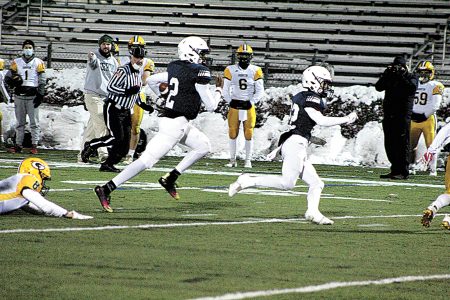
- The stands even for a North-BG playoff football game were empty at Stellos Stadium by necessity due to the pandemic last fall. As of now, that won’t be the case this season. (Telegraph photo by TOM KING)
Local Sports
Lindholm’s third period leads Bruins’ comeback win, 4-2
ANAHEIM, Calif. (AP) — Elias Lindholm assisted on the tying goal and scored the go-ahead goal in the third ...
BEDEVILED: Broncos start OK, but then fall to Salem 47-17