Don’t get spooked: Fire Prevention Month brings Halloween lighting safety reminders from NEMA

Safety warnings regarding the use of extra electric lighting during holidays are typically associated with the Christmas season, but experts say Halloween has quickly become the nation’s second most popular holiday for home decorating — often involving electric lighting.
According to the National Electrical Manufacturers Association.
The National Retail Federation reports that consumers now spend more than $10 billion annually to cover their homes inside and out with lights, candles and festive displays. While celebrating the fall season is fun, it’s also a time to pay extra attention to fire safety. According to National Fire Protection Association (NFPA) statistics, each year home decorations contribute to an average of 1,000 house fires, 53 injuries, six deaths and more than $16 million in property damage.
As October is National Fire Prevention Month, electrical safety experts are offering a few simple ways to prevent home décor from becoming home devastation.
* Ensure light bulbs are screwed in tightly
* Avoid placing furniture on cords and replace damaged extension cords
* Don’t overload circuits
* Use flashlights or flameless candles instead of open flames when decorating your home
* Check extension cords, appliances and lights for any damage before plugging them into an outlet
* Make sure your home is protected with arc fault circuit interrupters (AFCIs), devices designed to detect and stop dangerous arcing before an electrical fire can start.
“Thankfully, technologies like arc fault circuit interrupters exist to help prevent electrical fires from occurring in homes, but as an added level of safety we urge homeowners to also keep their eyes open to other preventable issues while they are decorating,” said David Kendall, a member of the National Electrical Manufacturers Association’s Low Voltage Distribution Section (LVDE) Arc Fault Circuit Interrupters (AFCI) Task Force.
For additional information and safety recommendations, go to www.nema.org or www.afcisafety.org.
–Submitted by National Electrical Manufacturers Association
Greater Nashua
Bedford Academy achieves global recognition for FIRST programming
BEDFORD – Bedford Academy was recently selected as a member of the 2026 Inspire the Future: FIRST Recognition ...
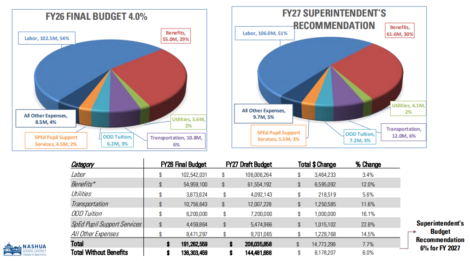
School officials approve $144m budget for FY27