School officials approve $144m budget for FY27
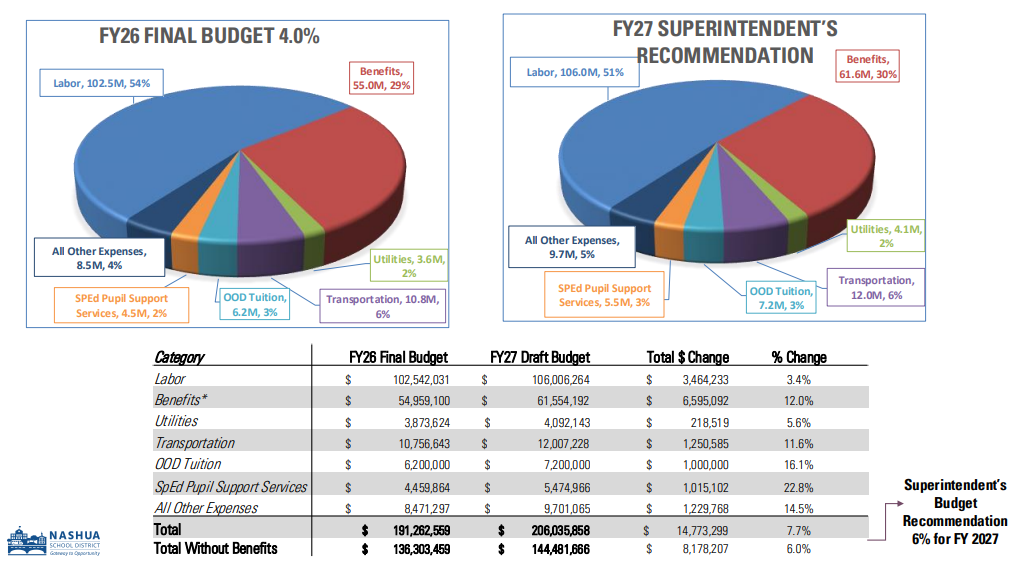
The Nashua School District is proposing a $144.4 million budget for fiscal year 2027. Courtesy image/Nashua School District
NASHUA – The Board of Education recently cast a unanimous vote to send its $144.4 million budget proposal for fiscal year 2027 to the Board of Aldermen.
This amount reflects a six percent increase over last year and does not yet include the cost of benefits. The percentage increase is currently double the limit set by Mayor James Donchess.
The budget also includes $106 million for labor costs, an increase of $3.4 million over last year, $12 million for transportation, an increase of $1.2 million and $7.2 million for out of district tuition, an increase of $1 million.
Prior to the March 9 vote, Gary Hoffman, president of the Nashua Teachers’ Union, said he understood the reasons for the six percent bump.
“The costs that are driving that increase are largely things we cannot control,” he said.
He said special education costs are projected to be $5.4 million, reflecting a $1 million increase, utilities have gone from $3.8 million last year to $4 million this year and transportation costs now exceed $12 million reflecting an increase of $1.2 million.
“What isn’t driving the increase are the salaries of the people who work in the district,” said Hoffman. “Adjusted for inflation, the average teacher’s salary is significantly less than it was 10 years ago.”
However, Hoffman said he still expects a challenge from the aldermen.
“I know this is going to be a tough sell, we’re going to have to explain this to the Board of Aldermen,” he said.
In addition, Hoffman said the state needs to assist with special education funding.
“It’s something that shouldn’t be left to the local communities to fund,” he said, adding that Vermont covers 90 percent of the special education costs for its school districts.
Kenneth Heaton, a social studies teacher at Nashua High School South, and his colleagues were tasked with taking the new high school schedule and “making it work.”
“That didn’t sit well with a lot of people,” he said. “Making it work is going to require more than just a new bell schedule.”
He said policy changes will be needed for lower class sizes, curriculum realignment and study halls.
“Smaller, single-level classes are a proven best practice, yet under a compressed schedule, this is not optimal,” said Heaton. “Our entire curriculum is built around a longer block.”
Jennifer Byrne, a math teacher at Nashua High School South, said the new schedule “pushes the problem somewhere else” rather than solving it, adding that attendance is the real concern.
She said that during the fall semester, she had two students who each required a paraprofessional. However, those students were absent for a combined 90 days.
“We paid for an entire position for students that were not there,” she said.
Byrne also taught two algebra classes during the fall semester, which ended with a 25 percent failure rate.
“I think that’s awful, 25 percent of my students didn’t pass,” she said, adding that the students with failing grades missed 20 percent of the school days. “I just don’t think we’re focusing on what we need to be focusing on. Not teaching kids that they have to show up is an issue.”
Speaking about enrollment, Superintendent of Schools Dr. Mario Andrade said there are currently 9,501 students in the district resulting in an average class size of 19 students.
“We’ve seen a decline in the last 10 years,” he said.
In contrast, 11,377 students were enrolled during the 2015-2016 school year.
Andrade also said student demographics have changed as the number of special education students and English Language Learners continues to grow. There are currently 2,235 special education students and 2,054 ELL students. Ten years ago, there were 1,910 special education students and 1,130 ELL students.