State DES issues cyanobacteria bloom advisory for Hudson’s Robinson Pond
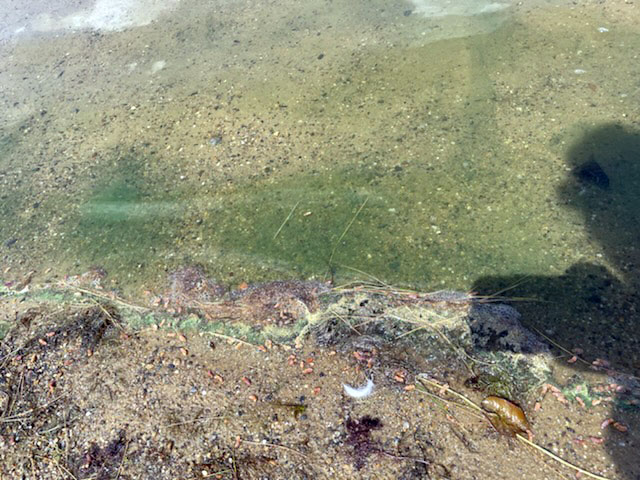
(Courtesy photo) The green flecks and patches of dense clouds along the shoreline indicate a cyanobacteria bloom on Robinson Pond in Hudson.
CONCORD — The state Department of Environmental Services on Monday issued an advisory after observing elements of a cyanobacteria bloom present in Robinson Pond in Hudson.
DES spokeswoman Kate Hastings said in a statement that the green flecks and patches of dense clouds observed along the shoreline are consistent with high levels of cyanobacteria, known scientifically as “dolichospermum” and “woronichinia.”
Sample testing indicated the elements were observed in concentrations up to 356,933 cells per milliliter in areas of highest observed accumulations, according to Hastings.
She said advisories are issued when cyanobacteria cell concentrations exceed 70,000 cells per milliliter, a small fraction of the concentration measured in the pond.
The advisory is geared toward people who use the pond for recreational purposes, Hastings said, adding that the advisory is not based on a toxin evaluation, but is intended as a precautionary measure for short-term exposure.
The advisory went into effect Monday, and will remain in effect until DES officials confirm that cell concentrations of the bloom have subsided, Hastings said.
She said the DES urges anyone who notices anything resembling cyanobacteria to contact DES immediately at 603-848-8094 or HAB@des.nh.gov.
In the meantime, people should refrain from wading, swimming, or drinking the water. Also, keep all pets out of the water.
According to Hastings, cyanobacteria are natural components of water bodies worldwide, although blooms and surface scums may form when excess nutrients are available to the water.
Some cyanobacteria produce toxins that are stored within the cells and released upon cell death. Toxins can cause both acute and chronic health effects that range in severity. Acute health effects include irritation of skin and mucous membranes, tingling, numbness, nausea, vomiting, seizures and diarrhea. Chronic effects may include liver and central nervous system damage.
People should be cautious of lake water that has a surface scum, changes colors, or appears to have green streaks or blue-green flecks aggregating along the shore, Hastings said.
Surface blooms can rapidly change and accumulate in various locations around a body of water. People are urged to monitor individual shorelines for changing conditions.
DES officials advise lake users to avoid contact with the water in areas experiencing elevated cyanobacteria cell conditions, also known as a bloom. Pet owners should keep their pets out of any waters that have a cyanobacteria bloom.
More about cyanobacteria and related information, including the DES Harmful Algal and Cyanobacteria Bloom Program, can be found at www.des.nh.gov.
Dean Shalhoup may be reached at 594-1256 or dshalhoup@nashuatelegraph.com.