IN-DEPTH: After debate, aldermen OK return of full expanded outdoor dining
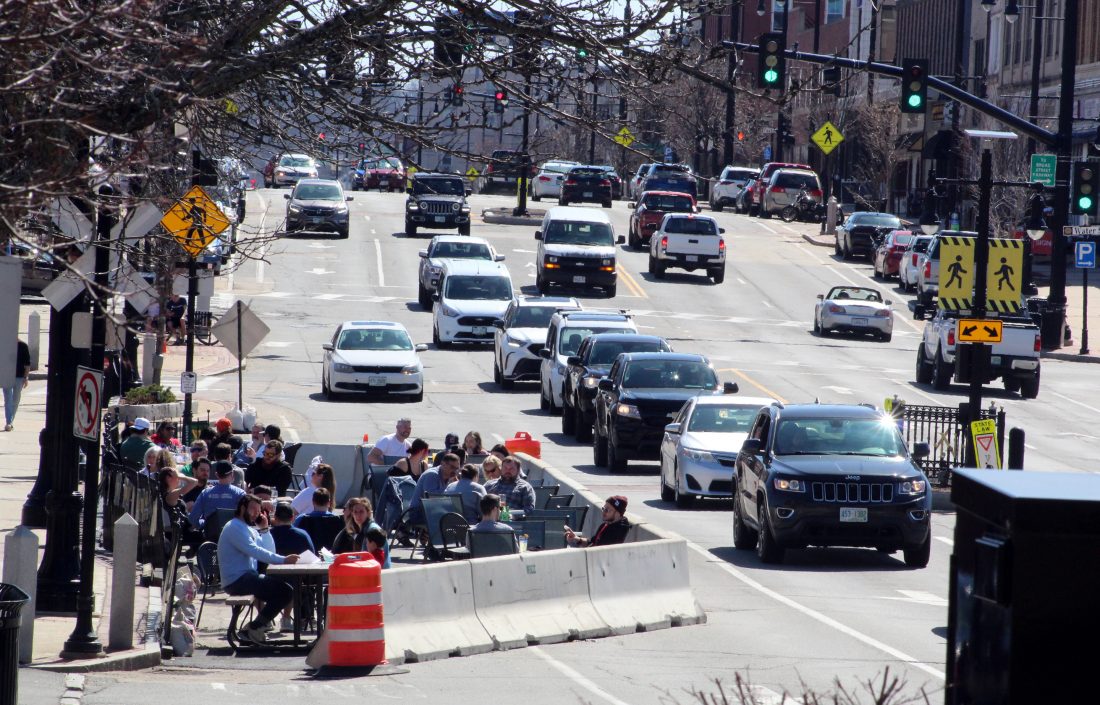
Patrons of Peddlers Daughter on Main Street were among the first diners to utilize expanded outdoor dining as the 2021 season got underway in March.
NASHUA – When the concrete barriers return and thereby signal the opening of the 2022 expanded outdoor dining season, there will be fewer of them than there were the past two years, and they should be more aesthetically pleasing with their uniform, red-brick terra cotta look.
That, and the fact that the plan was tweaked and amended to reinstate several parking spaces, including two in front of 100 Main St. and two, including a designated handicap parking spot, in front of San Francisco Kitchen, changed few if any minds of residents and some office-holders who strongly oppose using concrete barriers in any way, shape or form.
It was three minutes before 10 last Tuesday night – fairly early compared to some recent meetings – that the full Board of Aldermen handed down the long-anticipated verdict on the proposal to return expanded outdoor dining – with most of the barriers included – to downtown Nashua for the next three years.
When the barriers will begin arriving – and whether the city will need to hire outside contractors or can utilize Public Works crews to install them – isn’t yet known.
Messages left with city Economic Development director Tim Cummings last week seeking that information weren’t returned.
The amended version of the ordinance, O-22-008, was approved on an 11-4 roll-call vote, bringing to an end – at least in a legal and legislative sense – the spirited, at times fiery and occasionally acrimonious debate that filled the aldermanic chamber and the Zoom airwaves for many meeting hours over the past few weeks.
Casting the no votes were Aldermen Tyler Gouveia, Ward 1; Alex Comeau, Ward 6; John Cathey, Ward 7; and John Sullivan, Ward 9. All four are first-term aldermen.
Comeau, as a member of the Committee on Infrastructure, was also on the joint committee and its companion task force, or work group, serving as the clerk.
The joint committee, made up of members of the Committee on Infrastructure and the Planning and Economic Development Committee, was formed to study the proposed ordiance and put forth suggestions or make motions to modify, or amend, the original ordinance.
The task force, or work group, version of the committee included five non-office holders with interest in, or ties to, the city’s downtown: Paul Shea, a member of the Board of Public Works and former Great American Downtown executive director; Mary Lou Blaisdell, owner of the Main Street shop DesignWares and the chairwoman of the Downtown Improvement Committee; Kathy Cardin-Smith, third-generation owner of Cardin Jewelers on Main Street; Michael Buckley, owner of Surf and MT’s Local restaurants; and Ruth Boland, owner of the League of New Hampshire Craftsmen shop.
It was Shea who made the motion, which was granted, to have all the barriers painted a red-brick, or terra cotta, color and affix reflective strips to each of them for safety purposes.
Among the issues that prompted many members of the public, as well as a few committee and board members, to speak out is the related costs that, according to the speakers, the city is passing on to taxpayers – coupled with the fact the restaurant and shop owners who stand to benefit by expanded outdoor dining aren’t being asked to pay any fees.
Committee members said the practice of charging fees, common among many cities ranging in size from Portsmouth to Boston, will be addressed between the end of this season and the start of the 2023 season.
Some of the other changes to the original proposal include the elimination, for traffic safety purposes, of the barriers in front of the Peddler’s Daughter restaurant.
Sinage and other roadway traffic control devices, such as reflective, orange barrels, will be reduced to a minimum.
A motion by Comeau to not return barriers to the space in front of the City Room Cafe on West Pearl Street passed unanimously.
Cummings told the committee at one of the meetings that he and city engineer Dan Hudson will soon be launching a traffic study that will take place over the summer.
A dozen or so residents who attended the meeting in person or via Zoom rose to speak at Tuesday’s full Board of Aldermen meeting.
Among them was Laura Colquhoun, who, referring to the barriers, said that “a lot of Nashua residents don’t want them, but the restaurants and the bars do, so they will get them.
“This Board of Aldermen had better start thinking about the taxpayers rather than doing projects downtown,” Colquhoun added.
Most, if not all, residents who spoke against installing the barriers said they are in full support of outdoor dining – as long as it is limited to the sidewalks in front of the establishments.
“Outside dining has existed in Nashua for 20 years, and there was never a call to arms by any restaurants (complaining) that their space was inadequate,” said longtime Nashua Karen Bill.
On Tuesday, Bill asked the full board “to please reject the recommendation made by the joint committee” to approve the ordinance. “Residents have made it abundantly clear: They want outdoor dining, but not at the expense of narrowing Main Street.”
Bill also suggested city officials hadn’t kept residents up to date on the costs associated with expanded outdoor dining, particularly the cost of trucking in and installing the barriers.
“If barriers are installed for any purpose,” she added, the cost should be borne by downtown businesses.
During the public comment period that followed the vote, Bill told aldermen she felt that “those of you who voted for this have done a great disservice to the residents of Nashua.
“During the pandemic, that was one thing. There should have been more forethought among this governing body.”
Rich Lannan, a local businessman who owns and manages what he called “mixed use” downtown buildings, rose to express his support for the ordinance’s passage.
“I’m very much in favor of expanded dining. I’ve been thinking about the reasons people are opposed to it … one is the traffic, because (the barriers) cause bottlenecks and traffic congestion,” Lannan said.
“But a downtown is not supposed to be a thoroughfare, it’s a downtown. And the traffic (goes) too fast,” he added.
Lannan countered the argument that the barriers cause traffic backups to the extent many people claim.
“Heaven forbit it takes three or four minutes longer to drive a mile north or a mile south on Main Street,” he said. “This is about people coming downtown.”
He also pushed back on the widely-held belief that one of downtown’s biggest problems is its lack of parking.
“There’s so much parking in the downtown area … if you can’t park right in front of the store you’re going to, it seems to be a problem, and I don’t know why,” Lannan said.
“If you go to the mall and park in the parking lot, you’re going to walk a lot farther” than they would in the downtown area,” he said.
Dean Shalhoup may be reached at 594-1256 or dshalhoup@nashuatelegraph.com.