Of ‘mad mirth’ and mincemeat: Boston’s Puritans and their ‘war on Christmas’
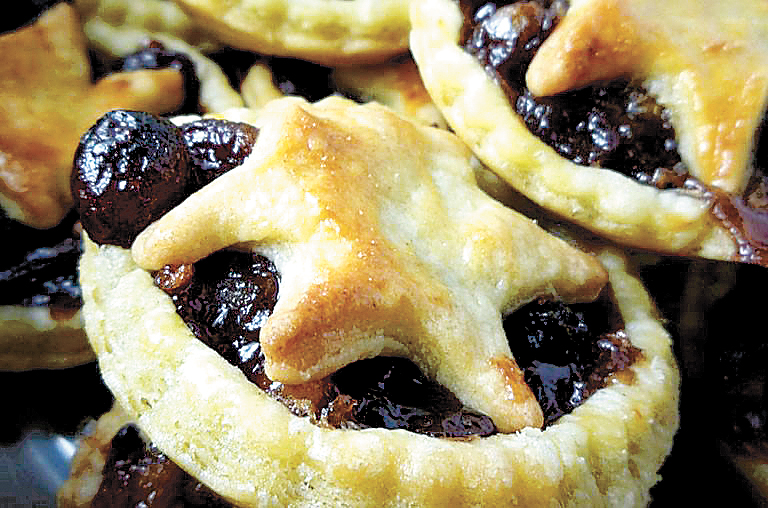
Image courtesy of New England HIstorical Society Enjoying mincemeat pie, such as these individual-sized ones depicted here, was prohibited by order of the Puritans in 17th century Christmas observances.
It’s Christmas. Once a time for ripping wrapping off of new toys, then later, clothing, and now, the annual labor of love: Filling a large plate with indescribably luscious culinary delights known as Christmas dinner.
And then there are the pies. Apple. Boston Creme. Pecan. Pumpkin. Maybe a strawberry/blueberry combo cheesecake to add some color to the smorgasbord of sweetness.
Which reminds me: I don’t care how appealing an experienced pie-maker may try to make it look, I do not like, nor will I eat, mincemeat pie.
And no, I have never tried it.
“Well, how do you know you don’t like it if you’ve never tried it?” comes the inevitable, and always annoying, question.
Because mincemeat pie is one of the very few culinary concoctions that I don’t need to sample to know I don’t like it.
Maybe it’s because I grew up hearing the phrase “why, I’ll make mincemeat outta ya!” in cartoons and kid-TV shows, along with the occasional utterance by a schoolyard bully “bravely” threatening a kid half his size.
Then, along came my friends at the New England Historical Society. Once again, they pointed me toward what could be at least part of the reason I don’t like mincemeat pie.
Consider this little factoid: In the days of old, when the Puritans roamed Greater Boston enjoying their newfound ability to worship as they pleased – while cheerfully weeding out and expelling settlers who dared not conform to their beliefs and teachings – they went as far as to “ban Christmas, and one particular type of pie.”
You guessed it. Back then, for some reason, mincemeat pie “held a special place (among) all the ways to celebrate Christmas,” according to NEHS research.
As tends to happen among unwavering (read: close-minded) devotees of certain religious sects, “myth and superstition had grown up around the holiday treat, and the Puritans would have none of it.”
The ban was announced on May 11, 1659, largely via handbills distributed among the population. At least they gave the citizenry plenty of notice to find a substitute for their mincemeat pies.
The handbill, titled “Publick Notice,” warned anyone caught smuggling a bootleg mincemeat pie into their homes come Christmas were fined five shillings, which back then equaled 60 pennies in British currency.
Whether that was a lot of money in 1659 I have no idea.
What I do know, thanks to the NEHS, is that the Puritans referred to mincemeat pie as “idolatrie in a crust.” Idolatrie, also spelled “idolatry,” means “the worship of someone or something other than God, as though it were God.”
The NEHS researchers further discovered that mincemeat pie also “carried political overtones in a time of deep partisan animosity,” confirming that yes, indeed, today’s political landscape is by no means unprecedented.
So, by simply cutting a slice of mincemeat pie, flopping it onto a plate and enjoying it bite by bite some 362 years ago this weekend meant that you sided with the English monarchy – the very entity the Puritans broke away from some years earlier.
The NEHS researchers summed it up quite cleverly: “For a time, the mincemeat pie had the same effect on a Puritan that a MAGA hat had on an NPR devotee.”
Who says historians aren’t known for their sense of humor?
This whole “war on mincemeat pie” crusade appears to have its roots in the fact that the Puritans “hated Christmas,” and by extension, traditions such as mincemeat pie, music-playing, consuming intoxicants and other such merry revelry, according to the research.
Why? Well, the way Christmas was celebrated bore little resemblance to the cozy family celebrations of modern times, the NEHS tells us.
It was more an echo of something called “Saturnalia,” a festival-like indulgence involving “unrestrained revelry, boozing, gambling and letting their libidoes go” first practiced by the Romans.
No matter how much unsavory activity the Romans, and later the English, and eventually the newly arrived Bostonians, engaged in, they always made sure they prepared plenty of “sweet meat pies”, later called mincemeat pie.
Enter Boston preacher the Rev. Increase Mather (the name Cotton Mather may sound more familiar; he was Increase Mather’s son and also a preacher).
Apparently, the NEHS tells us, the elder Mather wasn’t the type of guy you’d want to wish a Merry Christmas, because that would identify you as a Christmas celebrant, and the preacher actively “denounced Christmas celebrants” as lesser folks “consumed in Compotations, in Interludes, in playing at Cards, in Revellings, in excess of Wine, in Mad Mirth.”
“Compotations” means drinking and carousing. I looked it up.
It was right around there that something caught my attention: “Mincemeat is a Middle Eastern method of cooking meat with fruit and spices … .”
Hold on. Have I been consuming mincemeat my entire life believing that those scrumptious round (open) and triangle-shaped (closed) delicacies of ground beef and lamb garnished with pine nuts were Aunt Naify, and later, Pop’s, old-country-recipe meat pies?
Fortunately, no, that’s not the case, I learned as I kept reading.
For one thing, there’s no fruit in “our” meat pies. And, I was quite relieved to discover, the ancient mincemeat recipes called for “meat … any kind of meat: Mutton, goose, beef tongue, even lamb testicles.”
Gulp.
Good old USDA certified ground beef and lamb from Market Basket is definitely the way to go.
Here’s wishing everyone a very Merry Christmas, happy holidays and a Happy New Year.
Dean Shalhoup’s column appears weekly in The Sunday Telegraph. He may be reached at 594-1256 or dshalhoup@nashuatelegraph.com.