State DES issues unhealthy air alert for second straight day
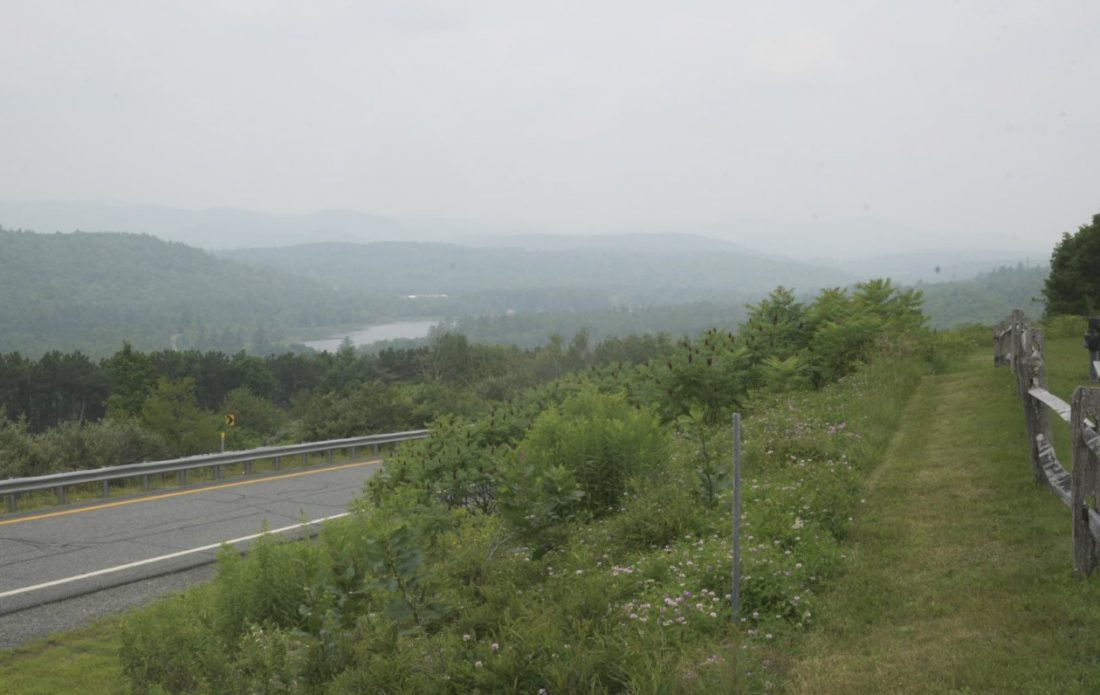
Photo by JEFFREY HASTINGS What may, at first glance, look like the rain shield and dark clouds of an approaching thunderstorm is actually an example of the diminished air-quality conditions across New Hampshire and much of the Northeast. The photo was taken around midday Monday along Route 89 looking toward the Sullivan County town of Springfield. (Photo by JEFFREY HASTINGS)
CONCORD – The noticeably hazy air conditions throughout the region on Monday and again today have prompted state Department of Environmental Services officials to issue an air-pollution advisory for the second straight day.
Called an “Air Quality Action Day,” the alert urges people in so-called “sensitive groups” to “take precautions to protect their health by limiting prolonged outdoor exertion,” according to DES spokesman Jeff Underhill.
Sensitive individuals include children and older adults; anyone with a lung disease such as asthma, emphysema and bronchitis; and people who are active outdoors, Underhill said.
He added that even healthy individuals may experience mild health effects due to the conditions, and should consider limiting strenuous or prolonged outdoor activities.
The haze is the result of a “particle air pollution event,” which Underhill said stems from the smoke coming from the extensive, widespread wildfires burning in the western United States and in central and western Canada.
“Current wind patterns are transporting waves of smoke from these fires across much of the country, including New Hampshire,” Underhill said.
“In addition to the health effects, these smoke plumes also diffract light, which causes the hazy appearance to the sky and reduces visibility of distant objects.”
Underhill explained that the severity of adverse health effects increases as fine particle concentrations increase. Symptoms of particle pollution exposure may include chest pain, palpitations, shortness of breath and difficulty breathing. People with asthma and other existing lung diseases may not be able to breathe as deeply or vigorously as normal and may experience symptoms such as coughing and shortness of breath.
Air quality is expected to improve on Wednesday as winds are forecast to move the smoke plumes out of the area.
For additional information, contact NHDES at 271-1370. For air quality forecasts and current air pollution levels in New Hampshire, call 800-935-SMOG or go to the air quality data link on the NHDES Website.
Dean Shalhoup may be reached at 594-1256 or dshalhoup@nashuatelegraph.com.