Big Brothers Big Sisters: Improving the future, one child’s life at a time
A certain song has transformed into cliche the belief that children are our future, but the truth is, they are. Unfortunately, it also encourages us to perhaps only think about the impact of future adults on our future selves’ lives. It is perfectly reasonable to have that concern, but in the end, our focus must be on childrens’ lives today. They are less likely to thrive in their adulthood if they are not given the opportunities to thrive while they are still young.
According to childdefense.org, children make up the poorest age group in America. In 2018, 1 in 6 children lived in poverty. Nearly 73% of children living in poverty today are Children of Color and American Indian and Alaska Native children. Considering the monumental impact of COVID-19 on families here in the states, most notably Families of Color, imagine just how much those statistics are exploding.
Imagine the effects on families that were already struggling every day before the pandemic fully hit us in March.
Poverty is undeniably the most impactful factor in determining the quality of a child’s life. Poverty determines what they eat and how often. Poverty determines where they grow up, where they play, and the experiences that they have. It affects incarceration rates, health and hygiene, and negatively affects education and enrichment opportunities. All of these things play a monumental role in shaping a child’s life and future.
To be clear, the whole of a community can only be as strong as its children that are living with the most difficult struggles.
Leading the fight in enriching the lives of children facing disparity in America is Big Brothers, Big Sisters. In 1904, a young New York City court clerk began to notice the surprising number of young boys being processed for petty crimes in his courtroom. His name was Ernest Coulter, and he believed that the children could benefit from having positive influences in their lives- that lives of poverty, hunger and abuse could be changed for the better. He set out to find volunteers who could help him make these differences, and together, they began the Big Brothers movement.
Almost simultaneously, a group called Ladies of Charity were taking young girls going through the New York City court system under their collective wing. They had the same ultimate vision: to make impactful changes in the lives of young girls who were making desperate decisions in order to survive. The Ladies of Charity formed a focused group that would eventually be known as Catholic Big Sisters.
These two separate groups transformed many lives independently for the next 73 years. In 1977, Big Brothers Association and Big Sisters International, as they were respectively known, joined forces to create Big Brothers Big Sisters of America. Today, BBBSA operates in all 50 states and Big Brothers Big Sisters International serves 14 other countries.
Community Based Mentoring is the foundation of Big Brothers Big Sisters’ approach. Children and volunteer mentors are matched based on gender, interests, personalities and geographic location. In order to best serve all children in need, BBBS of America incorporated a pilot program in 2016 called the LGBTQ Youth Mentoring Enhancement Initiative, starting with 5 agencies and expanding to 20 in 2017. Through this initiative, mentors and BBBSA employees receive training specific to the needs of LGBTQIA+ children in need, focusing on anti-bullying, self advocacy and identity exploration. With its expansion and the assumption that more adults in the LGBTQIA+ community will be welcomed and empowered to volunteer, it can be assured that more children in need of mentorship will benefit from the tireless work of Big Brothers Big Sisters of America.
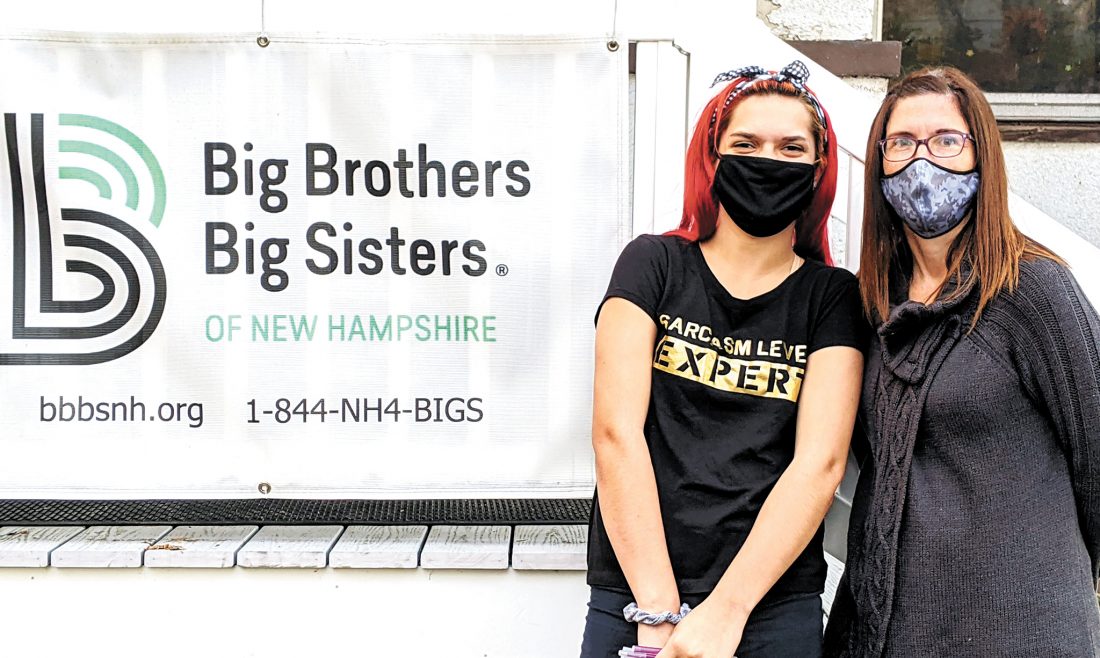
Big Brothers Big Sisters has been pairing compassionate and caring adult Mentors, or “Bigs”, with children (“Littles”) in need in New Hampshire since 1966. They create and nurture bonds between approximately 750 Littles and their Bigs each year, as well as provide support for the Littles’ families and caregivers. Volunteers are carefully screened and then trained before being paired with a Little by a Match Support Specialist.
Among other things, prospective Mentors must be at least 18 years old, be able to commit to at least one year in the program, have a clean driving record and pass an annual background check that is required by law.
Qualifying children are between the ages of 6 and 17 and must also be able to commit to at least one year in the program.
By spending a few hours together at least twice a month, lasting bonds are created that enrich the lives of Littles and their families. Lifewise, the life of a Big is greatly improved through the experience of being a positive role model and friend for a child who may otherwise be lacking.
The role of the Mentor is to model positive behavior, to take the time to listen to their Little, to encourage them to learn, have safe and healthy fun, and be true to themselves. Whether it is by playing, going to a movie, making art or just sitting down and talking, the time spent has an incredible influence on the life and future of every child.
Site-Based Mentoring brings the benefits of BBBSA into schools and after-school programs to children who have been identified by teachers, counselors and after-school staff as needing the benefits of a mentor relationship on site, and requires parental or caregiver approval. Bigs and Littles meet once a week and can have lunch together, play on the playground or in indoor play spaces, sit and talk, focus on homework, or read together. Whatever the activity winds up being, Littles are encouraged to focus on and improve their academic experience and personal development. Site-Based Mentoring also integrates the participation of screened and trained high school and college students as Mentors.
Beyond School Walls is a program that matches a local small to large corporation with schools in their community. Employees of the corporation, after screening and training, are matched one-on-one with children from a partner school, and they meet a couple times a month at the corporation site. This initiative gives kids the opportunity to not only catch a glimpse of adult professional lives, but opens their eyes to the possibilities of their own futures.
To learn more about the programs offered by Big Brothers Big Sisters of NH, visit https://www.bbbsnh.org/about/programs.
The children are indeed our future, but we are responsible for their lives and experiences right now. Too many children are facing hardship today; their struggles now will determine where they wind up as adults, and we cannot turn a blind eye to them.
Big Brothers Big Sisters of America has emerged as a leading force in ensuring that more children in need receive the mentorship and guidance that will give them a chance to grow from a statistic on a website to a strong and determined child.
Because strong and determined children grow into strong and determined adults.
If you have or know a child who could benefit from BBBSA Mentorship, visit https://www.bbbsnh.org/enroll-a-child.
If you would like to learn more about being a Mentor and are interested in applying, please visit https://www.bbbsnh.org/volunteer/be-a-big.