Preserved in the annals of America’s idyllic, Nashua High’s Glory Days continue to elicit personal anecdotes
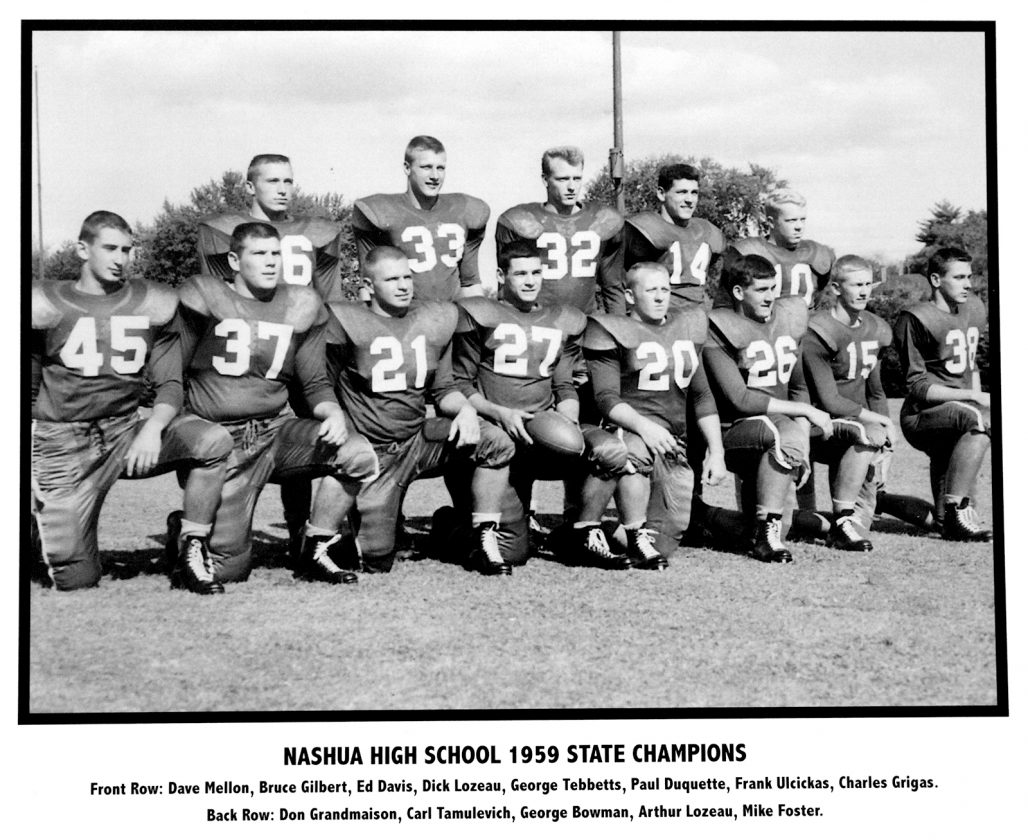
Courtesy photo The Nashua High School football team's state championship was the first of five for NHS teams in the famous 1959-60 school year.
Tucked among the last pages of the 1960 edition of the “Tusitala” – the name of Nashua High School’s senior class yearbook for decades – the section called “Synopsis” featured a one-sentence entry for December 1959.
“Our football team was given awards for emerging as state champions,” reads the sentence, which is sandwiched between a November entry, “Tusitala editors were selected,” and the other December entry, “Another enjoyable Christmas assembly was put on by the Glee Club under the direction of Stephen Norris.”
Pretty routine stuff for a typical, slightly above-average and progressive medium-sized city high school, a reader would likely conclude.
But as simple and routine as the sentence seems, it stands as the proverbial tip of the iceberg marking the spot where Nashua High School athletics, and a whole bunch of eager athletes destined to shine individually and collectively, rewrote a lot of schoolboy athletic history.
Excuse the cliche, but the accomplishments of Nashua High’s major 1959-60 teams – football, basketball, winter track, spring track and baseball – are the very definition of those quintessential Glory Days.

Dean Shalhoup
Longtime reporter, columnist and photographer, is back doing what he does best ñ chronicling the people and history of Nashua. Reaching 40 years with The Telegraph in September, Deanís insights have a large, appreciative following.
George Tebbetts, a fire hydrant of a lineman at barely 5 feet, 10 inches tall and 235 pounds, is among the alumni of that era, and one of several who, in retirement, still live in these parts.
Tebbetts, a nephew and namesake of the late Major League Baseball catcher, manager and scout George “Birdie” Tebbetts, timed things just right – he was the starting guard on Coach Buzz Harvey’s “powerhouse elevens” that won back-to-back state titles in 1958-59, his junior and senior years.
The ’59 team is talked about a lot, having been part of that “championship sweep” year of 1959-60. This, of course, is years before Nashua High had field hockey, ice hockey, soccer and softball teams, and while there was girls basketball, it wasn’t yet counted among the so-called “major sports.”
Boy, did that ever change. Thanks to a lot of work by a lot of people – most notably the late Coach John Fagula, whom we just lost last month – the NHS girls hoop team, initially nicknamed the “Purple Lassies,” went from “minor sport” status to, yes, the number one team in the entire nation.
The 1958-59 grid teams, meanwhile, each produced an All-American player: Al Briggs, a four-sport athlete, became Nashua’s, and New Hampshire’s, first selection to what they called the “All-American Football Eleven” for the 1958-59 season.
The next year brought Nashua High a second straight All-American selection with the nomination of Edwin “Ed” Davis, a powerfully built, natural athlete who also ran track for Coach Fran Tate.
New Hampshire, and much of New England, not exactly having a reputation as a hot bed of schoolboy football, made those two seasons, and a bunch of others engineered by Harvey and his line coach, Tony Marandos, that much more special.
The duo, teammates on the great College of the Holy Cross grid teams of the 1930s, came to Nashua in 1941, and made an immediate impact, to say the least.
They put an end to the Manchester Central (then Manchester High School) streak of victories over Nashua, warming up by tying them in ’41 then beating them in ’42, Harvey and Marandos’s first dominant team with many more to come.
As for the championship sweep year, Tebbetts recalls Harvey as the kind of coach “you weren’t so much afraid of, but one you wanted to please.”
Indeed, many of Harvey’s products would agree, if you came to the sidelines and nobody grabbed your facemask, slapped you upside the helmet or got in your face at full volume, you probably did OK on that last set of downs.
Certainly Harvey’s no-crap style is well-documented; just ask anyone who played for him in his 25 years pacing the Holman Stadium sidelines.
Marandos, it’s been said, played a sort-of “good cop” to Harvey’s “bad cop,” and whether it was designed that way or not, it certainly succeeded.
In an era when one or two coaches on the sidelines was normal, Nashua had three for all five “major” sports: Harvey, head football and baseball; Marandos, assistant football and head basketball; and Tate, head winter and spring track coach.
That’s it? Yep, and that was plenty.
Harvey’s, and Marandos’s and Tate’s, to an extent, connections with big-name colleges gave more kids than one could count post-secondary educations. Soon college coaches got the idea: If Harvey recommends a kid, that kid is worth taking a good look at.
“Every kid on that ’59 team, except one, went on to play in college,” Tebbetts recalls. At the time, he said, the service academies were bunched together at the top of the elite colleges list.
Harvey loved to coach players who ate, slept and breathed football, and was more than willing to feed that dedication.
“On the couple of Saturdays during the season when we weren’t playing, Buzz would charter a bus and take all of us to a college game,” Tebbetts said. Usually it was a game in Greater Boston, perhaps Metro West, and on occasion his kids would get to see his alma matre, Holy Cross, in action.
Harvey, despite his gruff, all-business persona on the gridiron – practice or game – was quite the social animal off the field.
The annual feast of football and food – Thanksgiving – was, not surprisingly, a big day for Harvey. And he did it up big: after the traditional 10 a.m. football game, he’d invite the players, the cheerleaders as well, to his home in Reeds Ferry, where not one, but two 25-pound turkeys were in the oven.
“Then he’d take out the projector and show films of games,” Tebbetts said with a laugh. “He loved needling us for missing a tackle or screwing up a play … we had a lot of laughs.”
A week after Nashua capped its “championship sweep” of 1959-60 by beating Laconia for the state baseball title, the Nashua Telegraph’s sports editor penned a column headlined “Hail 1959-60 as Year of Greatest NHS Achievement.”
The “history-making sweep” was a first; “a study of the NHIAA handbook reveals that never in the history of New Hampshire athletics has one school collected such a lion’s share of crowns,” wrote the columnist, who – full disclosure – was this columnist’s father.
The column quoted officials from Mayor Mario Vagge to Superintendent of Schools Edmund Keefe registering their praise and congrats. Even Walter Smith, the longtime NHIAA executive director, called the fete the “greatest achievement in the history of New Hampshire schoolboy athletics. Nashua should be proud … .”
“The garnering of five championships in a single school year is a record that will stand for many years to come,” the columnist summarized.
Dean Shalhoup’s column appears weekly in The Sunday Telegraph. He may be reached at 594-1256 or dshalhoup@nashuatelegraph.com.
-
- Courtesy photo The Nashua High School football team’s state championship was the first of five for NHS teams in the famous 1959-60 school year.
-

-
Dean Shalhoup
Longtime reporter, columnist and photographer, is back doing what he does best ñ chronicling the people and history of Nashua. Reaching 40 years with The Telegraph in September, Deanís insights have a large, appreciative following.