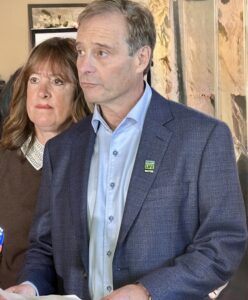
N.H. leaders call new Trump Medicaid plan ‘sabotage’
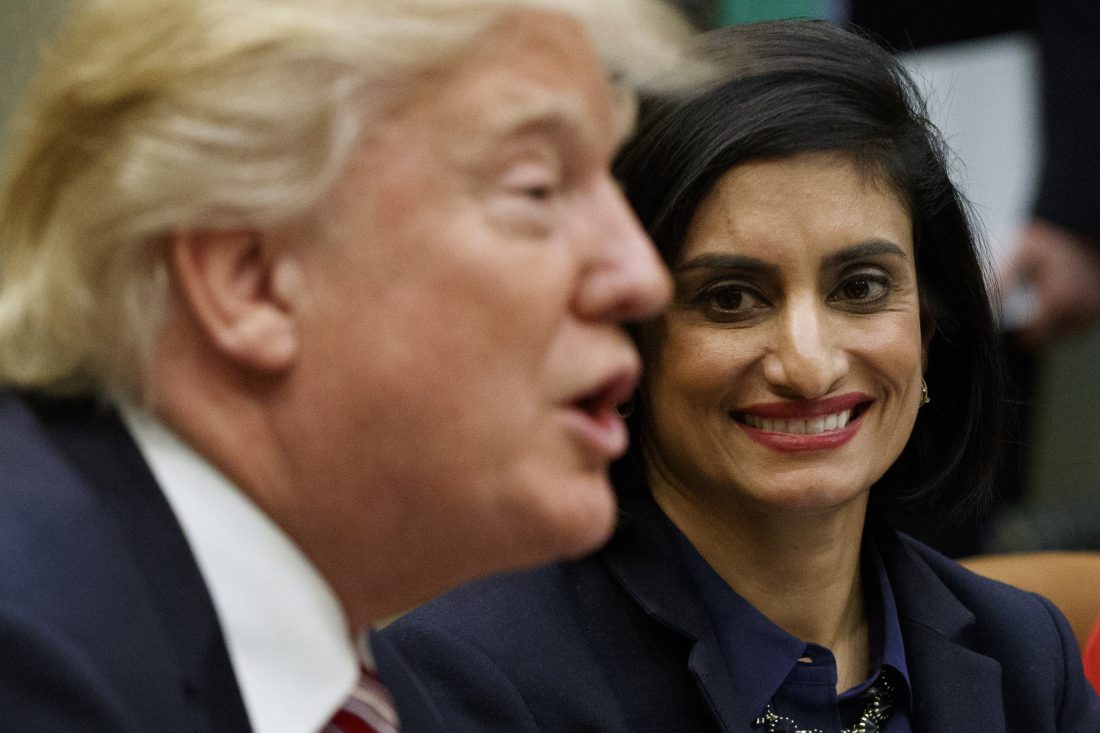
FILE - In this March 22, 2017 file photo, Administrator of the Centers for Medicare and Medicaid Services Seema Verma listen at right as President Donald Trump speaks during a meeting in the Roosevelt Room of the White House in Washington. The Trump administration has a Medicaid deal for states: more control over health care spending on certain low-income residents if they agree to a limit on how much the feds kick in. It's unclear how many states would be interested in such a trade-off under a complex Medicaid block grant proposal unveiled Thursday by Seema Verma, head of the Centers for Medicare and Medicaid Services. (AP Photo/Evan Vucci, File)
NASHUA – The Trump administration Thursday offered states more control over Medicaid spending for some of their poorest residents, but first governors must accept a limit on how much the feds kick in.
That’s a potentially tricky deal for states facing rising costs in the federal-state health program for low-income people. Although Oklahoma’s Republican governor quickly embraced the concept, it’s unclear how many others will follow.
With President Donald Trump already getting poor marks from the public for his handling of health care, the Medicaid plan is likely to provide more election-year talking points for Democrats.
It took New Hampshire Democrats virtually no time to call the president’s plan “reckless.”
“The administration’s new block grant guidance is a reckless attempt to cut Medicaid and it will be devastating to Granite Staters in the midst of an opioid epidemic,” U.S. Rep. Annie Kuster, D-N.H., said. “The Trump administration’s sabotage of health care for millions of Americans continues with this attack on some of our most vulnerable individuals.”
“Converting to a Medicaid block grant is wrong for New Hampshire. It is bad for Granite Staters’ access to health care and bad for the taxpayers who will have to pick up the tab,” New Hampshire Sen. Cindy Rosenwald, D-Nashua, added.
Seema Verma, head of the Centers for Medicaid and Medicaid Services, said the idea behind the administration’s “Healthy Adult Opportunity” is to improve the quality of care for the poor while controlling costs.
As unveiled by Verma, the complex block grant proposal would be a first step to changing a longstanding financial arrangement between Washington and the states. The federal share of Medicaid is now open-ended, meaning that a state is at least partly protected from unpleasant surprises like a new, $300,000 prescription drug or an economic downturn that swells enrollment.
Outlined in a letter from Verma to state Medicaid directors, the deal is optional for states. To get it, they’d have to apply for a federal waiver.
Its scope would be restricted to coverage for able-bodied adults under 65. A state could not put nursing home residents, disabled people, pregnant women, or children into the new plan. The federal government would not limit its Medicaid contribution for these groups, considered the most sensitive.
“Our focus … is to change the whole paradigm and to reset the framework of how we’re working with states,” said Verma. “We are providing them this up-front flexibility and the federal government is in the role of monitoring the program.”
However, U.S. Sen. Jeanne Shaheen, D-N.H., said this would hurt Medicaid’s long-term strength.
“Imposing block grants would cap funding for this program and would lead to reduced access to care for Granite Staters, particularly those who have received coverage through Medicaid expansion provided by the Affordable Care Act,” Shaheen added.
Gov. Chris Sununu did not comment on the matter Thursday.