N.H. leaders optimistic about Trump trade deal
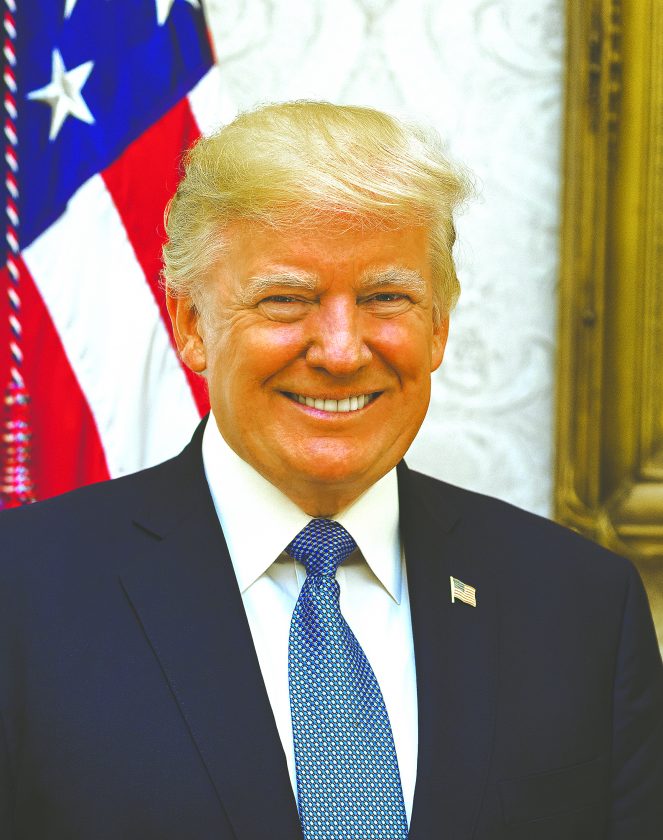
Official portrait of President Donald J. Trump, Friday, October 6, 2017. (Official White House photo by Shealah Craighead)
CONCORD – Both Republicans and Democrats in New Hampshire hope the U.S.-Mexico-Canada Agreement mitigates the impact President Donald Trump’s “trade war” is having on the Granite State.
House Democrats and the White House announced a deal on a modified North American trade pact, handing Trump a major Capitol Hill win Tuesday. Both sides hailed the deal as a win for American workers.
They said the revamped U.S.-Mexico-Canada Agreement was a significant improvement over the original North American Free Trade Agreement (NAFTA), with Democrats crowing about winning stronger provisions on enforcing the agreement while Republicans said it will help keep the economy humming along.
“There is no question of course that this trade agreement is much better than NAFTA,” House Speaker Nancy Pelosi, D-Calif., said in announcing the agreement, saying the pact is “infinitely better than what was initially proposed by the administration.”
Trump said the revamped trade pact will “be great” for the U.S.
“It will be the best and most important trade deal ever made by the USA. Good for everybody – Farmers, Manufacturers, Energy, Unions – tremendous support. Importantly, we will finally end our Country’s worst Trade Deal, NAFTA!,” the president said in a tweet.
In reacting to the developments in Washington, D.C., Gov. Chris Sununu seemed optimistic the new agreement would help New Hampshire.
“The U.S.-Mexico-Canada Agreement means greater access for New Hampshire businesses to the markets of two of our state’s top trading partners. I urge New Hampshire’s congressional delegation to get the job done and vote in favor of this deal,” Sununu said.
Promoted by then President Bill Clinton in the 1990s, NAFTA eliminated most tariffs and other trade barriers involving the U.S., Mexico and Canada. Critics, including Trump, labor unions and many Democratic lawmakers, branded the pact a job killer for the U.S. because it encouraged factories to move south of the border, capitalize on low-wage Mexican workers and ship products back to the U.S. duty free.
During the 2016 campaign, in battleground states such as Ohio, Pennsylvania, Michigan and Wisconsin, Trump repeatedly blamed Clinton for the numerous closed steel mills and factories found throughout the Rust Belt.
This likely helped Trump will all four of those states in the Electoral College over opponent Hillary Clinton, who Trump reminded everyone lived in the White House when NAFTA became law.
The original NAFTA badly divided Democrats, but the new pact is more protectionist and labor-friendly, and Pelosi is confident it won’t divide the party, though some liberal activists took to social media to carp at the agreement.
“There is no denying that the trade rules in America will now be fairer because of our hard work and perseverance. Working people have created a new standard for future trade negotiations,”said AFL-CIO President Richard Trumka. “President Trump may have opened this deal. But working people closed it.”
Business groups such as the U.S. Chamber of Commerce also chimed in to support the long-delayed agreement.
U.S. Sens. Maggie Hassan and Jeanne Shaheen, along with U.S. Rep. Annie Kuster, all D-N.H., said they will carefully consider how to vote on the new trade agreement, though they are optimistic.
“When done right, international trade can help New Hampshire businesses, consumers, and our economy thrive,” Hassan said. “I’m encouraged that Speaker Pelosi and President Trump have reached an agreement on the U.S.-Mexico-Canada Agreement, and I will closely review the final details as consideration of the proposal moves forward.”
“Trade plays a critical role in our New Hampshire economy, supporting job creation, expanding markets and creating growth for our small businesses. I am pleased to hear bipartisan progress is being made on negotiations between the United States, Mexico and Canada,” Shaheen said.
“Trade supports nearly 20,000 jobs in New Hampshire, and I have supported strengthening and modernizing our trade agreements to reflect our advanced 21st Century economy,” Kuster added. “I look forward to reviewing the full contents of the agreement and working in a bipartisan manner to advance USMCA through the House.”
The pact contains provisions designed to nudge manufacturing back to the U.S. For example, it requires that 40% to 45% of cars eventually be made in countries that pay autoworkers at least $16 an hour — that is, in the U.S. and Canada and not in Mexico.
The trade pact picked up some momentum after Mexico in April passed a labor-law overhaul required by USMCA. The reforms are meant to make it easier for Mexican workers to form independent unions and bargain for better pay and working conditions, narrowing the gap with the U.S.
Democrats succeeded in tossing overboard a 10-year protection for manufacturers of new drugs, including so-called biologics, that had won reprieve from lower-cost competition in the original accord. But Pelosi lost out in a bid to repeal so-called Section 230, a provision in a 1996 law that gives social media companies like Facebook broad immunity from lawsuits over the content they publish on their platforms.