Recalling city’s ’45 blaze
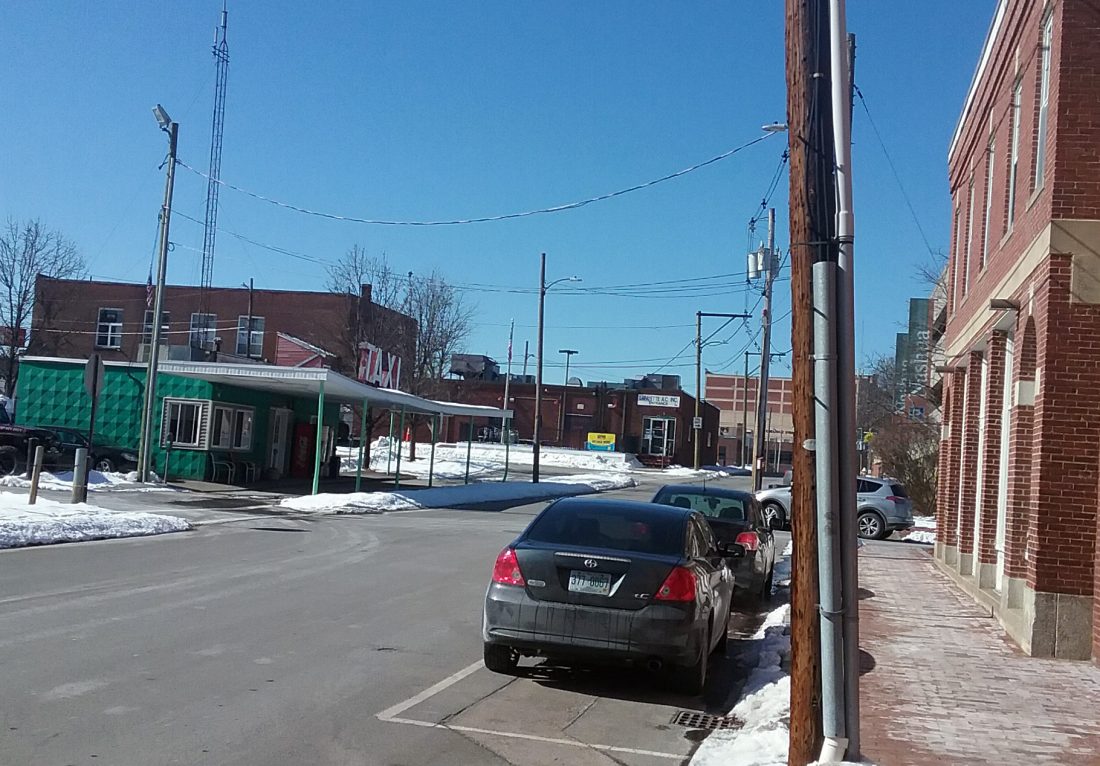
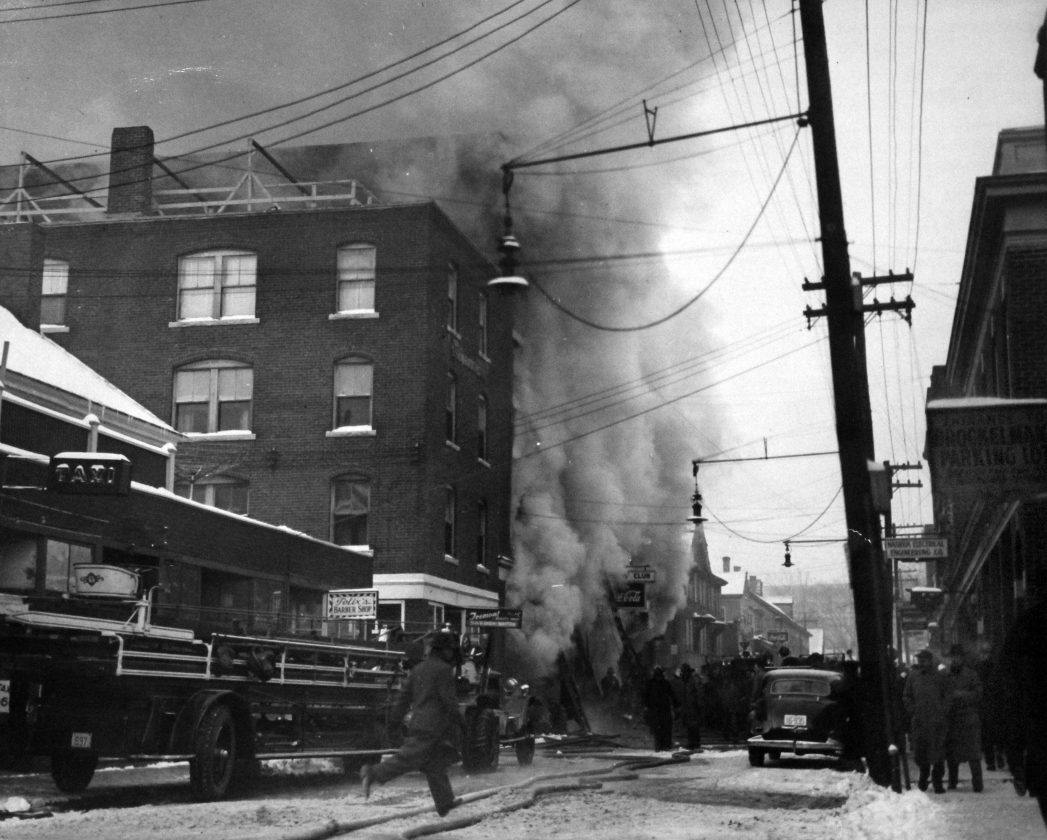
Telegraph photo by DEAN SHALHOUP This photo of High Street was taken from near where the photographer was standing while taking photos of the major Dec. 21, 1945, fire that destroyed the O'Donnell and Shea buildings, both of which stood just past the taxi stand at left.
-
- Telegraph photo by DEAN SHALHOUP This photo of High Street was taken from near where the photographer was standing while taking photos of the major Dec. 21, 1945, fire that destroyed the O’Donnell and Shea buildings, both of which stood just past the taxi stand at left.
-
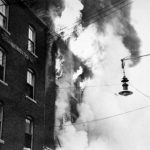
- COURTESY PHOTO A “veritable cauldron of fire,” as reported by the Telegraph, rises from the O’Donnell building on High Street, after the building’s facade collapsed onto the street during the Dec. 21, 1945, fire.
-
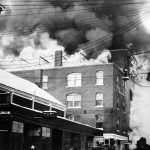
- COURTESY PHOTO Flames leap from the roofs of the O’Donnell and Shea buildings during the Dec. 21, 1945, fire on High Street that routed dozens of people and merchants from the two buildings.
-
- COURTESY PHOTO Smoke billows from the front of O’Donnell Hall on High Street during the Dec. 21, 1945, fire that routed dozens of people and merchants from two buildings. High Street has a much different look today.
So many readers touched base last week with a memory or some kind of personal story related to the tragic 1949 crash that killed two firefighters en route to a multiple alarm High Street blaze, I thought I’d continue with the “historic fire theme” in today’s essay.
Just before Christmas 1945, about three years before fire destroyed the old St. Jean Baptiste Hall on High Street and led to the Main Street rollover crash that fatally injured Capt. Alfred Laplante and firefighter George McCaughney, one of Nashua’s most destructive mid-20th-century fires broke out just up the street from the ’45 blaze.
While the ingredients for a calamitous outcome were present two side-by-side four-story buildings, retail shops on the first floor and apartments occupied mainly by elderly and disabled folks on the upper floors nobody, mercifully, lost their lives.
There were several injuries, including four firefighters, but looking at photos and reading up on the Telegraph’s and other accounts of the blaze, the outcome could, as they say, have been a lot worse.
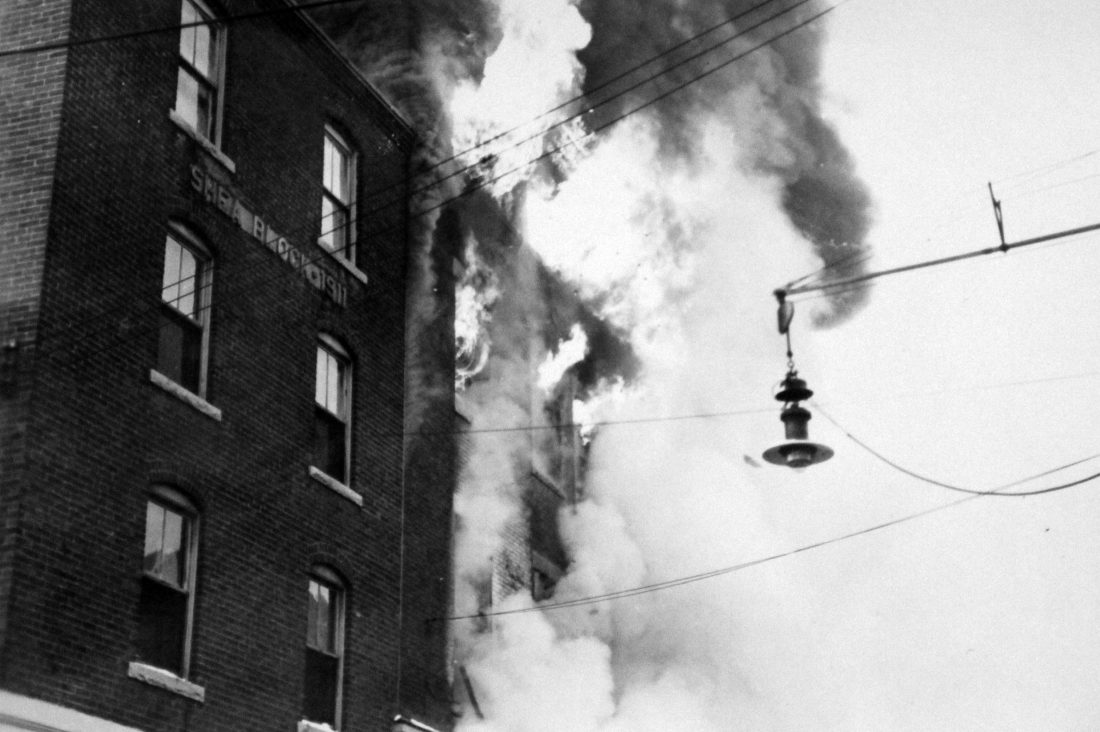
COURTESY PHOTO A "veritable cauldron of fire," as reported by the Telegraph, rises from the O'Donnell building on High Street, after the building's facade collapsed onto the street during the Dec. 21, 1945, fire.
Destroyed were the O’Donnell and Shea blocks, home to dozens of people who awoke to a frantic scene of smoke, fire, door-banging and the shouts of would-be rescuers from the moment police patrolman William Anagnost, just before 7 p.m., spotted flames coming from a bowling alley on the first floor of the O’Donnell building and turned in the alarm.
Like last week’s photo of the 1949 crash, I have numerous old black and whites of the Dec. 21, 1945 fire on loan from fellow historian Charlie Colletta, who in turn has them on loan from the family of the late Aurele Chasse, a Nashua firefighter for 33 years and, like Colletta, a lifelong French Hill resident.
Whomever took the photos appears to have been standing at, or close to, the corner of Main and High streets, facing west down High toward Walnut Street. The former Doehla Greeting Cards building, now called One Chestnut Street Business Center, is faintly visible in the background.
The landscape, not surprisingly, bears little resemblance to the High Street of today, except for the familiar “Taxi” sign affixed to a one-story building just about where the taxi stand is now. Next door was Felix’s Barbershop, at 12 1/2 High St., whose sign read “Nashuans, veterans, servicemen welcome.”
There appears to be an alley-width space between that building and the Shea block, from which smoke is billowing in the photos.But it’s the O’Donnell building, either adjoining, or very close to, the Shea block that’s producing the really heavy smoke, and frequent flames.
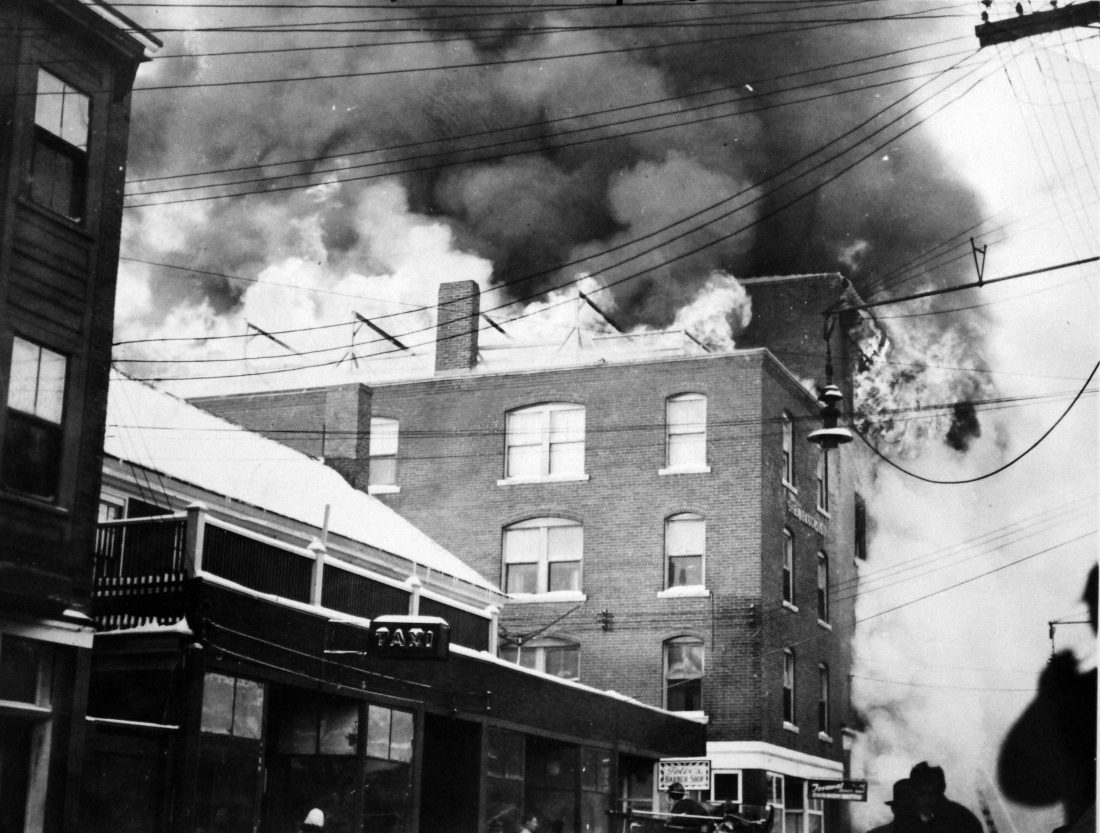
COURTESY PHOTO Flames leap from the roofs of the O'Donnell and Shea buildings during the Dec. 21, 1945, fire on High Street that routed dozens of people and merchants from the two buildings.
High Street is narrower than it is now, and is packed with firefighters, trucks and onlookers. Prominent in most photos is Nashua’s classic “tiller” ladder truck, surrounded by a spaghetti-like network of hoselines that lead to the front of the O’Donnell block.
Ice and snow cover the street and sidewalks; the region, according to the Telegraph, was in the grip of a cold snap that sent the mercury to 8 below zero that morning. As if firefighters didn’t have enough to deal with.
And not only were they faced from the moment of their arrival with a rapidly-spreading fire in an occupied building that was “already scorching buildings on the opposite side of High Street,” the Telegraph wrote, they had to immediately deploy crews to the rear of the buildings to keep it from spreading to two large structures: a two-story, wood-frame house fronting School Street that would have gone up like a matchbook, and the Tremont Theatre which became the Daniel Webster Theater in 1949, and which was “only a hop, skip and a jump” from the O’Donnell building, according to the story.
Help eventually arrived from Manchester and Lowell, just in time to spell dangerously chilled Nashua firefighters, who took turns hobbling into the nearby Frontenac Cafe to sip hot coffee and, in many cases, “take off their boots and socks for rubbing and immersion in cold water” the treatment for frostbite.
Several firefighters barely escaped serious injury, perhaps death, when the “whole center of the O’Donnell block, where the central staircase acted as a flue, crashed down in flames” around them. There were injuries, but none were deemed serious, the Telegraph reported.
COURTESY PHOTO Smoke billows from the front of O'Donnell Hall on High Street during the Dec. 21, 1945, fire that routed dozens of people and merchants from two buildings. High Street has a much different look today.
In those days, the Telegraph, for whatever reason, didn’t put reporters’ names on stories or photos, so we don’t know who painted this rather descriptive account:
“Sub-zero temperatures plagued Nashua’s heroic firefighters, as water froze on their faces and eyelashes, making ice effigies of all of them while they endeavored to stem the rushing flames … that brought whole center of the O’Donnell block crashing to the ground and sent a veritable cauldron of flames roaring toward the sky.”
Flaming embers, known as “brands,” flew in all directions, while the sound of falling bricks “accented the weird appearance of the scene … tongues of the fire came through the smoke and lighted the faces of spectators and firemen with their dancing glow,” the reporter wrote.
The Nashua Electrical Engineering Company on the other side of High Street “served as message center and first-aid station for the Red Cross.” Employees of pretty much every nearby business helped out in some way. Coffee and snacks were available at the electrical engineering office, Henry’s Diner, Prosper Cab and the Frontenac, while Salvation Army volunteers “spent their morning making coffee as fast as they could and sending it” to the scene.
A “valuable Persian cat” belonging to one family driven out by flames was missing and presumed lost. Members of the Nashua Canteen (a youth social club), on their way to school, “stood in the street and cried” as they watched their headquarters go up in flames.
The fire apparently started in the Social Bowling Alleys, a first-floor tenant in the O’Donnell block. Officials were looking at the possibility an unextinguished cigar or cigarette may have sparked the fire after smoldering “for many hours after the bowling alley closed.”
At an estimated $100,000 loss about $1.4 million in today’s dollars the historic High Street blaze was indeed costly. But the fact no firefighters, police or civilians suffered life-threatening injuries makes the monetary loss and cost of rebuilding a whole lot easier to deal with.