Hudson first responders remember 9/11
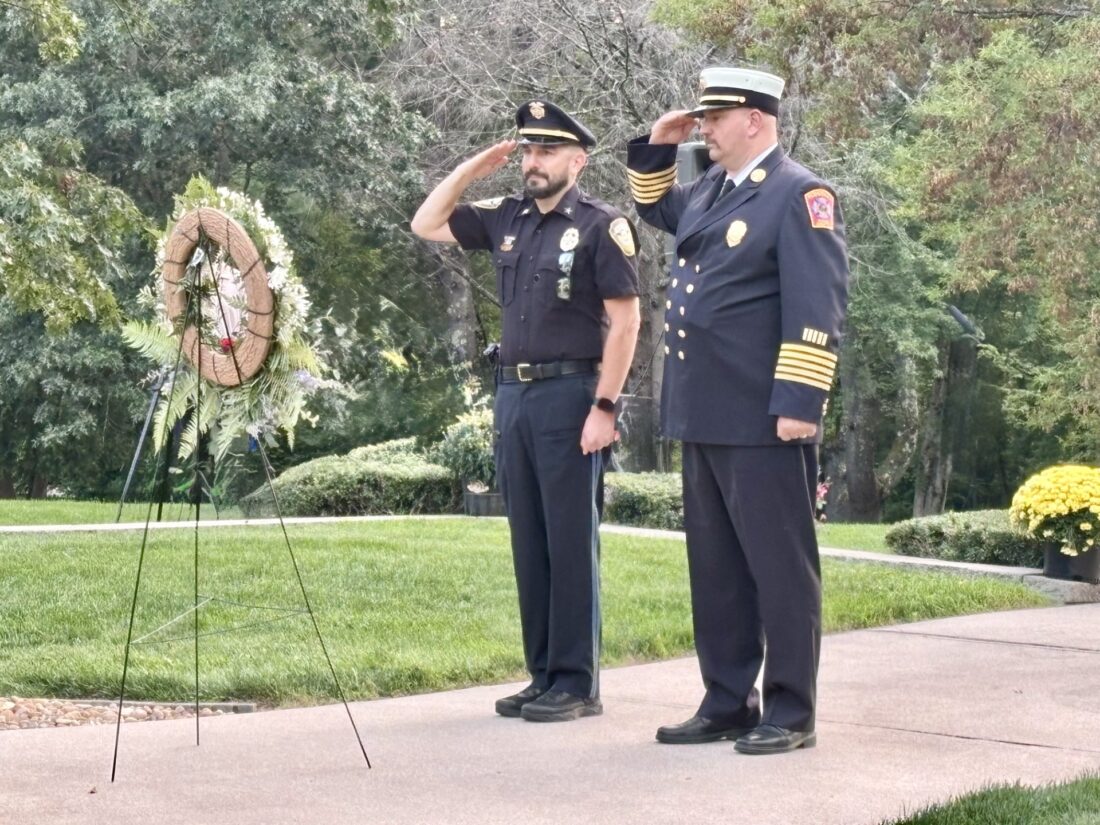
Police Chief David Cayot (left) and Fire Chief Scott Tice salute the wreath placed at the 9/11 Memorial at Benson Park. Telegraph photo by CHRISTOPHER ROBERSON
HUDSON – The town’s police officers and firefighters joined other first responders at Benson Park on Sept. 11 to mark the 24th anniversary of the worst terrorist attack in U.S. history.
David Kovalcin, 42, of Hudson, was a classic family man. Rather working longer hours, he chose to spend time with his wife, Elizabeth, and their two young daughters, Rebecca and Marina. Professionally, Kovalcin was a senior mechanical engineer at Raytheon and was scheduled for a four-day business trip to Los Angeles.
That morning, he left a note for his family that read: “Rebecca, Marina and Mommy, I will miss everybody very much. See you Friday night. I fed the dogs but not the fish.”
Kovalcin then left for Logan International Airport to board American Airlines Flight 11. At 8:14 a.m., the Boeing 767, carrying 13,900 gallons of fuel, was overrun by al-Qaeda terrorist Mohamed Atta and his team of four hijackers. Thirty-two minutes later, the aircraft, traveling at 440 miles per hour, plowed into the North Tower of New York City’s World Trade Center killing everyone on board.
In addition to Kovalcin, New Hampshire lost nine other residents that morning. They included Thelma Cuccinello of Wilmot, Carol Flyzik of Plaistow, Douglas Stone of Dover, Carl Hammond of Derry, Robert LeBlanc of Lee, Louis Mariani of Derry, Michael and Kathleen Shearer of Dover as well as Thomas McGuinness of Portsmouth, who was assigned as the first officer on Flight 11.
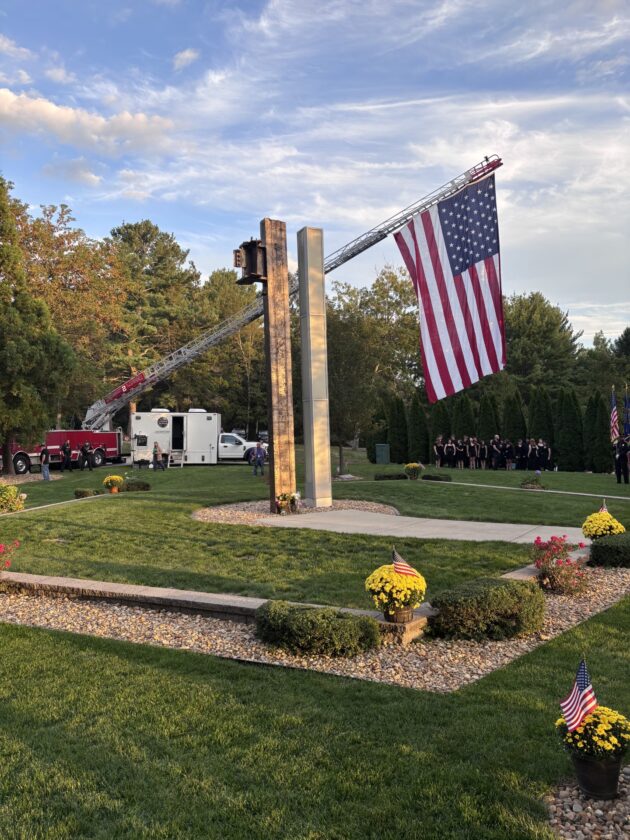
The 23-foot, nine-ton I-beam from the North Tower of the World Trade Center stands in the middle of the 9/11 Memorial at Benson Park. Also shown, is a glass column representing the South Tower. Telegraph photo by CHRISTOPHER ROBERSON
To honor Kovalcin’s memory, in early-2010, David Morin, then a captain with the Hudson Fire Department, contacted the Port Authority of New York and New Jersey to request an I-beam from the North Tower. The beam would be featured in the center of the town’s 9/11 Memorial.
Standing 23 feet tall, the nine-ton beam had been part of the 23rd floor elevator shaft. In May 2011, Hudson officials traveled to Queens, N.Y. to pick up the beam.
Representing the North Tower, the beam stands in Benson Park next to a glass column of equal size that represents the South Tower.
Perhaps the most telling are the countless radio transmissions and interviews released by the New York City Fire Department.
Less than one minute after Flight 11 crashed into the North Tower, Engine 10 firefighters gave the first real indication as to the seriousness of the situation: “Send every available ambulance, everything you’ve got, to the World Trade Center now.”
Battalion Chief Orio Palmer responded to the South Tower, which was hit at 9:03 a.m. by United Airlines Flight 175. He singlehandedly repaired an elevator and made it up to the 41st floor with Fire Marshal Ronald Bucca. From there, Palmer and Bucca, both seasoned marathon runners, reached the impact zone on the 78th floor.
Palmer reported his assessment at 9:52 a.m. At the time, the fire still seemed manageable.
“Battalion 7 — Ladder 15, we’ve got two isolated pockets of fire,” he said over the radio. “We should be able to knock it down with two lines.”
What Palmer and Bucca did not know was that the fires were being fed by jet fuel which was steadily melting the building’s support columns. Seven minutes later, the exterior columns on the 80th floor gave way. Palmer and Bucca were both killed in the subsequent collapse.
Although CNN reporter Aaron Brown witnessed the collapse of the South Tower live on the air, he remained unsure about what had just transpired.
“There has just been a huge explosion,” he said. “We can see billowing smoke rising and I’ll tell you that I can’t see that second tower.”
Firefighter Joseph Casaliggi of Engine 7 recalled watching office workers jump from the upper floors and slam into the ground at 150 mph.
“I just remember looking up and thinking, ‘how bad is it up there that the better option is to jump?'” he said.
Capt. Jay Jonas of Ladder 6 remembered the horror that he and his men faced as they approached the World Trade Center.
“We turned the corner onto Canal Street and what you saw — was a nightmare,” he said.
Jonas and his men were on the 27th floor of the North Tower when the South Tower fell at 9:59 a.m.
Now in a race against time, Jonas ordered his men out of the building. At the 20th floor, they found Josephine Harris, a Port Authority secretary, who had already descended 53 flights.
Suffering from an old injury, Harris struggled to make it down the stairs even with the firefighters’ assistance.
Harris and the men of Ladder 6 were in Stairwell B on the fourth floor when the North Tower came down at 10:28 a.m. Unlike the South Tower, the exterior columns of the North Tower fell outward creating a protective cocoon at the bottom of the building. By the time the collapse reached the fourth floor, the deadly kinetic energy had diminished to the point where it was survivable. Harris, Jonas and his firefighters were among the 14 individuals who ultimately walked out.
-
- Police Chief David Cayot (left) and Fire Chief Scott Tice salute the wreath placed at the 9/11 Memorial at Benson Park. Telegraph photo by CHRISTOPHER ROBERSON
-
- The 23-foot, nine-ton I-beam from the North Tower of the World Trade Center stands in the middle of the 9/11 Memorial at Benson Park. Also shown, is a glass column representing the South Tower. Telegraph photo by CHRISTOPHER ROBERSON
Greater Nashua
Bedford Academy achieves global recognition for FIRST programming
BEDFORD – Bedford Academy was recently selected as a member of the 2026 Inspire the Future: FIRST Recognition ...

School officials approve $144m budget for FY27