Ward alderman candidates weigh in on Commuter Rail
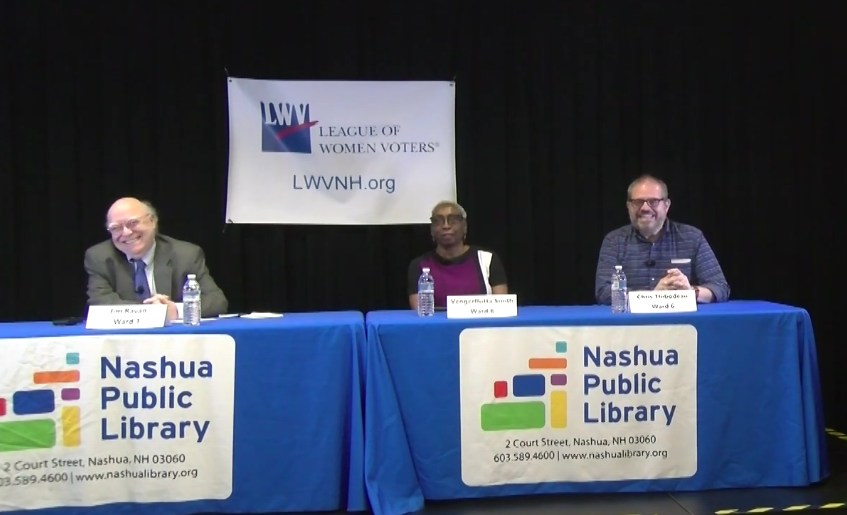
Shown from left are Ward 1 Alderman candidate James Ravan as well as Ward 6 Alderman candidates Vengerflutta Smith and Christopher Thibodeau during the second Candidates Forum on Oct. 19. Courtesy photo/Nashua Community Television
NASHUA – Six ward alderman candidates and two incumbent aldermen recently discussed the pros and cons of extending the MBTA Commuter Rail to Nashua and Manchester during the second Candidates Forum at the Nashua Public Library on Oct. 19.
Ward 1 challenger James Ravan said having the Commuter Rail would entice more Massachusetts residents to visit the Gate City.
“From the Massachusetts point of view, we are a destination to go to spend money,” he said.
Ward 6 challenger Vengerflutta Smith said she never looks forward to the 50-mile drive from Nashua to Boston.
“Every now and then I have to drive into Boston, it is not a pleasant drive, especially once I leave New Hampshire,” she said. “Anything that would bring additional commerce to the city is something we should consider, we could definitely use those Massachusetts dollars.”
Ward 6 challenger Christopher Thibodeau said that right now, he cannot support bringing the Commuter Rail into New Hampshire.
“I am not for it at the moment, ” he said. “It does not look like a benefit to the city, it looks like a huge expense.”
Ward 7 challenger Timothy Sennott said he commuted from Nashua to Peabody, Mass. for 10 years and remembers the countless hours he would spend in bumper to bumper traffic.
“I do suspect that the demand might be there,” he said of the Commuter Rail.
Ward 8 Alderman Derek Thibeault said he would support the proposal provided that it is a viable option for the city.
“We want to make sure it works,” he said.
Thibeault also called attention to the project’s turbulent history.
“The Executive Council cut the funding to finish the project, we could’ve finished it,” he said.
Ward 9 Alderman John Sullivan said he will remain neutral for the time being.
“I am truly ambivalent about it, I have a lot of questions,” he said. “The cost concerns me, ridership concerns me.”
According to the state Department of Transportation, the construction cost is estimated at $782 million. However, at least 55 percent of the cost would be covered by federal grants. Depending on ridership, fares could cover up to 82 percent of the $17 million in annual operating expenses.