
Winter storm rips through Gaza, exposing failure to deliver enough aid to territory
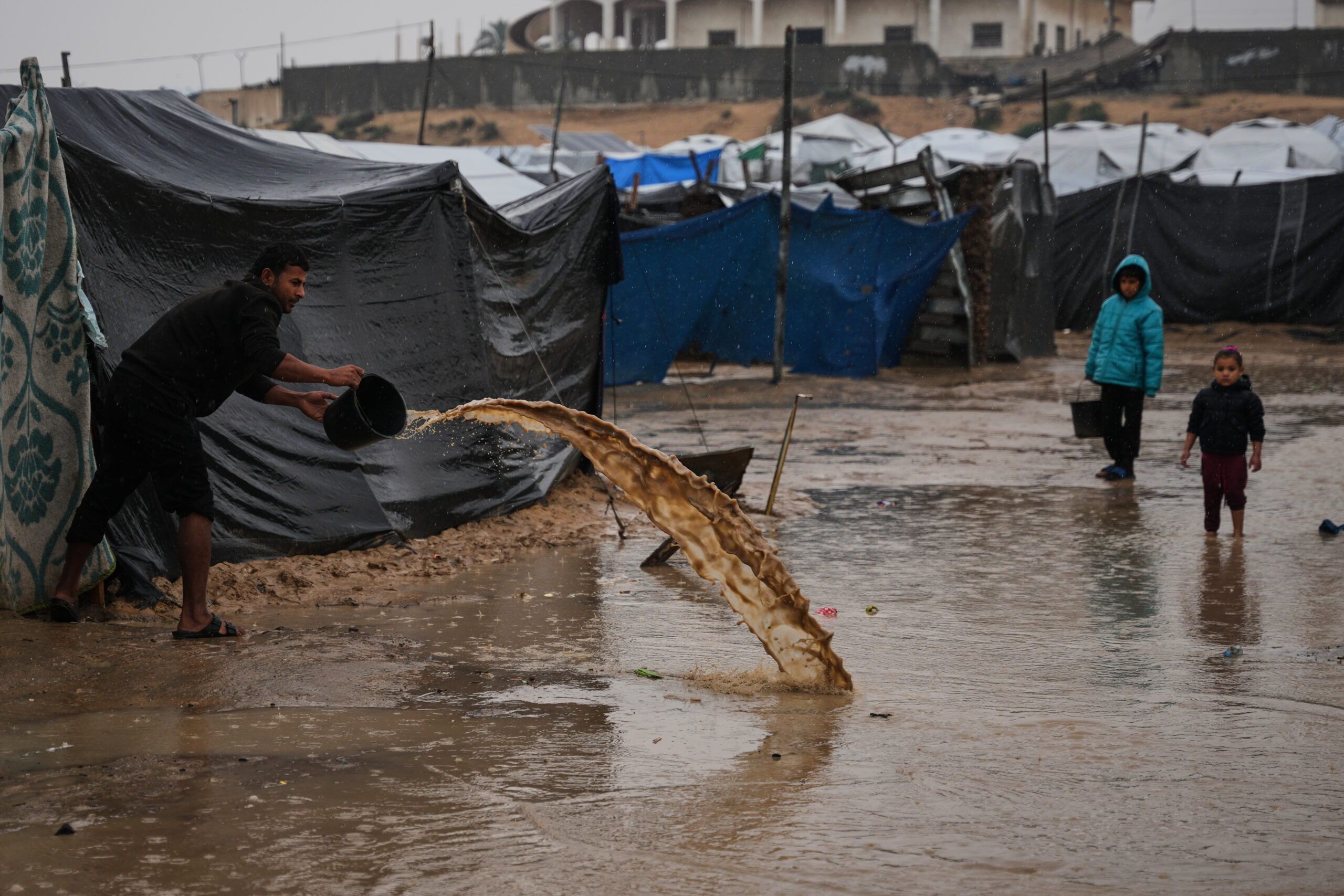
A man clears water from his tent at a camp for displaced Palestinians following heavy rain in Deir al-Balah, Gaza Strip, Thursday, Dec. 11, 2025. (AP Photo/Abdel Kareem Hana)
By WAFAA SHURAFA, BASSEM MROUE, and JULIA FRANKEL Associated Press
DEIR AL-BALAH, Gaza Strip (AP) — Rains drenched Gaza’s tent camps and dropping temperatures chilled Palestinians huddling inside them Thursday as winter storm Byron descended on the war-battered territory, showing how two months of a ceasefire have failed to sufficiently address the spiraling humanitarian crisis there.
Families found their possessions and food supplies soaked inside their tents. Children’s sandaled feet disappeared under opaque brown water that flooded the camps, running knee deep in some places. Trucks moved slowly to avoid sending waves of mud toward the tents. Piles of garbage and sewage turned to waterfalls.
“We have been drowned. I don’t have clothes to wear and we have no mattresses left,” said Um Salman Abu Qenas, a displaced mother in a Khan Younis tent camp. She said that her family couldn’t sleep the night before, because of the water in the tent.
Aid groups say not enough shelter aid is getting into Gaza during the truce. Figures recently released by Israel’s military suggest it hasn’t met the ceasefire stipulation of allowing 600 trucks of aid into Gaza a day, though Israel disputes that finding.
“Cold, overcrowded, and unsanitary environments heighten the risk of illness and infection,” the U.N. agency for Palestinian refugees, UNRWA, said in a terse statement posted on X. “This suffering could be prevented by unhindered humanitarian aid, including medical support and proper shelter.”
Rains wreak havoc in Gaza
Sabreen Qudeeh, also in the Khan Younis camp, in a squalid area known as Muwasi, said that her family woke up to rain leaking from their tent’s ceiling and water from the street soaking their mattresses.
“My little daughters were screaming,” she said.
Ahmad Abu Taha, also living in the camp, said there wasn’t a tent that escaped the flooding. “Conditions are very bad, we have old people, displaced, and sick people inside this camp,” he said.
Floods in south-central Israel trapped more than a dozen people in their cars, according to Hebrew media. Israel’s rescue services, MDA, said that two young girls were slightly injured when a tree fell on their school.
The contrasting scenes with Gaza made clear how profoundly the Israel-Hamas war had damaged the territory, destroying the majority of homes. Gaza’s population of around 2 million is almost entirely displaced, and most people live in vast tent camps stretching along the coast, or set up among the shells of damaged buildings without adequate flooding infrastructure and with cesspits dug near tents as toilets.
At least three buildings in Gaza City already damaged by Israeli bombardment during the war partially collapsed under the rain, Palestinian Civil Defense said. It warned people not to stay inside damaged buildings, saying they could too could fall down on top of them.
The agency also said that since the storm began, they have received more than 2,500 distress calls from citizens whose tents and shelters were damaged in all parts of the Gaza Strip.
“We cannot control anything,” said Abu Mohammad Abu Taha, who said he’d spent the night calling for help from civil defense and the municipal government. “No one is answering. We want any side to come and rescue us, so that we don’t have destruction more than what we already have.”
Not enough aid
Aid groups say that Israel isn’t allowing enough aid into Gaza to begin rebuilding the territory after years of war.
Under the agreement, Israel agreed to comply with aid stipulations from an earlier January truce, which specified that it allow 600 trucks of aid each day into Gaza, It maintains it’s doing so, but The Associated Press has found that some of its own figures call that into question.
The January truce also specified that Israel let in an agreed-upon number of caravans and tents. No caravans have yet entered Gaza during the ceasefire, said Tania Hary, executive director of Gisha, an Israeli group advocating for Palestinians’ right to freedom of movement.
The Israeli defense body in charge of coordinating aid to Gaza, called COGAT, said on Dec. 9, without providing evidence, that it had “lately” let 260,000 tents and tarpaulins into Gaza and more than 1,500 trucks of blankets and warm clothing. Shelter Cluster, an international coalition of aid providers led by the Norwegian Refugee Council, sets the number lower.
It says the U.N. and international nongovernmental organizations have gotten 15,590 tents into Gaza since the truce began, and other countries have sent about 48,000. Many of the tents aren’t properly insulated, Shelter Cluster says.
Amjad al-Shawa, Gaza chief of the Palestinian NGO Network, told Al Jazeera on Thursday that only a fraction of the 300,000 tents needed had entered Gaza. He said that Palestinians were in dire need of warmer winter clothes and accused Israel of blocking the entry of water pumps to help clear flooded shelters.
“All international sides should take the responsibility regarding conditions in Gaza,” he said. “There is real danger for people in Gaza at all levels.”
Hamas said in a statement that people’s tents have become worn out after the more than two-year war. Khaled Mashaal, a Hamas leader, said in an interview with Al Jazeera that Gaza needs the rehabilitation of hospitals, the entry of heavy machinery to remove rubble, and the opening of the Rafah crossing — which remains closed after Israel said last week it would shortly open.
COGAT didn’t immediately respond to a request for comment on the claims that Israel wasn’t allowing water pumps or heavy machinery into Gaza.
Ceasefire at a critical point
Mashaal called for moving to the second, more complicated phase of the U.S.-brokered ceasefire.
“The reconstruction should start in the second phase as today there is suffering in terms of shelter and stability,” Mashaal said in comments released by Hamas on social media.
Regional leaders have said time is critical for the ceasefire agreement. But obstacles to moving forward remain.
Israeli Prime Minister Benjamin Netanyahu’s office said Wednesday that the militants needed to return the body of a final hostage first.
Hamas has said Israel must open key border crossings and cease deadly strikes on the territory.
___
Bassem Mroue reported from Beirut, and Julia Frankel from Jerusalem. Natalie Melzer contributed to this report from Nahariya, Israel.