
As Trump hosts Congo and Rwanda's leaders for peace deal, here's what to know about the conflict
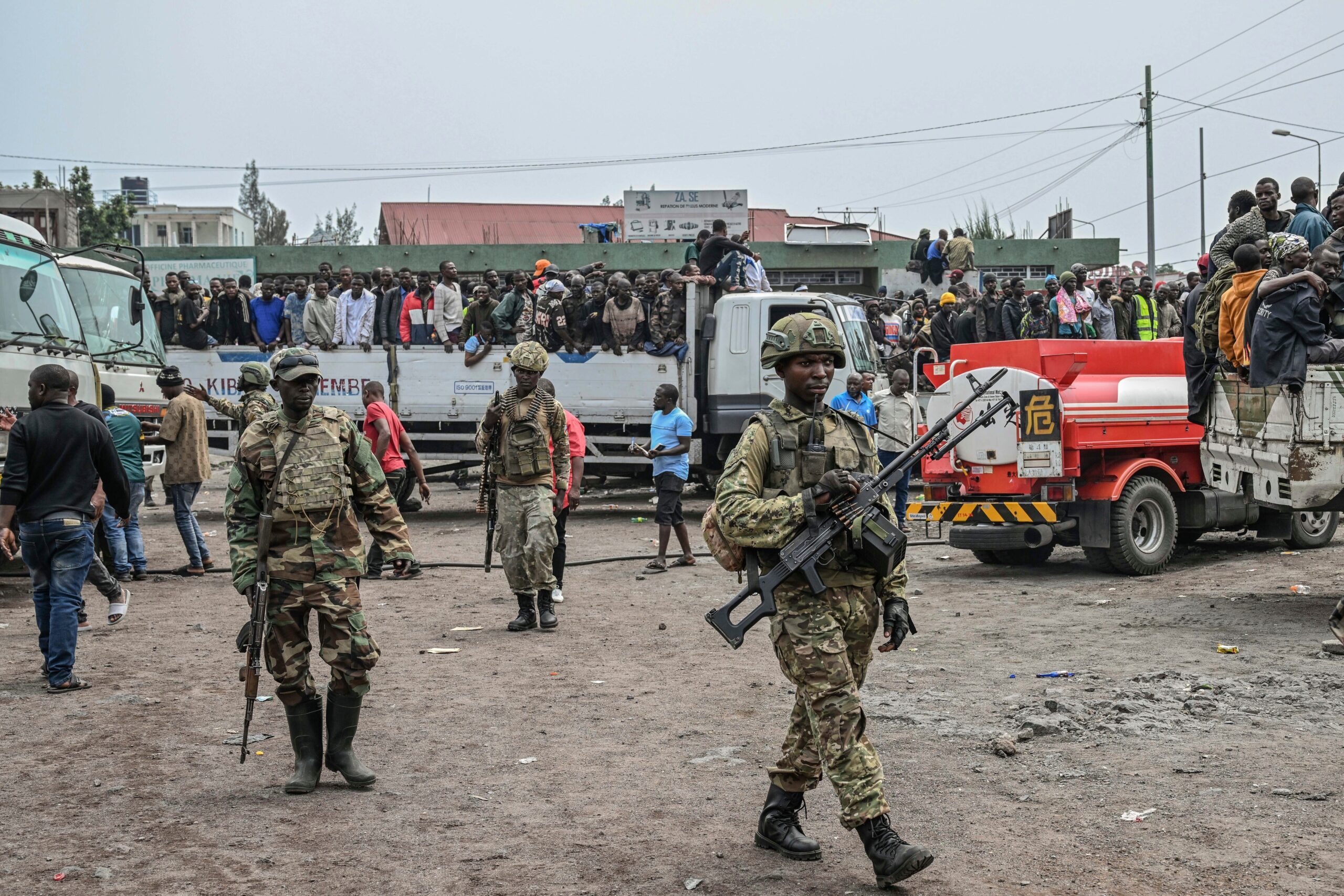
FILE - M23 rebels escort government soldiers and police who surrendered to an undisclosed location in Goma, Democratic republic of the Congo, Jan. 30, 2025. (AP Photo/Moses Sawasawa, File)
By MARK BANCHEREAU Associated Press
DAKAR, Senegal (AP) — U.S. President Donald Trump is hosting the leaders of the Democratic Republic of Congo and Rwanda on Thursday for a deal-signing aimed at ending the conflict in Congo.
The Central African nation has been battered by decades-long fighting with more than 100 armed groups, the most potent being the Rwanda-backed M23 rebels. In a major escalation earlier this year, M23 seized Goma and Bukavu, two key cities in eastern Congo.
Peace efforts mediated by Qatar and the United States this year have failed to put an end the conflict.
In recent weeks, residents reported pockets of clashes and rebel advances in various localities. Both the M23 and Congolese forces have often accused each other of violating the terms of a ceasefire agreed to earlier this year.
Here is what to know about the conflict:
The origins of the conflict
Congo and neighboring Rwanda have long accused each other of supporting various rival armed groups in eastern Congo, a mineral-rich region and major hub for humanitarian aid.
The conflict in Congo can be traced to the aftermath of the 1994 genocide in Rwanda, where Hutu militias killed between 500,000 and 1 million ethnic Tutsi, as well as moderate Hutus and Twa, Indigenous people.
When Tutsi-led forces fought back, nearly 2 million Hutus crossed into Congo, fearing reprisals. Tensions between Hutus and Tutsis have repeatedly flared in Congo since then.
Rwandan authorities have accused the Hutus who fled of participating in the genocide and alleged that elements of the Congolese army protected them. They have argued that the militias formed by a small fraction of the Hutus are a threat to Rwanda’s Tutsi population.
The M23 group is made up primarily of ethnic Tutsis who failed to integrate into the Congolese army and led a failed insurgency against the Congolese government in 2012. It was then dormant for a decade, until its resurgence in 2022.
M23 claims to defend Tutsi and Congolese of Rwandan origin from discrimination. Critics say it’s a pretext for Rwanda to obtain economic and political influence over eastern Congo.
Congo, the United States and U.N. experts accuse Rwanda of backing the M23, which had hundreds of members in 2021. Now, according to the U.N., the group has around 6,500 fighters.
While Rwanda denies that claim, it acknowledged last year that it has troops and missile systems in eastern Congo, allegedly to safeguard its security. U.N. experts estimate there are up to 4,000 Rwandan forces in Congo.
A mineral-rich region
Access to Congo’s critical minerals used in electronics has played a central role in the fighting. The country is the world’s largest producer of cobalt, a metal essential for lithium-ion batteries that power electric vehicles, smartphones and other devices.
Congo is also a leading supplier of coltan, the mineral used to make tantalum, which is an essential for component in fighter jets, laptops and other electronics. The country produced about 40% of the world’s coltan in 2023, according to the U.S. Geological Survey. Australia, Canada and Brazil are among the other major producers.
Although Rwanda says its involvement in Congo is to protect its territory and punish those connected to the 1994 genocide, its interests are also tied to the valuable minerals.
A team of U.N. experts said in a report in July that Rwanda was benefiting from minerals “fraudulently” exported from areas under the control of the M23 group. Rwanda denied this.
China and the United States also have financial interests in Congolese mines.
Critical minerals are of interest to Trump as Washington looks for ways to circumvent China to acquire rare earth elements. China accounts for nearly 70% of the world’s rare earth mining and controls roughly 90% of global rare earths processing.
Little of the region’s wealth has trickled down to Congolese citizens, with 60% out of its 100 million residents living below the poverty line. Instead, fighting over natural resources has destabilized the country.