WHAT HAPPENED? Silver Knights ponder on-field failure once again
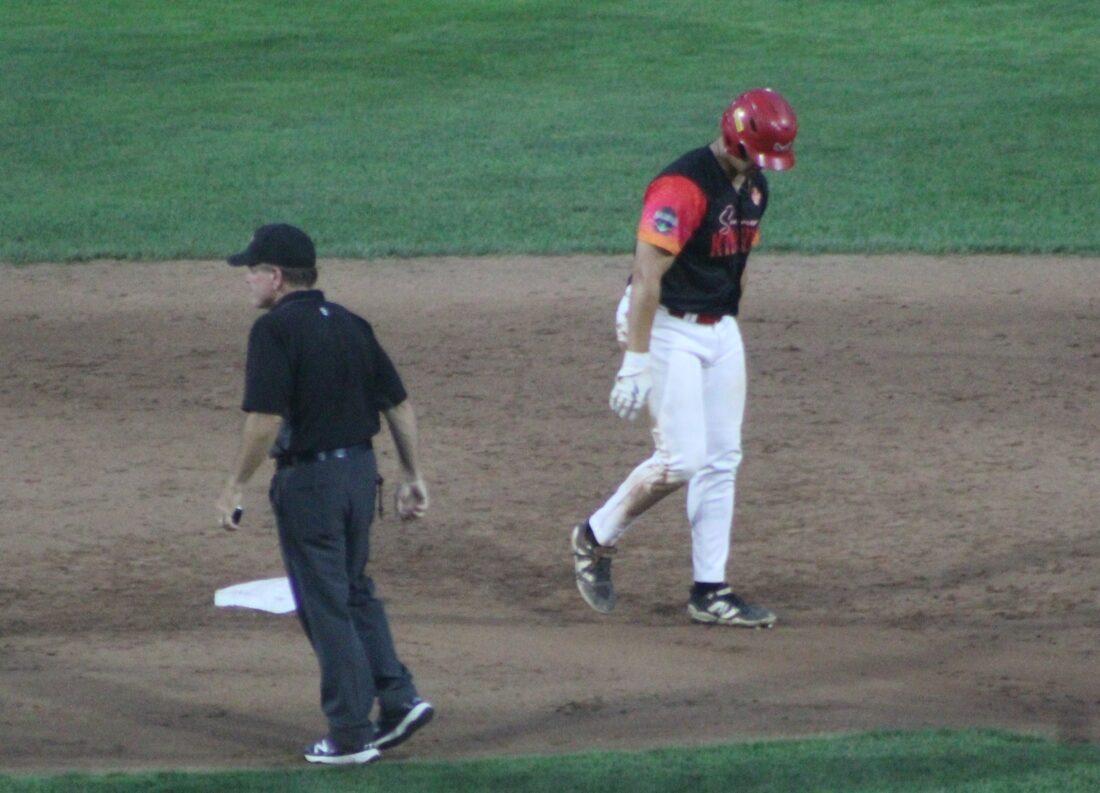
Nashua's Hudson Story begins the long walk to the dugout after being thrown out trying to steal second during the recent Silver Knights' home finale vs. Norwich at Historic Holman Stadium. (Telegraph file photo by TOM KING)
Editor’s Note: This is the first of a three-part series examining the Nashua Silver Knights 2026 season,on and off the field. The full series can also be found in print in the current Sunday Telegraph.
NASHUA – Staying power. The 2026 Nashua Silver Knights simply didn’t have it.
They left Lowell’s LeLacheur Park on Saturday, July 11 having hit six homers, scoring 17 runs and having offense now-former manager Nick Guarino and general manager Cam Cook envisioned when they put the Nashua Silver Knights roster together in the off season, getting some players from out of the region.
Guarino, looking back, had envisioned that day as the team’s “coming out party.”
The problem was, too many players left the party within a couple of weeks-plus. And by the final couple of home games, there were only 14 Nashua Silver Knights remaining from the group that reported to Historic Holman Stadium on Memorial Day for orientation and an initial workout. Guarino and general manager Cam Cook had sought commitment from players during the roster building process of the off-season, vowing to get make the most out of roster depth, keeping players engaged, etc. They felt some of the players who were coming for the short term – there were some, like a couple of Naval Academy players, who had early July comittments – would be replaced by some late arrivals from high school graduations, and injuries.
In theory, a good plan. But in execution, the departures reached an epidemic stage, especially with the pitching, by the All-Star Break or just before it. An excellent starting rotation was deplete. The bullpen was weak enough and the replacements didn’t help. Seven straight losses put the Knights into being in chase mode. FCBL Commissioner Joe Paolucci always says teams usually have three rosters: the one they start the season with, the one in early to mid-July, and the one they take either into the playoffs or the off-season. Nashua really had two, the second one couldn’t compete.
“There’s a lot of factors in play, I’m not trying to make excuses,” team owner John Creedon, Jr. said. “I said it before, beginning of the season, losing sucks.”
The collapse echoed 2025. Last year, the everyday lineup was weak.
“Last year was different,” said Guarino,who resigned late this past week. “Our offense wasn’t very good, and it showed once the pitchers left. This year if we had two or three more guys to keep us afloat so we could win two games a week, and we really didn’t have that. This year you saw we’d go out with our bullpen and put our best guys in. We’d lose the game, and then we’re screwed the rest of the week.”
So true. And with the next level of relief pitching, while the lineup was strong, the relief pitching was at several times brutal.
“Different pain points, but in terms of the calendar, damn near the exact same thing,” Cook said of the roster depletion. “I think as we come to a close and have time to analyze, this team was so much better than last year.There were three guys who were MVP candidates – Peter Keblinsky, Mason Compagna, and Connor Smith … It was a championship lineup.”
“We had a great roster this summer, we had some real impact players,” Creedon said. “MVP candidate caliber players. Great guys. So to not to be able to deliver more success on the field is disappointing.”
But the offense had camouflaged the team’s biggest weakness: it’s relief pitching.
And the Silver Knights season slowly began to disintegrate for the fourth straight year.The first two years of missing the playoffs – 2023 and ’24 — bad starts put the Knights in too deep of a hole to dig out of. The last two seasons, the team was at .500 or just a bit better when things would fall apart due to a couple of tough losses and then players that were either shut down by their college coaches (mainly pitchers) or shut themselves down due to baseball burnout or desire to salvage part of the summer before reporting back to school for fall baseball. Most FCBL teams go through it, but Nashua was hit hard.
Again.
“I don’t think it’s a matter of avoiding it, it’s a matter of navigating it,” Cook said. “We’d done a really good job in the past, but it wasn’t in mass. You have to know who the next guy is at every single position and probably five for pitchers.”
Guarino had hoped to see as many as 30 players from Opening Day still on the late July roster.
“It’s wishful thinking,” Cook said. “A lot of it is not something you can control, it’s the outside forces. You sign a guy October, November,December,January, you don’t know how many innings they’re going to throw at school. Guys we had had awesome years.”
For example, one was Nashua’s Opening Day starter Cam Piwinicki. He was a freshman at Brown who surpassed expectations and by mid to late June he was shut down by the school. “He’s pitching in the Ivy League championship which is awesome for him, but he’s coming to you with 30 innings already and he’s a young kid.
“Everybody else in this league, when they lost a guy, they had a back-fill. That’s a matter of communicating with the coaches, saying ‘Hey, we know you’re going to shut down so-and-so. If that’s the plan, is there a kid you’re going to ramp up, is thee someone you can replace him with? Try to go one in, one out, or you have a list of guys you’re keeping in touch with throughout the season when inevitably a spot opens up, where you’re one phone call away from filling it.”
Cook said maybe there could be better dialogue with the players to prevent being “blindsided” by a shutdown. But some things are simply out of the Knights control. In their playoff years, they used to get players who were done with their NECBL seasons, many Knights alums making their return.But this year, during the season, Nashua lost as many as five players to the rival league with no legit way to stop it. The contract players sign only pertains to FCBL rights. There is a coalition of non-profit leagues like the NECBL and the Cape Cod League that provides them some protection but the FCBL, being a for-profit circuit, is excluded. Nashua has lost players to the Cape Cod League, but no one would stand in the way of a player going to perhaps the country’s premier summer collegiate baseball league. And that’s usually happened with the player and the Knights knowing that was the plan.
One gnawing defection was starter Nigel Cross, for whom the team arranged its starting rotation so he could pitch only on Saturdays due to work and school commitments. Plus spread out his innings to three per start late in order to deal with his Wentworth-imposed innings limits. But he bolted for former FCBL franchise North Shore which didn’t make the NECBL postseason anyway. Ouch.
“I don’t know what you can attribute it to,” Cook said. “I think for players in this (New England) area, it’s the stigma of ‘Oh I’ve got to play in the NECBL’
“Summer collegiate baseball has changed a lot in the last five years.”
Team owner John Creedon even showed an internet posting by a Cape League team -Harwich — seeking pitching help.
“The Cape Cod League,” Creedon said. “When you reach that level of desperation to recruit players, what are we doing? That’s just one of the examples of the challenging landscape of college baseball. It (losing players to other leagues) is not unique to the Futures League. I would argue the Futures League manages it better than anyone else.”
It’s just an extension, Creedon said, of the free movement from school to school (transfer portal) in collee sports.
“No team is immune to it,” he said. “Not the Cape Cod League, not the Futures League ,not the NECBL. It’s free movement of these players and that’s just the reality right now.
“Mighty universities across sports are trying to solve this riddle.”
BULLPEN COLLAPSE
Of Nashua’s 35 losses, 11 came when the Knights were leading after six innings. Had they won near or just beyond half of those, they might have made it. Nashua blew 10-4 leads on back-to-back Sunday road games. And despite all their struggles, on the night of July 30 Nashua had a 6-1 lead on Norwich in the sixth at Holman, and a win would have gotten the Knights to within a half game of a playoff spot. They lost 7-6 as the pen simply could not hold the lead.
What happened? The plan for the season began with Fairfield closer Ryan Maiorano and his nine saves in the spring doing the same thing for Nashua. But he quickly pitched his way out of that closer role here and was gone by mid-season. Enter Aaron Forgues, who will be a senior this year at William & Mary out of Leominster, Mass. He had a sub 1.00 ERA and four saves, but was one of the NECBL defectors. And as Guarino said for the final week-plus, “We don’t have a closer.”
What could have been done differently?
“I’d probably start with a better dialogue with the players so you don’t get caught with your pants around your ankles,” Cook said, talking about team management as whole. “Probably a better dialogue with the (college) coaches so it’s coming straight from the horses mouth.”
Also, some games were lost due to mental mistakes during the season’s first half, and that prevented Nashua from having a won-loss cushion to absorb the roster blows.
In the end, it’s a crapshoot with a lot of the talent, but the frustration came because Cook and Guarino really did put together a much better team on paper than last year’s. Gannon (Pa.) University’s Connor Smith who hit .291 and led the team in homers (six) and RBIs (34) was the real deal.So were infielders Peter Keblinsky (team MVP, also hit .291) and Caleb Vacchiano both out of Division III Southern Maine.
The lineup, which was together for two-thirds of the season anda bit beyond, deserved better.
The lack of success this season is no mystery. The Curse of Summer Ball hurt Nashua immensely.
“The roster construction totally different for two years, and yielded the same result, hones in on where the focus needs to be,” Cook said, “which is managing the attrition rate throughout the season.
“The teams that are successful manage it really well; the teams that are not successful, don’t.”
And we know which category the Silver Knights unfortunately were in.
“It was definitely frustrating,” Guarino said before the season ended “It makes it not fun.”
“It is a whole new approach to recruiting, retaining and managing a roster,” Creedon said. “Turnover is now just part of it…
“We’ll get back to work. And set 2027 up for success.”