BRIGHT FUTURES: FCBL, with Lowell addition, now looks ahead
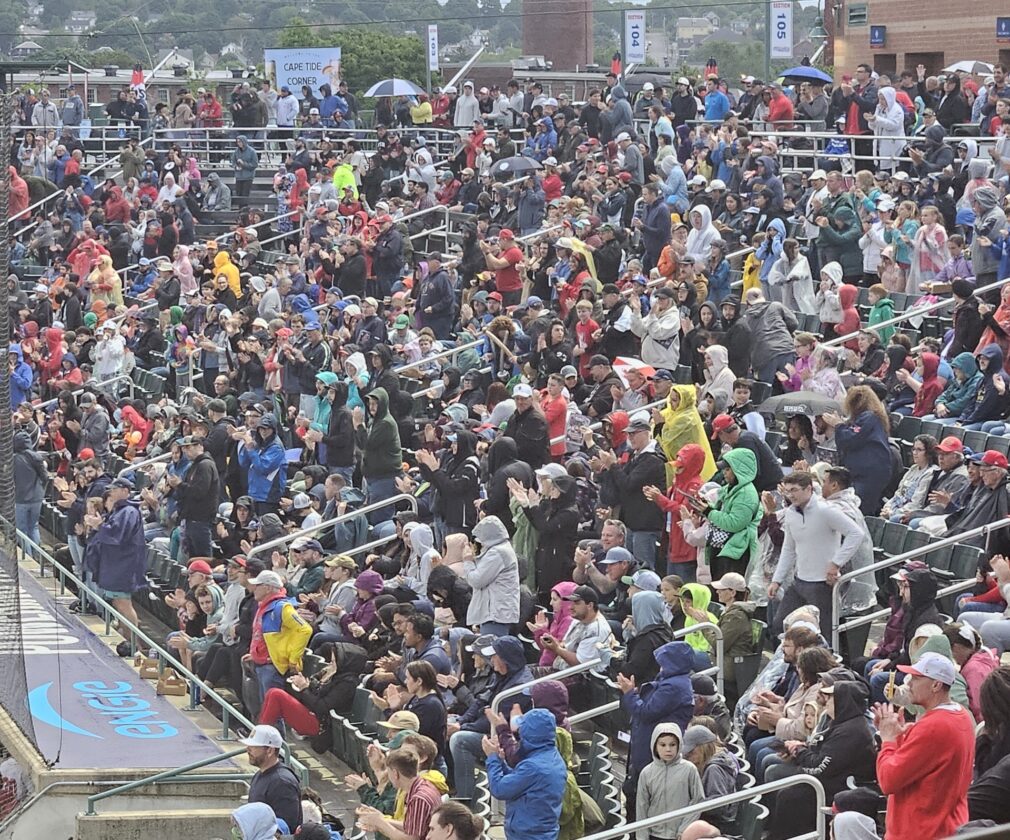
The recent Opening Night at LeLacheur Park is one of the reasons the future looks bright for the FCBL (Telegraph photo by TOM KING)
NASHUA – What’s in the future for the Futures Collegiate Baseball League?
It’s enjoyed a great opening week, especially with the opening of its newest franchise, the Lowell Spinners.
But a seven-team league is certainly not what the league wants to rest its laurels on. So the question is, what’s next?
“Obviously I’m really excited because ol Lowell,” Paolucci said. “It took a lot to get them into the league and it will be just a first class show there, night-in, night out. … The excitement is just what Lowell is going to bring.”
But now, as Paolucci said, “There aren’t many stadiums left in New England that we don’t have or are trying to (secure).”
And now the hope is the the addition of Lowell coud springboard further interest in the league for potential ownership groups and communities to step forward.
“It has,” Paolucci said. “We’ve had a lot of interest this off-season from people, inquiring. On our website there’s a whole page dedicated for people interested in ownership. We have a few irons in the fire, I believe. With that, nothing that’s really close, but this off-season should be another exciting one for that, hopefully.”
One community the league has been zooming in on, as has been reported in the past and confirmed by Paolucci, is Rockland, Mass. There’s a viable stadium, etc. and they’ve been close in trying to gain an owner but have not been able to bring it to the finish line.
“We had a group that was really interested,” Paolucci said. “They’re still kind of working at it I think. … (Rockland) is definitely a viable venture.”
That’s because the FCBL and town officials are on the same page, which is half the battle. “We’ve done so much work with the town and they really want a team,” Paolucci said. “We’ve got a ballpark idea what they’re looking for.”
There’s one New England state the Futures League has yet to explore – Rhode Island. Paolucci said there’s a group interested there “but they really don’t have a stadium yet.”
There has even been one inquiry from a group outside of New England but within a doable proximity. But if they did expand there, Paolucci said, the league might have to include more series play with its schedule..
Paolucci echoed what has been an FCBL rallying cry for the last few years: Quality over quantity.The league will not add a team just to make it an eight-team circuit, which is easier for scheduling purposes.
“To me it’s more about the stability of franchises,” Paolucci said. “I’d hate to have seven stabile franchises and one that’s about to fold any day now. Just to make the schedule work.”
The FCBL does have a forgotten eighth franchise in the Pittsfield (Mass.) Suns. Remember, historic Wahconah Park had its grandstand basically condemned and the facility teardown has begun, the obvious first step in the rebuild.
The Goldklang ownership group has been, according to Paolucci, paying annual dues to the league and has been an active voice, and it has the right of first refusal for the rebuilt Wahconah Park with the city of Pittsfield. Some are looking at 2027 as a possibility, but nothing about this situation has been on time. But expect Pittsfield to be in the FCBL sometime in the next couple of years.
LEAGUE TALENT
Besides franchises, one variable in the FCBL has always been the talent level.
“The talent looks great,”Paolucci said. “Just looking at the rosters around the league, I’m excited. The talent in New England is phenomenal.”
In fact, Holman Stadium was the sight of a recent open ttryout, and, Paolucci said, “The kids that were at the tryout are all good enough to play in our league. A lot of them the college coaches don’t have the connections so they’re not on rosters early.”
The roster limit this year has been increased by three to 43, but it goes down to 40 on July 1. “We wanted to give teams more flexibility in getting players,” Paolucci said.
Another topic is the playoff format. With seven teams, it remains the same as the last few years: top four teams in the standings.
“We talked a lot about different formats,” Paolucci said. “The managers probably want to see another team added whether it’s a play-in game or whatever. But I think the way we do it is fair and makes the most sense.”
Ironically, Paolucci would love to see a seven game series for the Finals, but it’s obviously not feasible due to time, etc. With that, he’d settle for a three-game first round series and a five-game final series, but again, not feasible due to time as the league ends in mid-August and players need to get home and ready to return to school late in the month.
“It (a best-of-seven) would be phenomenal,” Paolucci said.
But it’s likely not to ever happen. As Paolucci said “The only way you could do it is if you just do the top two teams (making the postseason). Nobody wants to go down that road.”
That’s because teams want the revenue for even one postseason game, and also want to keep fan interest going late in the regular season. To have five teams not make the playoffs is not what the FCBL owners or fans want, Paolucci said.
But, owners also don’t want to have to pay travel expenses for a fifth or sixth place team that wouldn’t get a home game, either. So things remain status quo. “There’s a couple of different ways of looking at it,” he said.
And Paolucci said that the All-Star Game, which is in Nashua this year, is in the latter part of July to help keep players around in the league to take part in that event and not leave earlier.
With that in mind, Paolucci is looking for big things for the FCBL All-Star Game in Nashua, mainly because of the creative mind of Silver Knights general manager Cam Cook.
“Cam is really coming into his own as a general manager,” Paolucci said. “And with him and the Creedons working together on planning this thing … I think it’s going to be right up there with the Vermont game from a couple of years ago, phenomenal for our league.”
One thing the league is doing differently is it’s doing away with the “Scout Day” workout that is part of the All-Star event. Instead there will be a “Scout Game” at Norwich with Futures League prospects vs. a team pro scouts put together at the end of June. “It’s perfect because it leads right into the (MLB) draft,” Paolucci said.
THE CHANGING COLLEGE LANDSCAPE
Paolucci said that teams are now being asked to put on the roster, where a player’s school is listed, that they are instead in the transfer portal.
And that leads to the new world, Paolucci said, of collegiate athletics.
“College coaches aren’t just recruiting high school kids any more,” he said. “Now they’re recruiting the transfers. At lot of schools, that’s there philosophy, right? They’re not even going after the high schools. Teams that are close to winning ways are replacing really good players (who have graduated) with really good transfer players. So we’ll make that easier for coaches to know who’s in the portal.”
Paolucci said it may be just a simple change as putting an asterisk next to a player’s name or school on the roster. Or just replace the school name with “transfer portal.”
And that leads to the bigger question: how the league can deal with the overall ever-changing landscape of college athletics in general.
“It hasn’t really affected it yet, but I think it’s going to,” Paolucci said. “I don’t know how the NIL (Name, Image and Likeness pay) is going to play out. In five years, are we going to have to pay really good players to play with us? I don’t think so, but I don’t know what the answers are with that.”
Paolucci said that now potential high school draft picks could choose the school over what he might sign for.That may be the case with current top Massachusetts prospect xxxx of Bishop Feehan, who is headed to Texas if he doesn’t sign out after being potentially drafted. “I’m sure Texas is going to offer probably more than any other Major League team,” Paolucci said.
And others might be in the same situation, choosing the facilities and developmental chances with a Divison I school than languishing in the pro bushes, more or less.
“These are all the decisions that the athletes have to make,” Paolucci said. “At some point this is going to affect summer collegiate ball. Without a crystal ball, I don’t exactly know what that’s going to include.”
One thing, players in the FCBL do pay an entrance fee to play in the league.
“I think the players need us, probably more than we need them,” Paolucci said, speaking hypothetically. “We can always find players. The talent level might drop off, but we’ll still be able to fill rosters.
“Whereas kids who want to get drafted and want to play in front of scouts all summer long, we’re providing them this great opportunity to do that. I don’t know if it will ever get to us paying the players.”
Paolucci said the cost of instruction, etc. on the youth level is well into four figures,so costs at both ends are increasing.
The success of the league can’t be argued with the number of former FCBL players that are in the Major League at this point, whether they spent a coup of coffee in summer collegiate ball or a full season. Yankees young starter Cam Schlitler pitched for just a little less than a month with the Silver Knights while at Northeastern and slugger Ben Rice was with Worcester for a couple of seasons. Of course Red Sox catcher-infielder Mickey Gasper, the former Merrimack High School standout, was the FCBL Player of the Year in 2016 with the Silver Knights.And there are plenty of others.
“I come into my office and the first thing I do is go on YouTube and see the Yankees highlights to see how Ben did,” said Paolucci. “And check out the Brewers and see how Sal Frelick did. I love it.”
In fact, Rice works out in Paolucci’s facility on the Massachusetts south shore area and his father throws him batting practice every day. Paolucci is hoping Rice participates in the MLB Home Run Derby at the All-Star Game this year.
Finally, with Nashua and Keene playing two exhibition games this summer, Paolucci was asked how the interaction is between the two leagues. One, the NECBL, is non profit, and the FCBL is a for profit circuit.
“It’s not great,” he said, except that he and NECBL Commissioner Sean McGrath have a good relationship. Paolucci wanted the Prospect Game to be one between the two leagues but the NECBL owners weren’t said to be too thrilled with the idea.
“I think the problem is the relationship has never been good,” Paolucci said. “And the people involved, probably more so on their side,aren’t willing to mend the relationship, or – I’m not saying anything bad – it’s just a ‘They do their thing, we do our thing’.
“And that’s fine. I say it all the time, the NECBL is more baseball centric, and we’re more business centric. All our owners are trying to turn a profit, and the NECBL focuses more on getting the better prospects, play fewer games, which I think is what most college coaches probably want is fewer games.
Two completely different leagues with completely different agendas.”
And, according to most industry sources – Paolucci wouldn’t confirm or deny – most if not all teams in the FCBL are making a profit.
“Obviously some more than others,” one source said. “Vermont is killing it up there, Nashua is doing incredible, and Worcester has always been profitable. … These guys wouldn’t come back every year if they werent’t making money.”