NEW REGIME: Brady ready to keep Rivier athletics purring
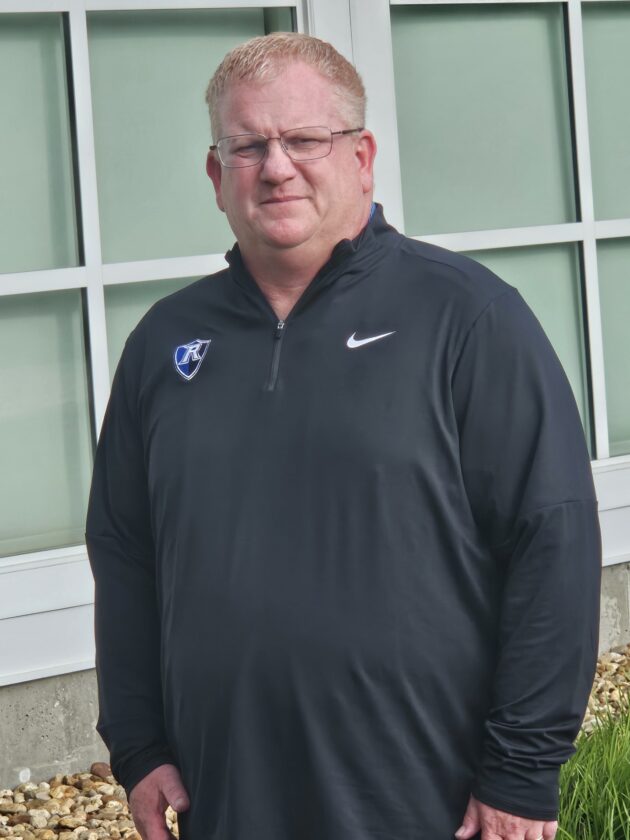
New Rivier AD Joe Brady will just try to keep the Raiders on the path that previous AD Jonathan Harper had them on. (Telegraph photo by TOM KING)
NASHUA – Joe Brady remembers when he decided to be brash and put his name in the hat for his first head soccer coaching job.
It was at Anna Maria, where the new Rivier University athletic director played and also did some work in the athletic department. He found out the head women’s coach wasn’t coming back got the courage to go into the athletic director’s office. He had also been a student assistant for basketball, so why not ask?
“I said, ‘I’d like a chance,'” he said.
Brady had just graduated, and there was some skepticism, but he got the job. He was coaching some players he went to school with, and was 21.
“I inherited a freshmen class that was pretty good and we had a decent year,” he said.
In his second year, two players who had left Anna Maria transferred back, a forward who went on to score 37 goals and a keeper who was one of the best in New England. A conference championship and ECAC tournament berth was the result, and there was another conference title during his five year run..
“I got lucky,” he said. “I say that to young people, sometimes it’s about luck and knowing the right people.”
And the now 51-year-old Brady, who knew former Rivier AD Jonathan Harper well as Anna Maria’s athletic director, was familiar with Rivier and the college landscape, jumped at the chance for another job he wanted, the Rivier AD job. This time, though, he wasn’t 21.
Back then, Brady knew how to change as a head coach. “It was hard,” he said. “I’ve got some really good friends who married and have had kids, my former players. I just kind of changed some of my decisions and what I did outside of the field, and it worked.”
Brady began playing soccer as a youth from Milbury, Mass. for a club that still exists in Sutton, Mass., the Full Hamlets. He played high school as a goalkeeper for St. John’s in Shrewsbury, Mass. and went on to play for Anna Maria. He tried one baseball practice as a youth, didn’t like it, and spotted the flier for a Full Hamlets tyout. He made it, and a soccer career was born.
But he also loved basketball, “and I thought I was going to play in the NBA. But never did.”
He played a lot of CYO ball, and tried out for the team at St. John’s but it was super competitive so he decided soccer was his one and only.
He started coaching his youngest brother’s rec team, and thought it was something he might want to do, so he pursued it.
What kind of coach was Joe Brady? He coached five year at Anna Maria, then coached 13 years at Clark University before five years working in variou job in athletic administration at Clark. Then he went back to Anna Maria as its athletic director.
“I coached with a lot of passion,” Brady said. “And I was their (his players’) biggest supporter.”
In his final year at Anna Maria as a coach, Brady’s team beat Clark, which ironically he moved on to coach. When he was interviewed for the Clark coaching job, he was asked about how excited he looked in beating Clark.
“I said to them, ‘When you beat someone that’s your rival, you’d do the same thing,'” Brady said. “When we beat Clark, they were the program we were trying to be at. They went to the NCAA tournament, had succes in the past. I told the players in the search committee ‘I’m going to do the same thing for you.'”
Brady said he always tried to evolve as a coach and constantly learn, which he’ll impart on his Rivier coaches.
Does Brady miss coaching? Part of it.
“I miss game day a lot, I miss the interaction, that really close relationship with the players,” he said. “There are some things I don’t miss. But I miss the competition, espccially the game day. The way I get it now is I get it for everybody (all the teams).”
He just transferred the feeling in a different role. “You experience more of the highs as an athletic director than you do the lows,” he said. “A loss eats away at you as a coach. (As an AD) you feel bad for the kids and the coach. But as an athletic director you see the progress: how they played in the first game and how they’re playing at the end (of the season), which is what I loved about coaching too. We used to say you want to be playing your best soccer at the end of the year. As an athletic director, this fall you want to see all four of our teams (two soccers, field hockey, women’s volleyball) making progress as you go.”
So Brady says you can still get that coach feeling. Longtime Rivier AD Joanne Merrill and her successor, Jonathan Harper, were highly visible at events and Brady says he will be the same. “I want to watch our teams play,” he said. “I say it all the time, this (AD) job allows us to watch games.”
What made Brady leave coaching for the administrative part of college athletics? Part of it was family time, he had very young children (son John and daughter Keira and that was a lot to put on his wife, Melissa. Clark had an internal candidate who could take over so Brady says he loves to say “I wasn’t asked if I was ready to get out of coaching, I was basically told.”
The timing was good after 18 years and the administrative opportunies were too good to pass up. “They don’t come up all the time,” he said of those jobs. “And eighteen years was a great run as a college coach. I got to stay where I was.”
Brady learned the difference fairly quickly about the difference between being a coach and an athletic director.
“I said to someone, when you’re coaching, you’re worried about one team,” he said. “When you’re an administrator, you’re worried about 13 teams. You’re trying to do what’s best for each team individually, because each team is so different,but you also have to think about the collective department. …
“I told the coaches when going through this process that I’m going to think as a coach, but I also then have to take that adminstrative lense as to how it’s going to impact everybody. … I’m going to decide as an administrator, but make sure it doesn’t negatively impact others.”
Keira Brady is a senior in high school and John is going into the seventh grade out in the central Mass./Worcester area, so Brady will probably commute for a while.
THE BRADY LOOK
What does an athletic department under Joe Brady look like?
“Great question,” he said with a grin. “I think it’s going to look like teams that one, will represent Rivier the right way. That coaches will bring in good student-athletes that are going to again represent River right. And then teams that will compete. At the end of the day, the coaches are going to be the ones that coach; I’m not telling the coaches how to coach. It’s their programs.
“But I think they’ll find as they get to know me a little bit, I love to watch teams that love to compete. And then, the tools are here. … sports medicine is a committed team, we have four athletic trainers. A lot of colleges our size don’t have that. And then the facilities, right? I continue to walk around from building to building. Our facility, the tools are there for them to be successful. I’m just there to keep the train going.”
Brady, who could see from afar, feels the Raiders have perhaps one of the most talented coaching staffs they’ve had. The other thing is for Brady, it’s key that Rivier has made the investment in both academics and athletics at the same time.
“If you don’t do them both together, one’s going to … that’s not the case here,” he said. “It’s going to help our student athletes. The one thing I want our coaches to do is give them a good student athlete experience, and they’re going to do that because (Rivier President) Sister Paula (Marie Buley) and others have made the commitment to our student athletes and others.”
What does Brady look for in a college coach? Experience in recruitment. “There are some people out there that could jump right into (coaching),” he said, “but the college recruitment is a key part of it. High character. … Obviously you want to find someone who has had some success, whether it’s an assistant in a program that’s had success. Playing success is an important part, but there’s good coaches who didn’t have successful playing careers. Somebody that’s passionate about being in college athletics, academics is important to them, community service, alumni engagement. They understand it’s not just coaching, as much as they want it to be … Someone that wants build a program and do all the stuff that goes with it.”
Brady said the biggest challenge during his AD years at Anna Maria was facilities, or lack of them. “Athletics is really important to the college and the enrollment, but the financial resources at times were limiting to do that next level thing,” he said. “At times, facilities were one of the biggest challenges.”
Of course, Rivier has the Muldoon Center, and the $4.5 million Linda Robinson Pavilion for rectangular sports and softball. Rivier baseball is able to use the Harvey Woods Field at the closed Daniel Webster College, while maintaining it basically as the Raiders’ own.
THE FUTURE
Brady always used to say in recruiting “There’s no guarantee in anything” but collegiate athletic administration is his chosen path. And he’s energized by the Rivier campus.
“I walk around, and talk to coaches about what they want to do,” he said. “It’s not really a job, at the end of the day. There’s times when it’s hard, but there’s so many jobs out there that aren’t really rewarding. This is not one.”
No, there are too many vaules in what Brady does in the collegiate world.
“Whether it’s athletes having success, or athletes going off and getting their first jobs, and overall really valuing the experience they’ve had at Rivier, that’s what’s rewarding about this.”
He picked up on the culture that Harper had established in a short three years. “He set the bar, and we’ve had those conversations as coaches, what are the next things we’re going to try to accomplish? … And it’s not just Jonathan, it’s Joanne. She set a standard. I get to take those keys an keep on going.”
The bar is in Brady’s mind,is “competitive success. We’ve got the facilities to support high level recruits. Academically, if someone were to come and play ice hockey, or field hockey, or soccer, they have the academic programs that say, ‘OK, you can be successful as a player, athlete and in academics.
“So now let’s go compete for conference championships. Let’s do what men’s lacrosse did. Softball’s hosing a (tourney) pod. Women’s hockey playing in a conference championship in its first year (in the MASCAC).”
So Brady says he’s walked around campus in the time before the student athletes report in a week or so, and sees how that bar was raised in different meetings and in talking with people.
“They’ve set those teams up now to raise the next bar,” he said. “Everybody wants to win. We’re going to win the right way, still be high level academics, but we have the tools here to compete here in the conference (Great Northeast Athletic Conference).”
Brady feels the GNAC is a perfect fit for Rivier, which helped create the conference in the first place some 30 years ago. He notes that GNAC champions are now starting to win in NCAA tourney games as well – as Rivier men’s lacrosse did this past spring. “There’s no reason that we can’t be in this conference, win it, get in the NCAA tournament, and wina game or two, or even more,” Brady said. “The GNAC has a geographical footprint that can be challenging but we’re in the right spot.”
Of course, this is a different time for collge athletics, in which the transfer portal makes it paramount you re-recruit your own players.
“It is hard, because things change and student athletes, they think there’s another, better place for them,” he said. “But my hope is that what we’re trying to do here, and with the coaches we have, they can come here and feel like, ‘OK, this is a home for four years.'”
But he knows the trickle down effect from Divsions I and II is there.
“Hopefully we have success, I know our coaches are going to give them a great experience,” Brady said. “And they’ll get top-notch facilities, and there’s the academic piece. Staying somewhere, call it home for four years, it’s going to be the goal.”
With Harper, taking over for a legend in Merrill, it was a drastic change and there was a makeover. With Brady, more is in place. Rivier is what he expected.
He’ll meet with the coaches and student athletes in the preseason, and knows with a new boss there coud be some apprehension. But he says if it ain’t broke, don’t fix it. He knows that last season was one of Rivier’s best athletic years ever.
“I’m going to ask them to continue doing what they’ve been doing,” he said. “I’m not coming in here to reshape anything. That’s why I was interested in this job. There are things I have to learn, things I’ll put my own mark on. But there’s a lot of things that are already in place. That’s what was attractive to take this job.”
And it’s a job Brady is expecting to have success in.
“This is all I’ve done,” he said. “Looking forward to seeing what we can do collectively over the next few years building up what they’ve already done.”