Harper takes over as Rivier athletic director
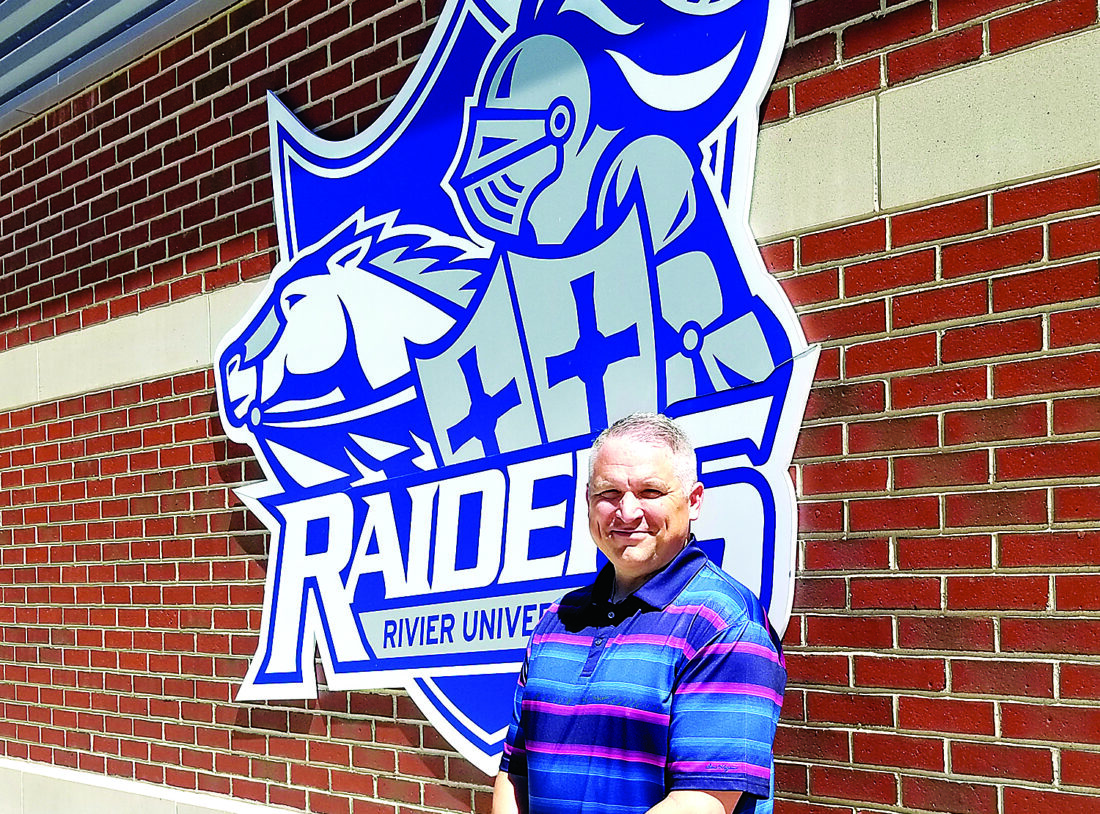
Jonathan Harper is taking things step by step as he has just begun his tenure as the new AD at Rivier University. (Telegraph photo by TOM KING)
NASHUA – Jonathan Harper was a junior in high school in Wichita, Kansas, when he and his family experienced a twist of fate.
His father, John Harper, was an administrator at Wichita State but was offered that spring the athletic director’s job at Bridgewater (Mass.) State University.
“He was thinking about it,” Harper said, “and that’s when a tornado came within a quarter-mile of our house. My mom took that as a sign: Time to go.”
Harper’s father thus moved the family to New England, and Harper put roots down in the region. It’s those roots that indirectly over time led him to taking over as the new athletic director at Rivier University, succeeding longtime AD Joanne Merrill, who will assist him through a transition year.
“I see a lot of Bridgewater State here,” Harper said. “Of course, the size is different, but you have the facilities, the programs, the aptitude of the staff and the coaches and the way that this institution is structured, is tremendous.
“It’s everybody pulling in the same direction here. That’s how Riv is going to continue to be successful.”
Harper had left the region a few years ago, but circumstances made him available to make another move.
“I wanted to come back home,” Harper said. “I was familiar with the area. When I was at Newbury (College), we played Rivier in a lot of sports. I have a tremendous amount of respect for the program, for Joanne, the way she ran the program here. It’s in a beautiful setting, just take a look around. But mostly the folks are so welcoming here.”
Harper was at a school in California when it shut down and he was out of a job, but managed a great landing spot.
“I was very fortunate,” he said. “When the partnership fell through with the institution that was going to acquire us, we knew the writing was on the wall.
“You’d like to think you’d be able to continue operations, but we suffered the fate that a number of small private schools are facing right now.
“The closing of institutions is not limited to Daniel Webster, Newbury, or Mount Ida. It’s going to continue.”
So Harper felt the best thing for him and his family was to move back to the New England area. “The opportunity to come back home was big for me,” he said.
•••
THE JOURNEY FROM THE START
Harper is actually originally from Springfield, Missouri, and his father – who later was the AD at Bridgewater State for 21 years – ran the student center at Southwest Missouri State. Then he ran the Smith Center at George Washington University so the family moved to the D.C.area. And later, of course, the family left Kansas to come to New England.
Harper was an athlete in high school, but a broken arm halted his baseball career. He played basketball at Bridgewater-Raynham against Chris Herron and Durfee in the Mass. South Sectional semis. Naturally, he went to Bridgewater State, but felt if he played any sport the feeling if he made the team would be because his father was the AD. So his playing career ended.
Thus, a career in sports management/administration beckoned. His first job? As an intern for the Bourne Braves of the prestigious Cape Cod Baseball League, and eventually was elevated to vice president. The logo they still use is Harper’s design.
During the second half of his final year at Bridgewater, he interned in the sports information department at Mass. Maritime. After a year at the ECAC, he got hired at Fitchburg State as an assistant AD/sports information director. He learned a lot there, but then moved on to work in the Northeast 10 conference office, first as the director of media relations, where he worked with former Daniel Webster College assistant AD/SID Ken Belbin.
Under Harper’s leadership, the NE10 was one of the first conferences in the country to have audio streaming for its championship games.
All that led to him being the commissioner of the East Coast Conference, which he said gave him “the global experience. The pressures all the presidents go through because they all meet. The faculty athletic representatives, all their challenges, the student advisory committees….As commissioner, I got to see all the student athletes only at their very best. Which is wonderful. But the main reason I left the conference office was I wanted to affect more lives, I could mentor more, on an everyday experience.”
Harper had a goal – a goal to take over “the family business.”
“I never felt like I took over the family business,” he said, “until I became the AD.”
And that happened at Newbury College in Brookline, Mass., which was in the New England Collegiate Conference along with Daniel Webster. And, unfortunately, met the same fate as DWC. In his final year as AD there Newbury won the men’s soccer title and men’s and women’s outdoor track titles.
With no job at Newbury, Harper and his wife, Heather moved out to Roseville, Cal. as she was able to get an attractive job on the west coast in her field of behavioral nursing.
The pandemic hit, delaying Harper’s chances to get back into college athletics. But his wife got an even better job in the Los Angeles area after a year, and Harper was offered and accepted the AD position at Marymount California University, an NAIA school.
“It was a tremendous opportunity,” he said.
But an opportunity that lasted only a couple of years. MCU also closed, and when Riv opened up, it was time to return, and the opportunity to work with Merrill and succeed her after a legendary 41 years was too good to pass up.
“If you work in New England, you know who Joanne Merrill is,” he said. “When the job opened up, I remember seeing it and turned to my wife and said, ‘That’s the job I want.’ She said, ‘Go after it, let’s do it.'”
And her wife adjusted, taking a new position within the same company that allowed her to work remotely and oversee departments in at least 11 regions around the country.
•••
HARPER’S VISION
Harper met with the athletic staff as a group, and began working on campus the second week in August, and knows that he has a great example to follow.
“You don’t take over after 42 years for Joanne Merrill,” he said. “You’re just ‘next.’ I’m the next director of athletics at Rivier University.’
“To have that institutional knowledge, to know the operation of the athletic program, she’s synonymous with the program. Her willingness to help us out is tremendous for me.”
So Harper is easing into things, a job that involves not just game management, but athletic training, sports information, and getting involved in the community. He says one of his tasks is to “make sure the community knows this is Nashua’s university. We want them here to help us support our programs.”
But all of that, he says, is for down the road. First he has to get the student athletes who arrived a couple of weeks ago settled into their fall programs/seasons. “Then the fall runs right into winter and the winter bleeds right into the spring. Once we get going, it’s going to be a sprint. It’s going to be may before we know it.”
But during that time Harper plans to network not only on campus but in the community as well. “Build bridges,” he said. “Find areas of opportunity to work smarter not harder. And take advantage of the technology on campus.”
Harper wants to see the city embrace Rivier athletics more than it has. He’s seen that work at Southern New Hampshire and Saint Anselm.
“A lot of the citizens of the area are at their games,” he said. “I’d like to see that here too. That will be an opportunity for me to get out into the area and invite folks to come to our games. I want you there. I want you to enjoy an experience that helps our student atheltes.
“That’s not atypical of Division III small schools.”
Hockey, he says, has given Rivier a chance to “be in the center of the community, and if you want to be around the community, you’ll be around hockey in New Hampshire. It’s one of the few times the athletic department here will have the intersection (at Conway Arena) with youth sports, high school sports, and then we come in at the collegiate level.” He feels the job the two coaches, Matt Keating (men) and Chris Czarnota (women) did was “tremendous in the time frame in which they made it happen; the flexibility they showed, the dedication they and their student athletes showed, that just makes you a stronger person.” And he knows there are scheduling issues, etc. to work out further.
So perhaps some signage and the use more of social media, etc. will help him in that goal.
As for coaches, Haprer has already been busy. As of this writing, there is a baseball head vacancy he has to fill – a decision was expected right around now – and he already had to quickly promote assistant women’s soccer coach David Richard to the interim head job after Brooke Arment stepped down following four seasons at the helm.
With baseball, one thing Harper says is the job will now be a full-time position. “We’re going to be OK,” he said, noting that he hopes Harvey Woods Field at DWC is still available to Riv, which can use Holman Stadium but usually only for the home stretch of the Raiders’ season. But Harper is used to that; there was no field on campus at Newbury or Marymout California.
“We can be competitive anywhere,” he said the approach is. “(Holman) is historic, it’s gorgeous, I’ve been in it several times. When it’s made available, it’s the right time for it to be made available … It’s home. We want a presence there, but again, it’s being part of the community as a whole.”
Rivier has had its ups and downs in the Great Northeast Athletic Conference; the Raiders had a more competitive year overall in 2021-22 in the conference it helped create some 30 years ago than in the past, but there’s still a new level to reach for several sports. Harper wants to see the programs be more competitive.
“No doubt about that,” he said. “The GNAC is one of the more difficult conferences in Division III, never mind New England. But when you’re running up against traditional powers in this conference, it’s tough to shake that tree and be successful. But we’re planning on doing just that.”
Harper says a lot of institutions are “traditionally more resourceful. I think it’s fair to say Rivier is knocking on that door. The organizational opportunities and the way we organize ourselves, and we take care of our own house, in-house, first, it will take care of our competitiveness in the GNAC. The more things we do correctly, the more successful we’ll be.”
The emphasis that stretches back to the admissions department has been to bring more student-athletes on campus; that’s one of the reasons men’s and women’s hockey was added to the program with their inaugural seasons a year ago. Harper wants to see that theme continue.
“Opportunities, right?” Harper said. “Opportunities for student athletes, not just here in southern New Hampshire, but the opportunity to recruit nationwide, we want to continue that onward. We want full rosters. But at the end of the day we need to have a quality experience for the student athletes. You will retain your student athletes, or at least you’ll have a greater chance of that, if you’re continuing to build value.”
Harper says you can’t fool today’s recruits.
“They are very keen at picking out value,” he said. “All you have to do is turn around and take a look at this beautiful turf field, this facility (Merrill Field) for rectangular sports – what a tremendous value to participate here.”
And, Harper says, add the facilities to the majors – including an increasingly popular sports management program – and you get value.
“Life,” he said, “is about opportunity.”
And in his opportunities in athletic administration, “I’ve seen a lot. I’ve seen closings, but also very successful institutions and what they did from the conference office. At the end of the day, it’s all about the quality of the education. If you have that, student-athletes will find you. If you have the facilities,student-athletes will find you. And then if you have the coaches and staff in place to help care for them while they’re here, you’ll retain them.”
And, in talking about the coaches, what is the common denominator or theme he wants for his coaches going forward?
“Honestly, do your best that you can possibly do,” he said. “You cannot underestimate how much coaches care about their individual sports. But it is to be accountable but to be empowered at the same time. I need to empower the staff, just like Joanne has, to continue to do their job and execute it well. And be accountable for our actions. It’s ‘This worked, that’s great; this didn’t work, let’s not go in that direction again.'”
And direction, he said, is for his coaches to continue to recruit quality students “and the success on the field will follow.”
It’s all a pattern, of one ingredient leading to another in Harper’s mind, the same way a series of events led him to come to New England over 30 years ago.
“It works out,” Harper said, “the way it’s supposed to.”