Jeff Kleiner follows father’s path
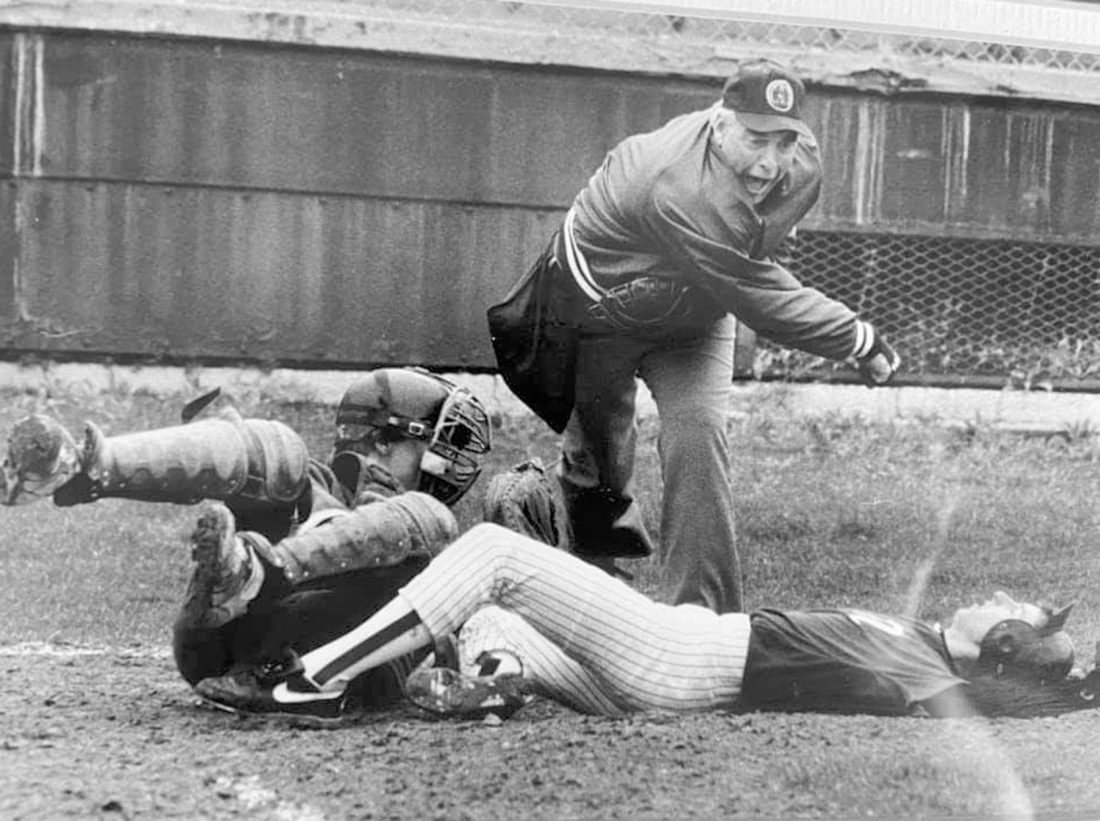
NASHUA – Jeff Kleiner is giving back – just like his father did.
Kleiner returned to the New Hampshire Baseball Umpires Association, and last summer got a phone call from the now former Baseball Umpire Development Director Gary Noyes. Would Kleiner be interested in taking over the development program?
“Absolutely, I’d be honored,” Kleiner said, and there’s a good reason why: His father, the late Larry Kleiner, began what was then known as the Apprentice Program more than 40 years ago to train and develop young umpires. Larry Kleiner passed away in 1992 after a battle with cancer, and Jeff first became an umpire to carry on his father’s legacy. He left umpiring for family reasons a decade ago, but came back in the last year.
“My dad started that program back in the 1970s and I helped him with it as a kid,” Kleiner said. “We’d actually have the meetings in the basement of our house. People would come over on Saturday mornings.
“So when I was asked for the opportunity, I said ‘Hmm, I’ll come full circle’. It was an honor because they wanted somebody who had college and professional (independent Atlantic League) experience. And my regular job being in business, having to organize, etc. Part of the reason I came back was to help out the veteran umpires, yes, but also the younger guys coming up. I’ve been doing this for so long.”
Kleiner returned to football a couple of years ago, enjoyed it, and then was asked about coming back to baseball, because that was his primary gig.
“So I said, you know what, let’s do it,” Kleiner said. “It ended up being a great year. I did the championship series of the Futures League, and all the high school tournament games. I picked up where I left off, so to speak.”
But to take over the Development program, he said, “is the coolest thing. Part of hit is because this sport has never forgotten my Dad.”
Indeed, Larry Kleiner was inducted into the 2020 Umpires Association Hall of Fame, although there wasn’t a formal ceremony due to the pandemic. There is also an Association award named after Larry Kleiner.
The theory is this: Umpiring should be,Kleiner said, “for people who actually care about it,build up a relationship with the coaches. We’ve got a handful of guys in every sport for it’s all just for the money, I just want to go out and get my 80 or 90 bucks, whatever it is, and that’s it. The fact that I get to continue something for a bunch of years that my Dad did is pretty cool, pretty full circle. Especially since they never forgot him, recognized him every year, and had the award for him right away starting in 1993, the spring after he passed.”
THE PROGRAM
The classes/sessions for the Development Program starts on February 13 – Super Bowl Sunday – and last eight weeks. It will be about a four hour class each Sunday, and part of it will be “going over rules that you really are going to go come across.’
“The rulebook is filled with stuff that I haven’t seen in 40 years, so I’m not going to bog them down with stuff like that,” Kleiner said. “The basics and fundamentals of the game.”
Kleiner went over to the Football Officials Association for some help to speak about what officiating entails.
The students will do rule sessions, and then Kleiner plans on having them work in a gym or on a field, the latter if the weather breaks soon enough in late March or early April.
“Hopefully we can get on a field,” he said, “and go through some situations, where are you supposed to be when the ball is hit here, where are you supposed to be when there’s a runner here. How do you get behind the catcher and set up to call balls and strikes and know you’re in the right spot to see the entire pitch?
“A lot of (umps) lean back there with their arms behind their back, because they saw some kid doing a Little League game with their kid (playing) and don’t know what the specifics are.”
Kleiner said his instructors have either professional game or college game experience.
“They’re going to get instruction from people who have experienced a much higher level than what we’re teaching,” Kleiner said.
Kleiner said his first couple of classes will at the auto dealership Kleiner works at in Manchester, and then he is trying to work out something with Bow High School, feeling it is more centrally located.
That is taking time because of restrictions related to the pandemic. He’s also talked to a couple of other schools.
“I’m trying to get a spot where these guys don’t have to take a Sunday afternoon and blow their whole day,” Kleiner said. “I don’t want to say I’m the Nashua guy and you’ve got to come to me.”
Some are coming from the seacoast, a couple from up north in Plymouth or out west in Keene.
“And unfortunately some of it might end up being Zoom, depending on how things change,” Kleiner said.
Kleiner’s undertaking is important for another reason: umpires are sorely needed for the spring.
“That’s where these coaches and ADs have to really step up and help us out,” Kleiner said. “They’re not going to have programs if we don’t have umpires, football officials, swimming, any sport. These are all under Federation rules and if you don’t have certified trained umpires, they’re not going to have seasons and games. I don’t think any institution doesn’t want to have athletic programs.
“If we don’t get some of these coaches and ADs to get the word out – let’s be honest, in New Hampshire,there’s going to be less than half a percent that they’ll make it to professional baseball and one percent they go on to play high level Division I baseball.
“So there’s no better way to stay involved in the game. Switch it up, you can still go out on the field, it’s not every day at practice, and boom, you get a check for it too.”
Kleiner said there’s a need for young umpires, as the average age on the executive board is 58 years.
When the assigning process was discussed, according to Kleiner, the result is there will be a large number of sub varsity games with just one umpire, as varsity games will require two.
“It was that way last year, too,” he said. “Obviously we have to go varsity right down the line, but it’s not fair to these kids who are in middle school and junior high. That’s the most important (level), that’s the thing they look forward to. We want to make sure everybody has an opportunity to play.
“And it’s a safety thing, too. If you’re one umpire, who knows, you don’t see something that happens could be an injury. Now if something happens, it happens, having another umpire there is not going to prevent a collision or something like that. But if we are right now looking at the majority of sub varsity games having to be rescheduled or having only one umpire.”
Varsity games are safe to be staffed, Kleiner said, unless there are more pandemic complications and some don’t want to venture to do games. Some of the northern schools may have issues getting umps assigned due to mileage issues.
Co-op teams also help limit the number of games; Manchester Central and West are said to taking that route this spring.
Kleiner’s kids are grown and gone, so the last couple of years was good time to return. He did 200 games from the start of high school through the Futures Collegiate Baseball League, many of them Nashua Silver Knights games. He worked last summer with young umpires who were just starting out. “I was there, too, I was doing college games when I was 18, 19 years old,” said Kleiner, now 53.
Thus, what does he see in young umpires?
“The younger ones that I worked with last year, and I’m hoping I work with this year, there’s always going to be the type I couldn’t shake loose in the parking lot after a game,” Kleiner said. “Which is awesome. But there were others who said, ‘Nice working with you’ and off they went. And I was saying, ‘Wow, this kid should’ve stayed and asked some questions because he’s got a long ways to go.
“It’s the same, whether it’s the business of umpiring or you’ve got a regular business. Some who really want to do it, they ask the questions. Then you have the ones who just want the check, already think they know it all, and then they realize they don’t.”
And that realization comes, Kleiner said, when they don’t get the nod for playoff/tournament games, or Division I varsity games.
“That’s when the conversation gets re-introduced,” he said, “that this is what you need to work on, you’ve got to ask about this, and so forth. I do have some college kids that are interested in doing it.”
What’s the biggest mistake a young umpire makes?
“Not wanting to learn,” Kleiner said. “The most critical mistake is watching a Red Sox game and trying to be that umpire before they learn how many balls a guy gets before he gets a walk. … They’re watching these guys doing a four-man (crew) and work together all the time. Other leagues you work with the same guys all the time and know where each other is. That’s a huge mistake when they don’t want to listen to what’s pertinent to what they’re doing, be it high school baseball or sub-varsity baseball. No different than the players trying to watch this stuff.”
And during a game, Kleiner said, the biggest mistake they make during a game is “being out of position and unsure of themselves. A lot of players can explode on you, although not so much on the sub-varsity level because the game’s not as quick. But the first mistake is not looking like you belong on the field – if you don’t have the uniform looking right, the shoes clean, and you’re ready to go when you walk on the field, you’re screwed.
“If everything’s tight and right, you buy the first three innings with a close play, and no coach is going to question it.”
No, the questions should be asked by the younger umpires, like a young Jeff Kleiner did once, often directing them at his father, Larry. Once again, in taking over the Developmental Program, Jeff Kleiner is following in his father’s footsteps.
Editor’s note: Those interested in taking the umpire training with the thought of umpiring this spring for high school games, etc. should contact Kleiner at jeffkleiner@comcast.net.