Lions Club’s Holman Sports Legends Hall of Fame event set
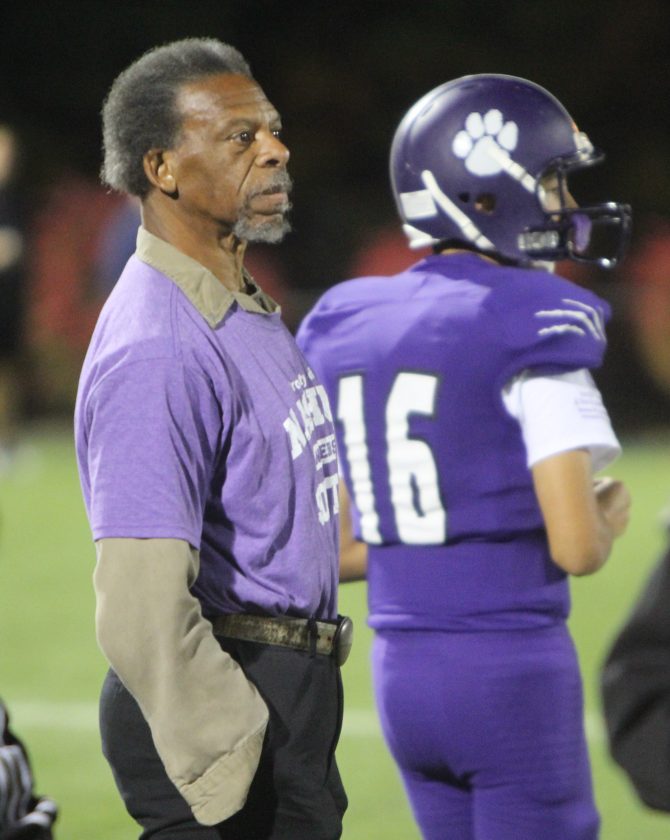
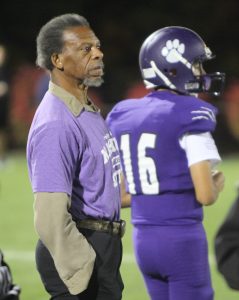
Nashua football legend Duane Briggs is shown on the Nashua South sidelines a few years ago. Briggs, his brother Al and nephew Mel will be inducted this weekend into the Lions Club Legends of Holman Hall of Fame. (Telegraph file photo byh TOM KING)
NASHUA – They were local stars, local heroes and local legends.
Three members of Nashua’s incredibly athletic Briggs family – brothers Al and Duane, plus nephew Mel – as well as the late Ed Dobrowolski, all made their mark at Holman Stadium. And all will be recognized at the city’s annual July 4 Celebration at Holman with their induction into the Lions Club’s Holman Sports Legends Hall of Fame.
And they all have a common theme of leaving the opposition in their wake as football standouts at Holman.
“It’s just nice to know that Nashua still remembers us and it’s quite an honor,” Mel said. “It’s nice just to reflect back.”
“I think it’s an honor and a privilege that people think that much of you,” Al Briggs said.
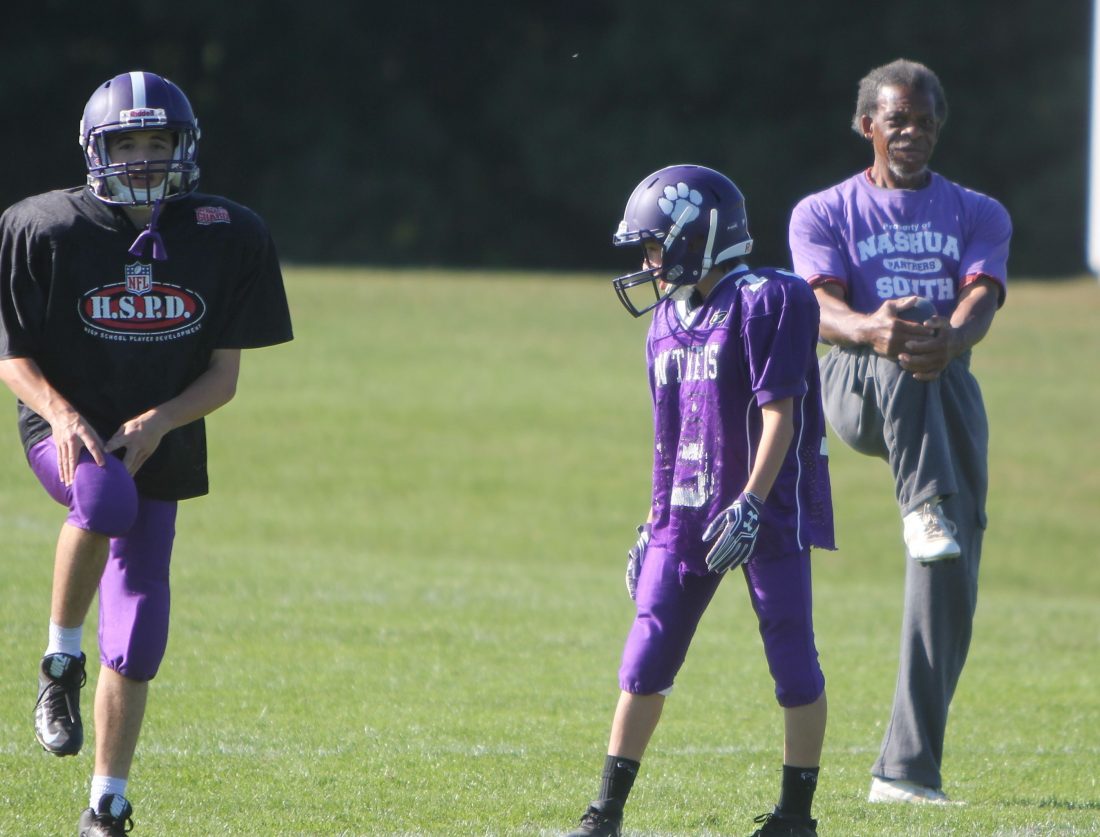
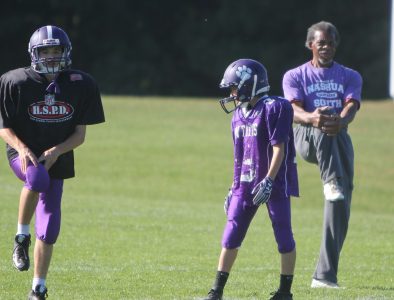
Nashua football legend Duane Briggs is shown working out a few years ago with the Nashua South football team. Briggs, his brother Al and uncle Mel will be inducted into the Holman Stadium Hall of Feme this weekend. (Telegraph file photo by TOM KING)
“I certainly appreciate their thoughts and their opinion on how I was as an athlete and a person. … It had to be one of the best things in my life as I was growing up, being a man.”
And Al Briggs took his cue from his dad, Burleigh, “who was a pretty good boxer in those days,” Al said.
“As a family, all the uniqueness, all intertwined together, everybody was happy, it was nothing but the greatest,” Duane Briggs said.
Dobrowolski starred in the 1940s, and is remembered as one of the greatest running backs in Nashua High history, a 1947 NHS graduate and a captain of the famed 1946 team that went 12-0, including a post season win against Andrew Jackson High in Jacksonville, FL. Dobrowolski had two touchdowns in that game and scored a total of 229 points during his high school career. He had 22 touchdowns in 1946, and went on to become one of the nation’s top rushers at Syracuse University.
Al Briggs was called “All American Al” for a good reason. He was an All-State player in 1957-58 and was named an All-American end in 1958. He was also a standout in baseball, track and basketball.
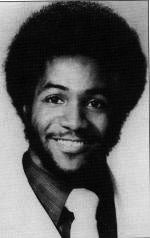
MEL BRIGGS
Duane Briggs, who still lives in Nashua, was a standout running back from the early 1960s, as well as a two-time State Decathlon champion.
He was one of the so-called “Harveymen”, playing for legendary Nashua coach Buzz Harvey and with future NFL quarterback (think Detroit Lions) Greg Landry. In his final season in 1963, the Panthers were anointed state champions by their 7-2 record (no playoff). They beat Gardner, Mass. 28-20 on Thanksgiving in his final game in which he went out with a touchdown. Briggs is definitely part of Nashua and Holman Stadium history.
His senior season, Briggs made a lot of plays. It was a year in which a game against Waltham (Mass.) was rescheduled due to rain and then canceled altogether when the country shut down due to the JFK assassination.
Mel Briggs was a 1970 Nashua grad, scored four TDs in a memorable win over Manchester Central his senior year, and was also a super track athlete. He was an All-State football player for three years, a team MVP and All-American honorable mention.
But in football he went on to play with and then coach as an assistant at Boston College and was a scout for the Pittsburgh Steelers in the late 1970s.
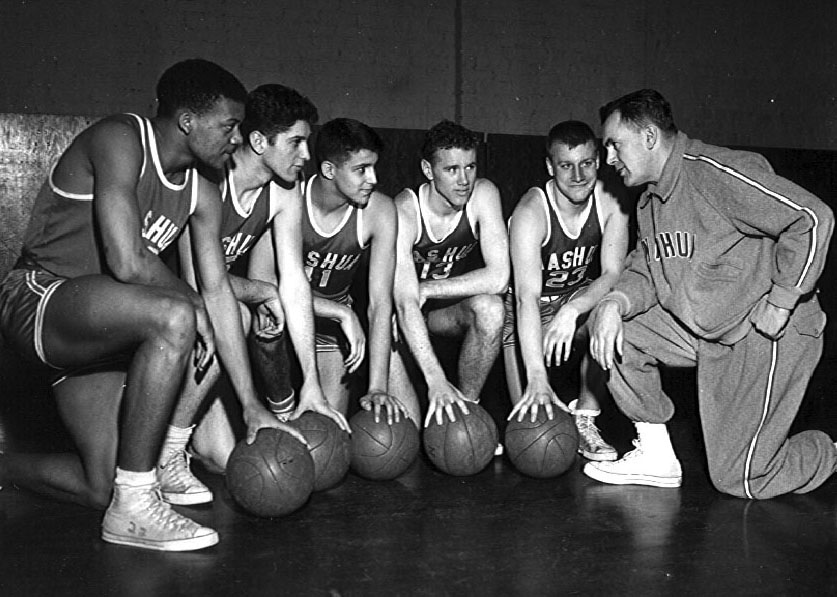
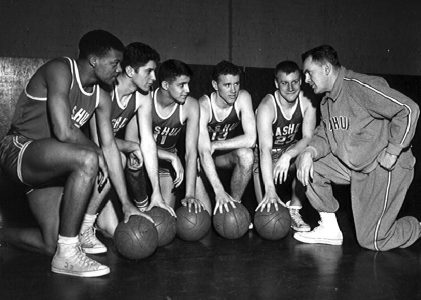
Al Briggs, left, with Coach Tony Marandos and the four other starters of the 1958 or '59 Nashua High hoop team
Mel Briggs currently lives in San Diego, and does security for baseball’s San Diego Padres. He’s at PetCo Park early to make sure everything is safe for the players; he will be with the Padres in Philadelphia this weekend and will have to miss the induction. As will Al Briggs for health reasons, as he lives in Taunton, Mass. Duane Briggs still lives in Nashua but is not likely to attend.
When Mel Briggs reflects back, he thinks of the atmosphere at Holman Stadium when thousands packed the stands.
“Oh it’s great,” he said. “We had a crowd at every home game at Holman Stadium that people would marvel at, sometimes 3,000. It was Brockton, and Lowell. … You’d come out of the locker room and come down the ramp and people would be yelling. It was just a great atmosphere that you reflect on now and say, ‘Boy, I had it pretty lucky.'”
Mel Briggs spent time as an NFL and college scout, so he has seen how things are elsewhere, where high school football is treated like major college ball.
“Holman Stadium is a special place,” Mel said. “You can go down to Texas, down to Alabama, North Carolina and places like that, but that’s all they have. Football is their lives 24-7. Nashua has a great history because it has a great baseball atmosphere as well. So Holman Stadium has a lot of character and excitement.”
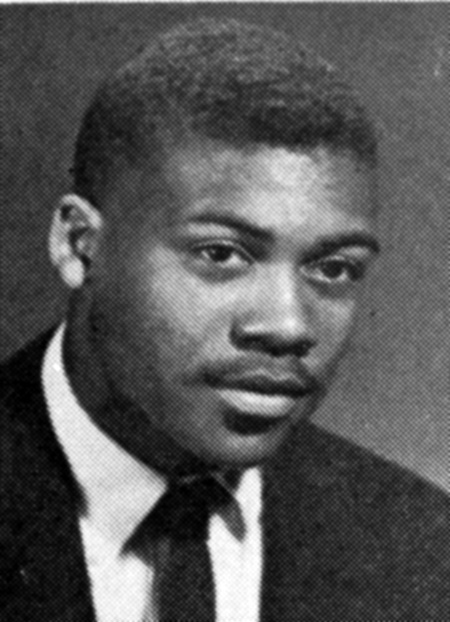
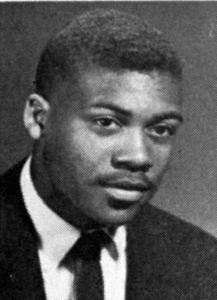
Al Briggs, Nashua High School Class of 1959 yearbook photo
Mel Briggs said his family is what got him into football, his uncles telling him about the great tradition. The competition between all the other families and players, he said, “made it fun.” So he opted in.
Of course, his uncle, Al Briggs, was an All-American. Uncle Duane Briggs was a top Decathlete. Mel said there was competition within the generations.
“There was a type of camaraderie that we had to compete with each generation, ‘I was good at that, I was good at this’. There was always that competitive edge between us, but a growing admiration as family members.”
Mel Briggs said the coaches, Buzz Harvey and Tony Mirandos, fueled the fire.
“There was inspiration enough right there,” Mel Briggs said. “Each generation Buzz taught, reverted to the next one. It was always ‘You’ve got to be better than the next relative. He did this ‘I’ve got to do that, he did that, I’ve got to do this.’ All in love.”
Harvey, Briggs said, might refer to family members, but briefly, knowing that was enough to get a response.
“Within ourselves, you’d go back and see that great big trophy Al had being an All American, that Duane had for winning the Decathlon, you’d say ‘I want one of those. I want to be better than he was, and he was good.'”
Mel said he was just elated to be able to play; he had to wait until after his freshman year (freshmen weren’t allowed) to play. When he first got out onto Holman in pads, “I was a starry-eyed, wide-eyed kid. Here was my chance to show – I had never played in front of a crowd before that. I had gone to games, used to sneak into games to go watch Nashua High play. But to play in front of a crowd like that was amazing. … The crowds, and the lights – to me it was like a million people in the stadium.”
Mel Briggs enjoyed playing running backs and returning kicks. What did it take then to make a good running back?
“You had to have moxie,” he said. “And being a small guy, I had to rely on speed. I wasn’t a big guy. But I could run, so if I had that, you could forget about a lot of the other.”
—
DUANE BRIGGS’ LOVE FOR FOOTBALL
Duane Briggs, Mel said, “was an all around athlete. He lived football. That’s all he talked about. That’s what he loved to do. He liked track, but football was his thing. He’d talk about how he’d out-maneuver a guy, or how he’d run over him if he had to. Duane was fast, but he didn’t believe in running away from people; he believed in running over people.”
And today he still looks that way. “He’s in pretty good shape for a man that never drank,” Mel said. “He’s one of those special people, that’s what it takes in order to play the game the way it needs to be played, special dedication.”
Duane Briggs said Harvey “was a great coach, I loved him, you know?” and that playing in front of the Holman crowds was incredible.
“Man, I tell you, those days the place was packed, more than the capacity of the place,” he said. “That’s what I remember.”
But Duane said he was all about “performing.” The game was the thing.
“It was the attitude ‘This team is coming,’,” he said. “And I was part of it and glad for it, you know? I was lucky and grateful that I made the team.”
Duane Briggs has a keen perspective on today’s athletes. The Decathlon he won twice, he said, is more grueling today than when he did it. He spent time with Nashua South a few years ago, often at practice during warmups and on the sidelines during games. What does he see in today’s players?
“It’s football, you know, they’re just as tough as anybody,” he said. “I don’t see anything stopping them, probably just the rules. They’re rough, tough winners.”
Briggs said he wasn’t the only one during his time who loved football as much as he did. “When I played, the ones I played with seemed like they did, too,” he said. “Every single bit of it was great – great players, great coaches, everything around me.”
He decided to try out football as he had brothers go before him. He loved it. “Once you make it, you’ve got to put everything forward,” he said.
How was he so good? “Good coaching, that’s why,” he said.
—
WISDOM OF BUZZ HARVEY
Al Briggs explained how Harvey had treated him and the rest of the players at Nashua, helping them map out their futures. “He taught us how to deal with those things,” Al Briggs said. “He couldn’t tell us where we’d end up, he’d just tell us these are the things you have to do to get there, and it’s up to you to do those things.
“I don’t know about the others, but whatever he told me worked out.”
That’s because Al Briggs went on to a career in youth services, both as a hands-on worker and also as an administrator in the Boston area. As a youth, he was never in trouble, but said he was fortunate to have adults coming up through his youth to give him a positive experience.
“Some of them really gave you a good discussion on how to live a good life,” he said. “Buzz and Tony were ones who really spoke to me and with me.”
Al Briggs’ favorite memories of Holman were similar to Mel’s – the people who came out to watch Nashua play. He said the support the starters got from the players on the sidelines was special. Combined, the two groups “made us all feel like we were No. 1s.”
Of all the sports Al Briggs played – football, baseball, basketball – football was his favorite.
“The thing that brought my potential out were the kids I played with in the neighborhood,” he said. “We’d seen each other in the neighborhood. And the parents were involved in that too. Everybody knew everybody, and talked to everybody. That’s a big part of anyone’s life, when you get support not only from your family but your community.”
Al Briggs said his state title team in 1957 didn’t really realize what they had done, saying they played as hard as they could. He remembers all the time spent with his teammates, and people, he said, “would go cross town to see each other.”
Al Briggs had a special relationship with the head coach at Lowell High School, a team he calls Nashua’s toughest opponent.
“We were always surprised when we beat them,” he said. “But it was the relationships we made with the Lowell team, not only the players but the coaches, too. I knew some of the players on Lowell like I knew them on my team. And the coaches were the same way.”
Briggs said he knew Lowell coach Ray Riddick “like I knew Buzz. … That was extraordinary.”
In fact, Lowell’s Riddick came to Briggs’ house “two or three different times, unexpectedly, and we talked a lot,” Al said.
In fact, Riddick introduced Briggs to an assistant coach at Michigan State, which was all set to add Briggs to their big-time roster.
“He thought that much of me as a person and a ballplayer, and I thought a lot of him,” Briggs said. “I didn’t know what to do when he showed up.”
And, smartly, Briggs never told Harvey. “No, I didn’t say anything,” he said with a chuckle.
Briggs played tight end on offense and played a defensive end position that played off the line, similar to today’s “elephant” position.
And yes, Briggs was set to go to Michigan State but was drafted into the Army. He was able to put off actually having to join the military until he would graduate college, but the interruption had him headed to play two years at a junior college in Dodge City, Kansas. After then he joined the service in Kansas, the Air Force – but leg injuries/conditions prevented him from passing the physical – injuries that he still lives with today as he’s basically housebound, using a walker.
Does he ever think of what would have happened had he been able to go to Michigan State? His mindset at the time, he said, was to play sports and get through school. “I would have made the football team down there and I know for a fact I would have gotten a shot at some of the pro teams,” he said.
It was a shot his nephew, Mel, got in the early 1970s.
Mel Briggs was too young to watch Al Briggs play; he did see Duane play, and he watched Greg Landry play. And then he joined Landry and Dick Jauron in training camp as a Detroit Lion briefly, in a preseason in 1974.
“You had a short time to do what you needed to do, but it was fun,” Mel Briggs said, as he played in all the preseason games but not during the regular season.
Dobrowolski actually played at Syracuse with another top former NHS athlete, Bob Young. At 5′ 9″ and 169 lbs., he went on to achieve All-American status and be called one of the country’s best, mentioned in national publications such as Colliers, Saturday Evening Post, etc.
He went on to be a rep for a major oil company, and was married to the former Anne Siergiewicz, who now lives in Rye. They met when she was a Nashua cheerleader, and as legend has it, their relationship was the subject of some newspaper stories entitled “A Feller and His Gal.
—
MEL ON TODAY’S PLAYERS
How different are the players today?
“They’re much stronger, much faster, and they’ve got more time to train,” Mel Briggs said. “Being in high school, you don’t really know. You need a person who is versed into training an athlete, into being a dominant characteristic of a player. The equipment they have is so much better; the meals they have are so much better. The things the player can put into dedicating his craft are much more available now.”
Running drills, agility, and year-round training for one particular sport. Mel Briggs ran track to become a better football player. “The training off-season was track for me,” Mel Briggs said. “I loved track.” He marveled at what Al and Duane did in track, in the pole vault, high jumping, and other events.
Those all helped with agility; that was the training for football. “They do it today, they do it in a different fashion,” he said.
Mel Briggs went on to a career in coaching (Boston College) and scouting. He would look for diamonds in the rough on the football field, and it always would bring back memories. “I’d be ‘Wow, I’m looking at this from a totally different perspective.'”
When he coached, he tried to impart what he did to become successful.
Briggs remembers one athlete he knew who came in after him at Nashua – Bill Stumpf, who helps coach track today.
“He came in with two left feet and two right arms,” Mel Briggs said. “I watched that kid blossom into one of the best players that I think I’ve seen in quite awhile. A Herschel Walker type of player who gave it everything he got… God love ’em.”
Holman history is being honored once again.
“It’s great,” said Duane Briggs. “It’s good news, and when your family hears good news, they enjoy it, enjoy it to the utmost.”
-
- Nashua football legend Duane Briggs is shown on the Nashua South sidelines a few years ago. Briggs, his brother Al and nephew Mel will be inducted this weekend into the Lions Club Legends of Holman Hall of Fame. (Telegraph file photo byh TOM KING)
-
- Nashua football legend Duane Briggs is shown working out a few years ago with the Nashua South football team. Briggs, his brother Al and uncle Mel will be inducted into the Holman Stadium Hall of Feme this weekend. (Telegraph file photo by TOM KING)
-
- MEL BRIGGS
-
- Al Briggs, left, with Coach Tony Marandos and the four other starters of the 1958 or ’59 Nashua High hoop team
-
- Al Briggs, Nashua High School Class of 1959 yearbook photo