THE FOOTBALL REBUILD: Most coaches have a solid plan
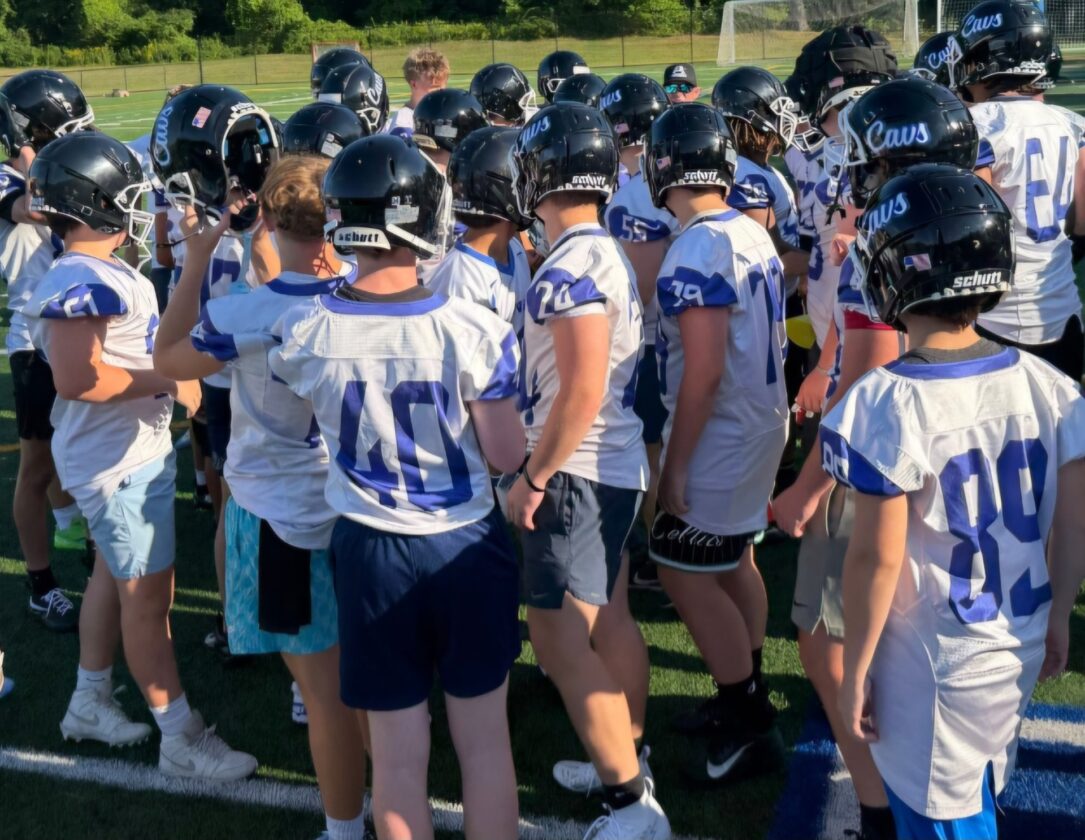
Hollis Brookline has gotten its numbers back up to a competitive level under second-year head coach Pat Gendron. (Courtesy photo)
They may be the perfect example of how to rebuild a high school football program.
Can we look no further than Hollis Brookline? Perhaps, as the Cavaliers have more than doubled their numbers from a year ago under second year head coach Pat Gendron.
And when Gendron was hired in January of 2025, there were 15 active players on the roster. At the start of this year’s preseason camp, he had 59 signed up.
Amazing.
“Patrick’s done a great job at Hollis,” Souhegan coach Robin Bowkett said. “Rebuilding the culture. That’s what you want. It’s always better in the local area when Milford, Hollis and Souhegan are all competing and really good. It makes it way more fun.”
What’s the first step? Gendron was asked that during his interview for the position nearly two years ago.
“It’s create relationships,” he said. “Everywhere, whether its an admin, custodians, the athletic trainer, coaching staff, youth program.
“Then after that it’s to make football the best part of a kid’s day. They go home and say, ‘That was awesome.’ If it’s ‘I can’t believe I have to go back there’. That’s not how you’re going to get kids.’
“We knew by all means we had to get players.”
How to do that? Connect with the youth levels/feeder programs, which for HB had suffered after COVID. Then word was the participation levels were up, and Gendron has a couple of assistants who work with the youth programs.
“I also knew the health of the youth program was in good shape,” Gendron said. “I saw there could be potential for growth here. So we’re excited to build it and start a new foundation.”
Gendron had all sorts of off-season activities. He wants multi-sport athletes but if they had the time to come out in the winter, spring and summer, they were welcome.
“We want them going home excited about football,” Gendron said. “They’re excited to come back next year. We want to build it, make it as fun as possible. That doesn’t mean we’re playing “Duck, Duck, Goose” but we’re competing for things we do and having the kids buy into it.”
Nashua South coach Josh Porter hasn’t had to rebuild, although his predecessor, longtime coach Scott Knight, did, and the way he did it was to absorb the hit by playing freshmen and sophomores knowing it would pay off later.
Porter has a plan in case he’s ever in that situation.
“First and foremost is starting with your feeder program,” he said. “You have to shore up your feeder program to make sure kids are learning football before they’re getting to you.”
North coach Chad Zibolis is a huge proponent of that. North players tended to go through the Nashua Cougars program, and Zibolis is at those practices a lot. “That youth program has been running our system the last few years,” he said. “And we’re really starting to see that now. … You really do have to start at the youth level, you really do. And I’m not saying kids have to be playing tackle football at the third grade level. I go to their practices every night and you see the third through sixth working fundamentals, fundamentals, fundamentals. And then you’ve got the seventh and eighth grade team still working the fundamentals, but they’re running our type of offense, using our lingo. So when they get to us, they’re ready to go.”
Porter invited middle school players to work out with the South players in the summer activities (7 on 7s, etc.) “just to build a relationship with them.”
Step one. Step two? “From there,” Porter said, “You’ve got to recruit the building. You build relationships within the building, but you need your players recruiting for you.”
Yes, that’s the key. After one Hollis Brookline practice two years ago, interim coach – and program founder – Milt Robinson implored his players to invite any of their friends to come to practice, etc. Numbers were that low.
“I tell our guys,” Porter said. “It’s one thing for me to constantly asking a kid to come out and play, but when their friend is doing it, they’re more likely to come. Our guys really bought into that and that’s why we have 25 seniors this year. Some are first-timers but they’re good athletes.”
That’s the philosophy Alvirne coach/AD Justin Hufft made sure to have when he took over last year – up the total of multi-sport athletes in his program. So far, it’s working. “Some are coming back (to football), some have never tried it before,” Hufft said. “It’s two-fold – it’s not easy…. We’re looking for kids who are looking for a challenge, we’ll provide that. You have to make it so it’s worthwhile. … It’s getting them in, being able to attract them to the program, but it’s high standards.”
Let them learn, explain that it may not come easy right away, and at the same time make it fun. “It’s not easy,” said Hufft, who has rebuilt a couple of programs along the way. “Some days you get stuck between both worlds.”
Merrimack may have as many as 30 freshmen as school is now underway.
“The kids that play when they’re younger, making sure you retain them,” ‘Hawks coach Kip Jackson said, “as well as obviously increasing the numbers. But the kids are really the ones who recruit the other kids. That’s what happened when we first got here. The kids were
really good at getting other kids to play. We just have to get back to that.
“It’s slipped. Just in general, kids don’t want to do anything that requires a huge time commitment, and that’s a challenge.”
The other key obviously is the weight room. Once you get the players, they need to get stronger. You can put a young team o the field, but as one coach said, “You’re going to have 14-year-olds playing against 18-year-olds, there’s going to be a physical difference.”
The weight room changes that eventually, but it goes back to kids recruiting kids.
“Good programs, coaches lead; elite programs, the players lead,” Porter said. “When the players are holding each other accountable to be in the weight room for months ahead of time, you’re in a good spot.”
Bowkett remembers when he first took over the program a decade ago, he was recruiting the hallways.
“You’re building relationships,” he said. “Your current players are often your best recruiters, so if you’re current players are like ‘Coach is awesome, do you want to be a part of it?’ … People want to be a part of something bigger than themselves. Obviously winning helps. Having great players helps. But as you do that, your players are telling their friends, ‘Bro, you’ve got to come out, this is so much fun.'”
Bowkett hates the word ‘rebuild’.
“It’s not fair to the seniors who’ve been doing it; we just tell them it’s a rebuilding year so what, we’re not going to work as hard?” Bowkett said. “The standards at our place never change, regardless of whose playing…
“If the kids are having a great experience playing football, word is going to travel.”
Campbell in Division III will face a rebuild in the next couple of years because the sophomore class football numbers are very low. Head coach Glen Costello actually now has a job in the building, “and I talked to every possible kid there was. … At the end of the day, if a coach is recruiting a kid, I don’t think that’s much of a motivator nowadays.”
Costello says kids are being pulled in “a million different directions” making the job more difficult.
The goal, Gendron said, is to turn HB “into a competitive, sustainable football culture” that is fun for the players.
“We may not have seen the numbers we wanted on the scoreboard last year,” Gendron said. “But when we see the numbers return, that shows we’re doing something right.
“Who knows. School starts and maybe we’ll pick up a couple more.”
He had wide grin when he said it.