Winter Olympics: Tough day for Shiffrin; U.S. Curling makes history
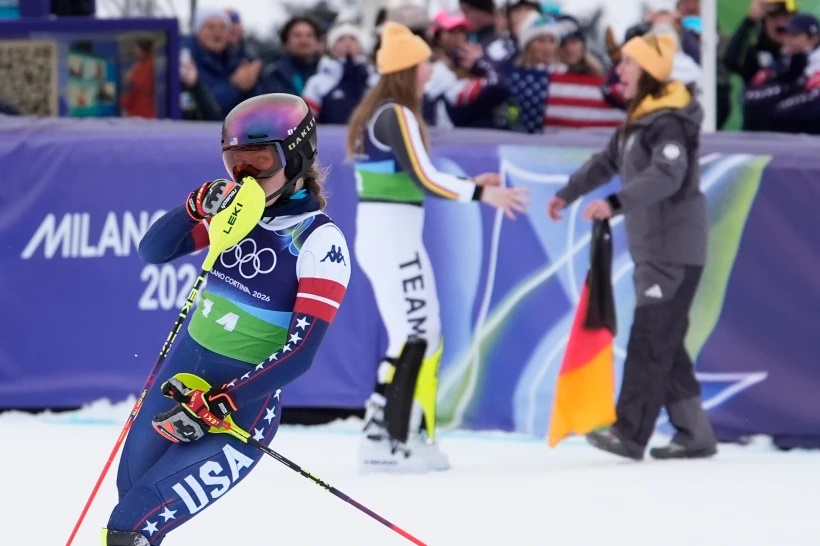
U.S. skier Mikaela Shiffrin reacts to a tough run during Tuesday's Winter Olympics in Italy. (AP photo)
CORTINA D’AMPEZZO, Italy (AP) — Mikaela Shiffrin didn’t offer any excuses. No sense of anger, frustration or tears for that matter, either.
The most decorated slalom racer in history could tell the snow under her skis didn’t feel right to her as she made her way down the Tofane course in the first Olympic women’s team combined event on Tuesday.
Something about the feedback she was getting seemed … off.
By the time Shiffrin crossed the finish line, the slim lead Breezy Johnson handed her after a brilliant and gutsy downhill was gone. So was a shot at the gold, which went to the Austrian team of Ariane Raedler and Katharina Huber.
Silver and bronze disappeared, too, with fellow Team USA members Jackie Wiles and Paula Moltzan holding off their two friends for third to earn the first Olympic medals of their lengthy careers.
Shiffrin’s been doing this a long time. She knows these things happen. Yet for Shiffrin, they have typically come in training. The only time they seem to pop up in competition is at the Olympics.
Four years removed from a forgettable two weeks in Beijing when she went 0 for 6 and failed to even reach the finish line three times, Shiffrin’s fourth Olympics began with a run that started slow and never came together. She lost time at every checkpoint, sending her and Johnson sliding down to fourth.
How sluggish was Shiffrin? Her time of 45.38 was 15th fastest out of the 18 skiers who reached the bottom. For comparison, Shiffrin hadn’t finished that low in an individual slalom she finished since 2012, when she still was a teenager and her rise to three Olympic medals and a record 108 World Cup titles (and counting) was still beyond her wildest dreams.
“There’s something to learn today,” Shiffrin said. “I’m going to learn it.”
It wasn’t a confidence issue. Shiffrin took the chair lift up to the top of the course inspired by Johnson, who backed up a gold-medal performance in the women’s downhill on Sunday by storming her way to the front to give Shiffrin a slim lead of .06 seconds heading into the slalom.
Shiffrin, who knows a thing or two about attention, marveled at Johnson’s ability to focus given the whirlwind that comes when you break through at the Olympics. She leaned forward at the start intent on giving Johnson her second gold in 48 hours.
Down at the finish, Wiles and Moltzan sat in third torn between rooting for their teammates and dreading having a medal snatched away by the best to ever do it.
“We were asking for a miracle,” Wiles said.
They got one. Shiffrin stood in the finish area after her time was posted and was immediately embraced by Johnson. Hugs with Moltzan and Wiles — well aware of the bullet they dodged — soon followed.
“I think if you let Mikaela go run that course (again), I think she’d come down at least a second (faster),” Moltzan said.
Only she didn’t. Not this time anyway. Whatever personal disappointment Shiffrin might have felt was offset by watching two friends she’s skied alongside for the better part of two decades have their Olympic moment years in the making.
Wiles, who cried while talking to the media after a fourth-place finish in the downhill, became the oldest woman to medal in an Alpine event at 33 years, 7 months.
“There’s so much sweet about the day,” Shiffrin said. “So we’re taking that and I will have some learning to do like always.”
She always does. Shiffrin expressed confidence coming into Cortina and with good reason. Shiffrin arrived at the snow-capped Dolomite mountains having already secured her record ninth World Cup season title in her signature discipline thanks to seven victories that have offered tangible proof she remains as dominant as ever at 30.
Shiffrin was careful to not put too much pressure on herself, having learned that every Olympic experience is different. There was joy at the 2014 Sochi Games and in Pyeongchang four years later. There was dismay in China after her ambitious schedule was pockmarked with baffling DNFs that left her sitting in the snow wondering what went wrong.
The spotlight she commanded in Beijing isn’t quite so bright this time around, thanks in part to the return of Lindsey Vonn. Shiffrin also took a more calculated approach to Cortina, limiting herself to the team combined, giant slalom and the slalom.
The media area that was packed to watch Vonn in the downhill was a little more roomy on an overcast afternoon. When Shiffrin crossed the line, there wasn’t a collective groan from the grandstand but shouts of joy from the winners nearby.
Shiffrin will spend Wednesday recovering. On Thursday, she’ll point to the rest of an Olympics that may still have plenty to offer. Just not on Tuesday, when the comfort level she needed to get to full speed never arrived.
“I’m going to have to learn what to do, what to adjust in the short time we have before the other tech races,” she said. “There’s always something to learn.”
HISTORIC EFFORT FOR U.S. CURLING
At one end of the ice was the brother, pumping his fists. At the other was the sister, jumping up and down with her broom in her hand and a look of disbelief on her bespectacled face.
Isabella and Rasmus Wranå, Sweden’s first-ever team of siblings at the Winter Olympics, won gold in mixed doubles curling on Tuesday night, beating U.S. pair Cory Thiesse and Korey Dropkin.
The Wranås persevered through a nailbiter of a championship game in front of a spirited, pro-U.S. crowd and pounced on an opening left by the Americans in the last end. Isabella threw the winning stone and hunched close to the ice, watching her brother sweep until their red stone knocked out the Americans’ yellow rock for a 6-5 victory.
For the Americans, just making this far was historic. They became the first U.S. team to medal in Olympic mixed doubles, and Thiesse is the first American woman to medal in Olympic curling.
The Wranå siblings grew up as rivals and were coached by their father, Mats Wranå.
Throughout the match, the Wranås enjoyed a somewhat silent camaraderie with their small contingent of fans. The two remained stoic while Dropkin played to the crowd, whipping up the loud American supporters.
The Wranås won the world title in 2024. Thiesse and Dropkin won at worlds a year earlier.
The Swedish duo started their Olympic bid on stumbly legs, losing three games in a row in the round robin. The skid prompted the Swedish media to label their Olympic bid a “Curlingfiasko.”
But they managed to turn it around and won most of their remaining matches.
It was a heartbreaker for the Americans, who enjoyed roaring support. An American curler screamed from the rafters, “Show me your biceps!” Dropkin obliged.
Thiesse and Dropkin are based in Duluth, Minnesota, and have full-time jobs. Thiesse is a lab technician and Dropkin a real estate agent. Dropkin is engaged and Thiesse is married.
They were classmates in college. Dropkin asked Thiesse to be his mixed doubles partner after a failed qualification run for the Beijing 2022 Games. She agreed and they were world champions a year later.
Italy wins bronze
Italy’s Stefania Constantini and Amos Mosaner won bronze, defeating Britain 5-3.
It was a bittersweet result for the Italians, the defending Olympic champions whose fans packed the stands throughout the round-robin in hopes to see a repeat. And it was devastating for the Brits, Jennifer Dodds and Bruce Mouat, who were expected to make the final after exiting the round-robin with the most wins of any pair.
They faltered against exacting throws from Mosaner and Constantini, who hails from Cortina and has become a darling of this stadium. The British duo walked off the ice dejected.