March Madness and its brackets are back in business
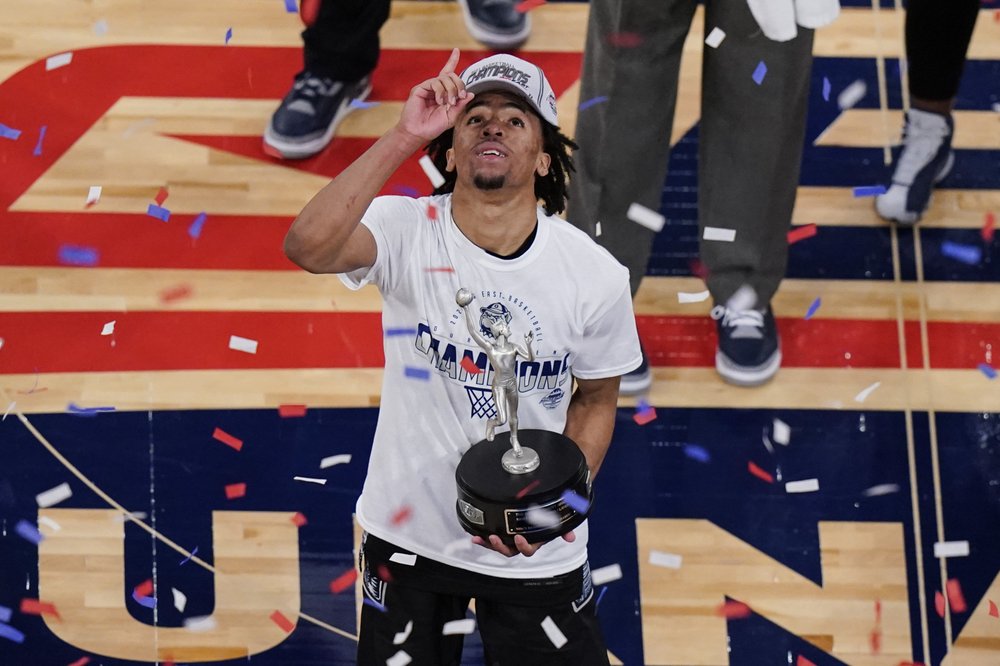
Georgetown's Dante Harris celebrates while holding the Most Outstanding Player trophy after the game gainst Creighton in the championship of the Big East Conference tournament Saturday. (AP photo)
The biggest unknown leading into a March Madness bracket reveal more than a year in the making had little to do with bubble teams or top seeds. Instead, it was the not-so-simple matter of which programs would be healthy enough to play.
Kansas and Virginia, two programs hit with COVID-19 breakouts over the past week, made it into the bracket released Sunday by the NCAA selection committee, signaling both teams believe they’ll have enough healthy players to be ready for their tip-offs next weekend.
That there was any doubt about the Jayhawks and defending champion Cavaliers securing spots in the 68-team tournament was the most jarring reminder that the 2021 tournament itself is no sure thing.
“There were a lot of different things about this year’s selection process,” said committee chairman Mitch Barnhart, the athletic director at Kentucky.
A year after the tournament was canceled as the COVID-19 virus was mushrooming into a worldwide pandemic, all 68 teams will gather in Indiana for all 67 games beginning Thursday and ending April 3 and 5 with the Final Four. But all it takes is a single COVID outbreak to upend the finely calibrated beauty of that plan. More than one and the entire endeavor could crater.
There were no surprises among the four No. 1 seeds. Gonzaga, Baylor, Illinois and Michigan earned those slots – with the Bulldogs the 11-4 favorite to win it all and become the first team since the 1976 Indiana Hoosiers to finish a season undefeated.
The last teams to earn the 37 at-large bids — one more than usual because the Ivy League canceled play this year — were Drake and Wichita State, which play Thursday in a First Four game, and UCLA and Michigan State, two decorated programs with surprisingly low seeds that meet in another play-in game.
“Heck of a game to start the tournament,” Barnhart said, with tongue in cheek.
Four teams that didn’t make it — Louisville, Colorado State, St. Louis and Mississippi — have been put on stand-by. They could find their way into the bracket if a team in the field notifies the NCAA by Tuesday night that it must withdraw because of health concerns. After that, if a team pulls out, its opponent will advance via what is essentially a forfeit.
Fittingly for such an unpredictable season, some teams hoping to sneak in off the bubble were denied when Oregon State and Georgetown — coached by its own former superstar, Patrick Ewing — won their conference tournaments to steal bids they wouldn’t otherwise have won.
Another unexpected entry is a familiar face: Rick Pitino. The coach, ousted at Louisville after a sordid recruiting scandal that enveloped the program for years, led his new team, Iona, from the ninth seed in the Metro Atlantic Athletic Conference all the way to the league title and the automatic bid that comes with it. The Gaels open Saturday against Alabama. Iona played only 13 regular-season games because of COVID-19 concerns that sidelined the Gaels for weeks. It was that kind of season.
And if hoops fans needed any more evidence of how unfamiliar this tournament will feel, maybe it’s this: For the first time since 1976, Duke and Kentucky will both be missing from the tournament. Like Virginia and Kansas, Duke pulled out of its conference tournament last week because of COVID-19. The Blue Devils announced that marked the end of their season, before telling the NCAA that, yes, they’d be available for March Madness if asked. But no dice. The 13-11 record wasn’t enough.
Virginia and Kansas were never in doubt until the coronavirus hit both programs. The Jayhawks (20-8) will bring a No. 3 seed into the tournament’s West region — the NCAA stuck with the usual names of the regions — while the Cavaliers (18-6) will be a 4 seed in the same part of the bracket, and come in as the most unusual of defending champions.
They won it all in 2019, and were poised for the run at a repeat last March when sports got wiped off the map by the still-nascent pandemic.
A year later, sports are back, but the hoops the NCAA is jumping through to make this tournament go are a symbol of how far we are from normal.
The decision to place all the games in and around the Indianapolis area is a first-of-its-kind move. Also unique are the quarantine-like situations all teams will be under during their stay. Players will get their own rooms and teams will have their own floors in a cluster of hotels around the downtown convention center. That facility, usually a magnet for fan fests and coaching conferences, will turn into the main practice and meeting area for all the teams. Players will have to produce negative tests for seven days before arriving in Indianapolis to be eligible to play.
And if they’re not? In one of its most eye-grabbing tidbits, the NCAA announced that if a team is hit with the virus but still has five players who can pass the protocol, that’s enough to get on the floor for tip-off.
All just another piece of the puzzle for Americans to consider when they get back to a much-missed rite of spring — filling out their brackets, crossing their fingers and waiting for madness to begin.
STAR POWER
The NCAA Tournament was filled with plenty of star power the past few times it was played, from Trae to Ja to Zion.
This year’s bracket will be no different.
Iowa’s Luka Garza is an All-American, a front-runner for national player of the year and a dominating force.
Oklahoma State’s appeal on a NCAA-mandated postseason ban has not been been resolved, which means college basketball fans get to watch what Cade Cunningham can do in March. The dynamic freshman point guard was clutch during the regular season and could do something special in the NCAA Tournament.
Speaking of clutch, Gonzaga’s Jalen Suggs seems to play his best when the pressure’s on, like he did in the WCC Tournament final against BYU. The former high school quarterback doesn’t play like a freshman.
Put Illinois’ Ayo Dosunmu in the same category. He’s confident, athletic and loves pressure situations.
Southern California’s Evan Mobley can dominate at both ends, a big reason the 7-foot freshman is projected as the No. 1 overall pick on some NBA draft boards.
FIRST FOUR SCORE
The First Four games are usually filled with small-conference teams playing against schools from larger conferences that sneaked into the bracket.
This year’s opening set of games includes two of college basketball’s marquee teams squaring off: Michigan State and UCLA.
The Spartans have played in eight Final Fours under coach Tom Izzo, but appeared to be headed for an NCAA Tournament-less offseason after a stretch of seven losses in nine games.
Michigan State (15-12) pulled it together just in time, capped by a win over East Region No. 1 seed Michigan to close out the regular season.
UCLA (17-9), the all-time leader with 11 national championships, appeared to be in good shape heading into the final month of the season, but closed it out with four straight losses to teeter on the NCAA Tournament bubble.
The First Four is always fun and this one will be worth tuning in to.
MUST-WATCH GAMES
The Michigan State-UCLA First Four game kicks things off right, but there are plenty of other must-watch games (aren’t they all this time of year?).
If you like fast-pace, high-scoring games with lots of 3s, be sure to tune in to the South Region opener between No. 3 Arkansas and No. 14 Colgate on Friday. Whatever the over is, take it.
Villanova is typically a favorite to make a deep run in March. Injuries, particularly a season-ender to point guard Collin Gillespie, have turned the Wildcats into a popular pick to be upset by Winthrop in the South Region. The Wildcats still have plenty of talent, but the Eagles lost just one game all season and have shooters all over the floor.
Clemson has the higher seed at No. 7 in the Midwest Region, but No. 10 Rutgers has been pegged as the betting favorite. Oddmakers are expecting the Scarlet Knights to make the most of their first NCAA Tournament appearance in 30 years, so that could be one worth keeping an eye on Friday.
SISTER JEAN RETURNS
Sister Jean became a fan favorite in 2018 when she followed Loyola Chicago all the way to the Final Four as a No. 11 seed.
Now she’s back and so are the Ramblers.
Loyola Chicago clinched its first spot in the field of 68 since that magical run with a 75-65 win over Drake in the Missouri Valley Conference title game.
Sister Jean would like to join the Ramblers in Indianapolis.
The 101-year-old team chaplain has already received the COVID-19 vaccine and, though she wasn’t allowed to attend MVC Tournament games, is hoping to get clearance from the NCAA.