
Much ado about nothing: The real potential concerning black hole breakthrough
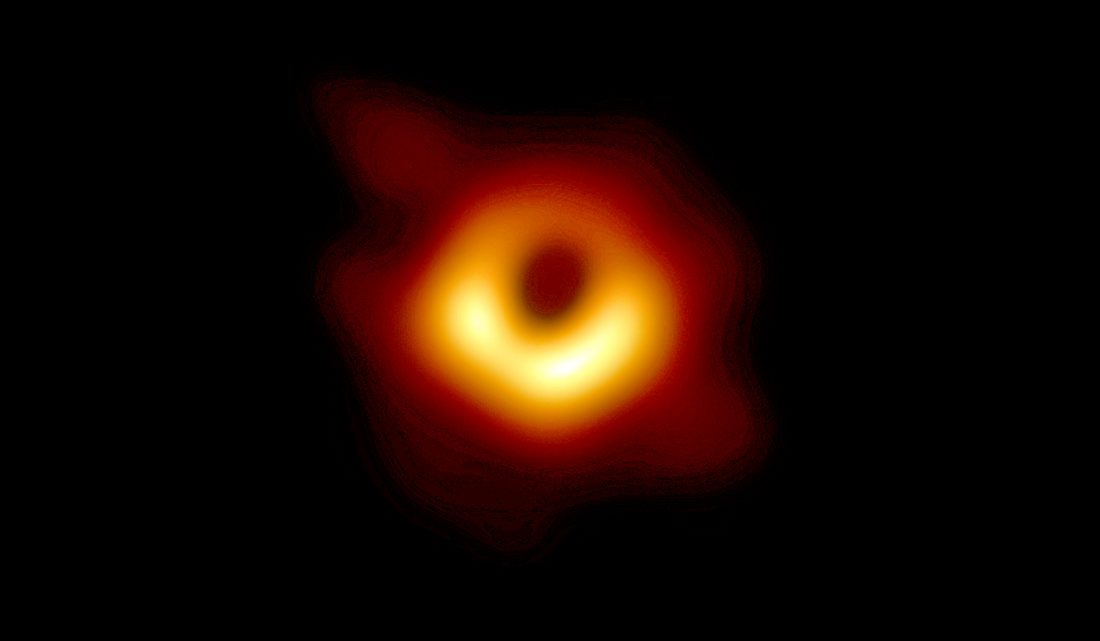
This false-color image released Wednesday, April 10, 2019 by the Event Horizon Telescope shows a black hole at the center of the Messier 87 galaxy. Scientists revealed the first image ever made of the mysterious stellar phenomenon after assembling data gathered by a network of radio telescopes around the Earth. It is located about 53 million light years away. (Event Horizon Telescope Collaboration/Maunakea Observatories via AP)
“I am not afraid to be a pioneer. When a door is ajar, you need to open it fully. And once you are in that room, you need to see what other doors there might be and where they might lead.” – Gurinder Chadha
Pioneers teach us to think outside the box. They are driven by “What if?” curiosity, often sparked by puzzles, ideas that do not make sense to the “untrained” mind.
Such was the case for 10-year-old Nassim Haramein, growing up in Montreal, the son of an Iranian father and an Italian mother. For young Nassim, the catalyst came in Geometry class. The teacher put a dot on the board and said: “That’s dimension zero – it doesn’t exist.” Then, he put a few dots on the board and said, “That’s the first dimension. It doesn’t exist.” Then he drew four lines, and created a plane and said, “That’s the second dimension. It does exist.” Finally, he created a box with six planes and said: “That’s the third dimension, which encloses a volume that makes up reality.”
Haramein recalled: “I was puzzled and totally disappointed. From the back of the class, I could clearly see the dot ‘that didn’t exist.’ It didn’t make sense to me that dots and lines that didn’t exist created something that did exist. I remember deciding then and there that I needed to understand reality better.”
Not surprisingly, that quest took Haramein, a severe dyslexic, outside conventional education. He quit high school as soon as Canadian law would allow to pursue a career in sports, as a ski instructor and mountain guide, a career which allowed him the unfettered opportunity to observe, learn and question nature itself.
Fascinated by the repeating geometric patterns he saw everywhere in nature, in snowflakes, leaves and trees, Haramein surmised this organization was far from random, that “some mechanism…makes it possible for everything to communicate with everything else and to self-organize…an underlying structure that was highly coherent at the base of the natural world – from the atomic level to the biological and the astronomical.”
Common sense told Haramein that the dot was, in fact, the only thing that did exist. Imagining he was a bird flying high over his house, he saw that his house had become a dot – and then looking from higher up, the earth becomes a dot, and then even a galaxy. On the micro-level, a cell is a dot, and so is a molecule, an atom and a subatomic particle.
What if what mattered was not the dot, but the spaces between the dots? What if space itself was an information-carrier, the great connection between all things? What if space defined matter rather than matter defining space? Eventually, Haramein traded in his skis, bought a van, and filled it with all the books he could gather on philosophy, physics, mathematics, chemistry and spirituality. For five years, he lived in a van in the mountains on an annual budget of $2,500, money he earned as a mountain guide, reading when he was not hiking.
Obsessed by the idea of “empty” space, of nothingness, Haramein pondered the idea that a vacuum actually contained something. But when physicists measured the energy density of a vacuum and found it measured 1093 grams per cubic, this contradictory idea did “fit” the popular paradigm and so was disregarded by many physicists.
Instead of rejecting the idea, Haramein embraced it, swimming upstream against all conventional thinking in his field. Why, or how, did a vacuum – that was, in fact, dense with something – appear to be nothing? This paradox made Haramein surmise that it must be in perfect equilibrium. What about spin? If everything from the rotating globe, to the smallest atom is actually spinning, where does that energy come from? Haramein surmised that spin was being generated by subtle fluctuations in the vacuum. In the 1990s, precise instruments indeed showed there is a spin force produced by the energy fluctuations in a vacuum.
For two decades, Haramein has been arguing that there must be a singularity at the center of every galaxy from which information was spinning in and out, resembling pictures we see of swirling galaxies, a hypothesis that got him kicked out of some physics conferences.
Better telescopes have now confirmed there is a black hole at the center of each galaxy. Haramein believes there is a black hole at the core of each atom, that maybe the proton in the nucleus of the atom is the “exchange mechanism” with the vacuum, the place where information is stored. And if the energy of the vacuum carries the information of all protons in the universe, in one proton, maybe “all the information is holographic.”
Haramein lives on the Hawaiian island of Kauai where he founded the Resonance Project, now supported by substantial sponsors indicative that mainstream science is starting to take notice. The next question is if, indeed, there is energy and information in the vacuum, how to extract it?
Just this month, a consortium of astronomers confirmed the first photograph taken of a black hole, based on two years of collating data from eight radio telescopes located around the globe – Chile, Mexico, Spain, Hawaii, Arizona and the Antarctic. Shep Doeleman, Harvard University senior research fellow and director of the Event Horizon Telescope, announced at Washington’s National Press Club: “We are delighted to report to you that we have seen what was thought to be unseeable. We now have visual evidence. We know that a black hole sits at the center of the M87 galaxy. This is the equivalent of being able to read the date on a quarter in Los Angeles, standing here in Washington, D.C.”
Back to nothingness. For most of the last century, physicists determined the necessity of ever more powerful particle-splitters to “get to the nature of matter” only to find that there are ever smaller particles – assuming that matter itself was the most important thing to study. What if, instead, we have been studying the wrong thing for decades because we have been too attached to our own arrogance, assuming that what we believe we know is absolute truth?
Haramein: “Our challenge is to build the right ‘radio.’ Nobody can see radio waves. But they are there, and when you have the right machine, you can tune in and you hear music. This challenge is exactly the same. The energy is there. We just need to ‘tune in.'”
Hence, the name of his Resonance Project. “If you know the dynamics of the vacuum, how the protons spin, how they self-organize to produce mass or energy, you have a road map to build a device that could artificially reproduce the energy.”
Tapping into energy that has been there all along, like the air we breathe. Tapping free energy from nothingness could revolutionize the hierarchy of need built on the global reality of limited resources.
Much ado about nothing? In fact, the significance of nothing could be everything.
For more information, see Haramein’s TEDx Talk, The Connected Universe.
Quincy Whitney is a career journalist, biographer and poet. Contact her at quincysquill@nashuatelegraph.com, or at quincy@quincywhitney.com.
Local Commentary
How did you celebrate the new year?
Well, the sun again revolved around the earth as we bid goodbye to the year 2025 a couple weeks ago and welcomed in ...
Supporting our neighbors and strengthening our community
Imagine a community where every child starts the school day with a full belly and a full backpack – and every ...
