Lessons of the Holocaust more important today than ever, speakers tell gathering at Nashua memorial service
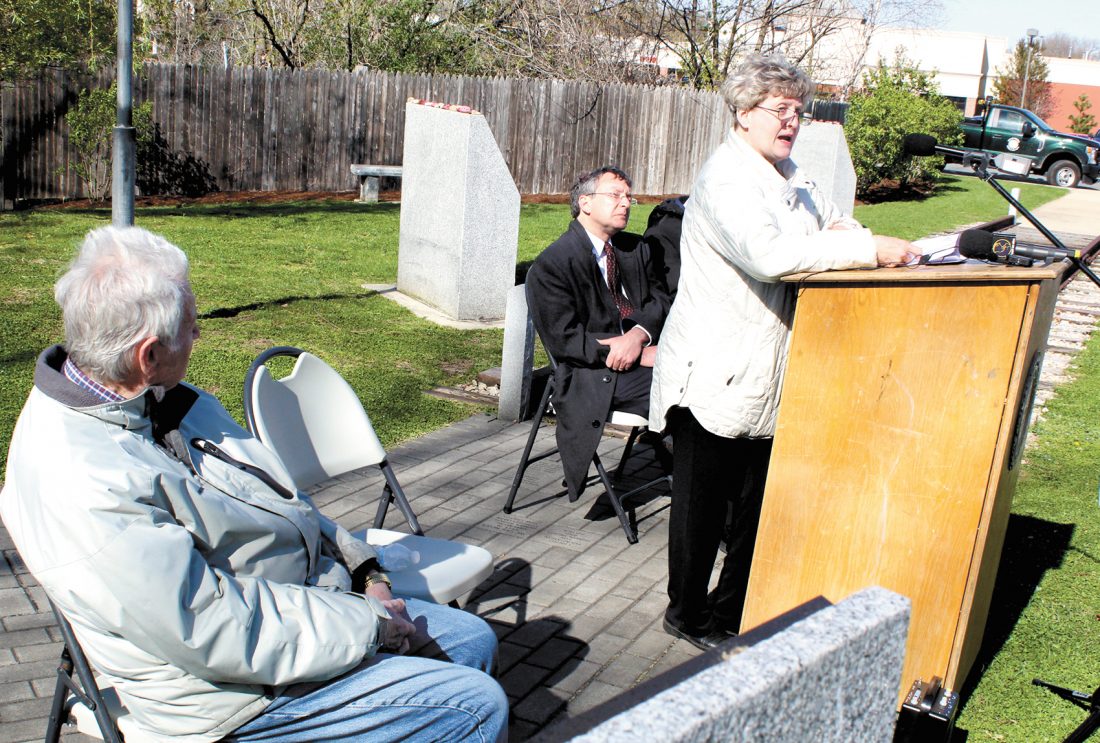
Carol Babel, a former Nashua resident who is descended from Ukraine immigrants, addresses attendees to Thursday's Yom Hashoah observance at the New Hampshire Holocaust Memorial in Nashua. At left is Fred Teeboom, who created the memorial; Temple Beth Abraham Rabbi Jonathan Spira-Savett, right, also spoke at the event.
NASHUA – Carol Babel, a former Nashua resident and second-generation American whose ancestors came from the Ukraine, recalls in detail a chance encounter with an elderly woman while both were visiting Israel some 15 years ago.
“I was in the pool area of the hotel where my group was staying and we got to talking,” Babel said of the woman, who was from New York City and was vacationing in Israel with her husband.
“Have you ever been to the Holocaust Memorial here (in Israel)?” the woman asked Babel. “Our group is going there tomorrow,” she responded.
The woman paused briefly, then held up her arm “and she rolled it over, so I could see,” Babel recalled.
“Do you know what this is?” the woman asked Babel.
She did.
“I wanted to cry. I wanted to hug her, but … we talked for a good hour,” Babel said Thursday afternoon, speaking as loudly as she could through a stiff, gusty wind without the aid of a microphone.
Babel, who was among the speakers at Thursday’s Yom Hashoah (Holocaust remembrance day) program at the New Hampshire Holocaust Memorial in Nashua, recalled the woman showing her the tattoo that she, and millions of other Jewish folks, many of them imprisoned in Nazi death camps during World War II, were forced into have burned into their arms by the Nazis.
That she happened to meet a survivor of the infamous Auschwitz concentration camp on the eve of her planned visit to Israel’s Holocaust Memorial is a memory Babel said will always stay with her.
For a number of years, Babel has been a summer missionary to Ukraine, traveling there to teach at a summer sports camp that accepts children and youth of all religions. Because it is free, the camp attracts children from low-income families and those experiencing poverty, which babel said is widespread in many parts of Ukraine.
Babel said she wasn’t able to go in 2020 due to COVID-19 related travel restrictions, and this year is in doubt due to the Russian invasion.
“The kids really look forward to these camps,” she said. “I’m not sure we’ll be able to hold the camps this year,” she added, noting that she typically arrives there at the end of April.
Babel was the keynote speaker at the roughly 90-minute program and remembrance service organized by longtime Nashuan Fred Teeboom, who about a decade ago brought to fruition an ambitious plan to install the state’s only public Holocaust Memorial, which is adjacent to Rotary Common Park off Main Street just south of Lake Street.
Also on the speaking program were Temple Beth Abraham Rabbi Jonathan Spira-Savett and Mayor Jim Donchess, who, like the other speakers and the 50 or so observers, braved weather conditions more like the beginning of March than the end of April.
“This year we are gathering (for Yom Hashoah) while across the world, once again atrocities are taking place,” Spira-Savett said.
He referred to the Russian invasion of Ukraine, citing, as the other speakers did, the similarities between the Nazi invasion of Germany’s European neighbors and Putin’s aggression against Ukraine.
Donchess called Nashua “fortunate” to be the home of the only public Holocaust Memorial in the state, and credited Teeboom for his efforts in making it a reality.
But while Greater Nashuans “are fortunate to be able to gather here, so many (people) around the world are not as fortunate. They’re facing terror, displacement and genocide – still now, in the 21st century,” Donchess said.
The Holocaust must “always be remembered” for its atrocities, and “we must use the Holocaust as a lesson we pass on to our children and grandchildren.
“Those who wish to stifle the teaching of history’s dark chapter are only enabling those kinds of atrocities to reoccur,” Donchess told the group.
Teeboom, 83, who was born in the Netherlands, was a child when he was rescued from the Nazis by “very brave and devout Christians.”
He gestured toward one of the granite monuments near the speaking platform, which has “NEVER FORGET” carved into one side and “NEVER AGAIN” on the other side.
While “we want to remember the many millions of innocent victims who suffered so much during those terrible years” of Nazi invasion and occupation, Teeboom said, “never again” has recently taken on a particularly important message.
“If I placed that monument on its platform today, I would turn it around” to the “never again” side, Teeboom told the group.
“Yes, those terrible years have started again, in a democratic country called Ukraine.
“Just like Rotterdam was bombed to rubble by the Nazis in 1940, Ukraine is systematically being bombed to rubble by the Russians,” he said.
Dean Shalhoup may be reached at 594-1256 or dshalhoup@nashuatelegraph.com.