A thread in common: Fast Day and baseball and Henry David Thoreau
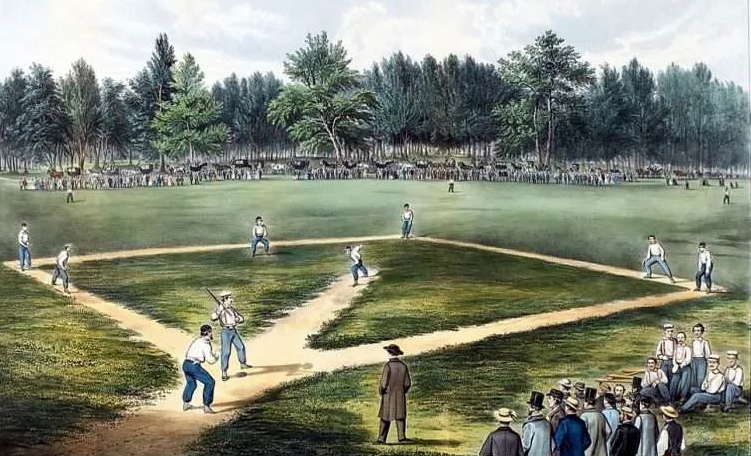
(Currier & Ives lithograph courtesy of New England Historical Society) This lithograph, titled "The American National Game of Base Ball," depicts an early baseball game played at Elysian Fields in Hoboken, New Jersey, perhaps during Henry David Thoreau's time.
On a breezy, mild day some 166 years ago this month, in an unpopulated wilderness just a brief jaunt south of a New Hampshire city incorporated just three years earlier as the City of Nashua, a man of about 38 years set out on foot in the direction of some mostly level fields that, for him and a handful of other folks, represented much more than a place to harvest hay or sow seeds.
The man, a “young man” by today’s standards but a man in the latter stages of middle age in the context of his time, went there to “check out the fields,” and concluded, “they were dry enough for baseball.”
By all accounts, this wasn’t a man with a casual interest in baseball who, like so many of us did and still do, celebrated the arrival of spring because with spring came baseball.
This was a man who history remembers as a thoughtful, observant, self-reliant individual who found great solace in living very simply and very much apart from clusters of villages and the “rat race” pace of commerce and industry.
He was a man who held dear his belief in the inherent goodness of people and nature, and was so fond — and respectful — of animals, forests and waterways that he decided, on the Fourth of July 1845, to assemble a small cabin, about the size of today’s average backyard tool shed, out on the shores of Walden Pond in the woods of Concord, Massachusetts.
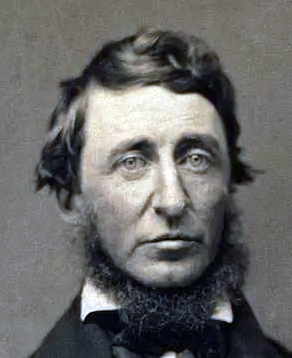
(Courtesy of New England Historical Society) Henry David Thoreau
By now you recognize — or should recognize — this man as Henry David Thoreau, who, I was fascinated to learn just the other day thanks to my friends at the New England Historical Society, thought about, and wrote about, the subjects of Fast Day and baseball way more often than I’d ever imagined.
Adding to my surprise, especially the Fast Day part, was the fact I had no idea until now that the quirky holiday was once observed in Massachusetts, and Maine as well. And it appears, according to my valued adviser Mr. Google, that Fast Day was once observed in all the New England states, having been brought to these parts by the Puritans.
So if you’re a Granite Stater of a certain age, you can thank the Puritans for giving you the fourth Monday in April off of work — and school too, unless it fell during April vacation week, which it often did.
So what if most of us kept enjoying the day off year after year without really knowing what we were supposed to be observing?
I bet Henry David Thoreau knew. That mild, breezy April day some 166 years ago this month was April 10, 1856, which happened to be Fast Day.
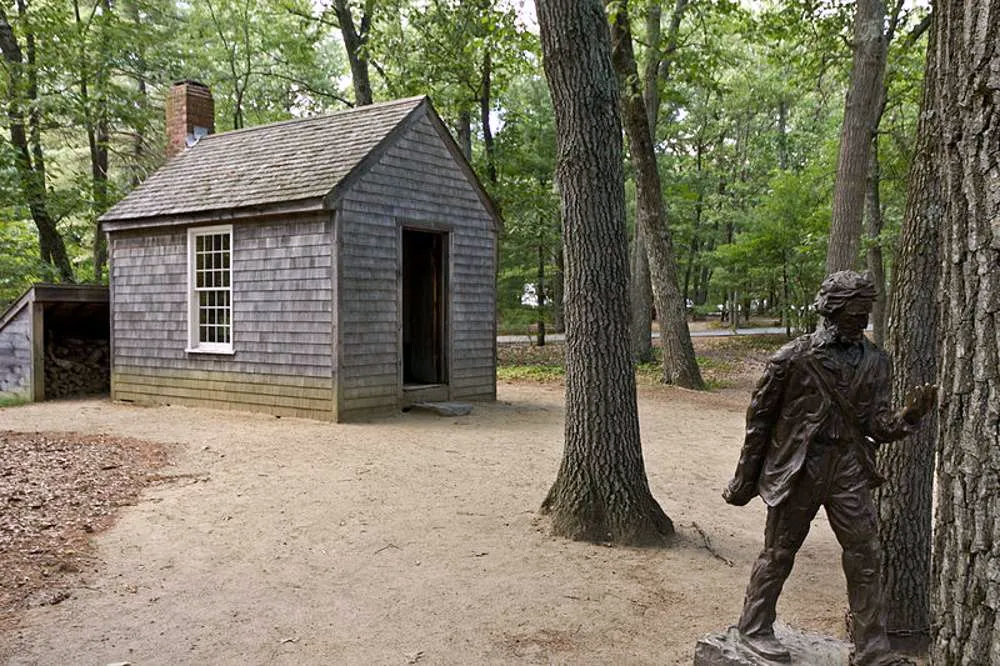
(Courtesy of New England Historical Society) A statue of Henry David Thoreau in front of a replica of the cabin on Walden Pond in which he lived for two years, when, as he famously wrote, "I went to the woods."
After “checking out the fields” that day, Thoreau returned home, opened his diary and began writing.
“April 10. Thursday. Fast-Day. Some fields are dried sufficiently for the games of ball with which this season is commonly ushered in.
“I associated this day, when I can remember it, with games of baseball played over behind the hills in the russet fields toward Sleepy Hollow where the snow was just melted and dried up,” Thoreau wrote.
According to the New England Historical Society story in this month’s online newsletter, the baseball historian Larry McCray “reckoned Thoreau remembered games played around 1830 — well before Abner Doubleday supposedly invented the game in 1839.”
The observance of Fast Day originated with the Puritans, whose practice of fasting and praying and engaging in “sober reflection” in response to a specific event — sickness, a big fire, a bad crop, military disaster or catastrophic weather event for example — evolved into an annual event to be observed in April, initially on the third Monday, then the last Thursday and eventually, the fourth Monday.

Dean Shalhoup
“Fast Day lasted from sunrise to sundown,” according to the NEHS story. “People were expected to fast, listen to a sermon in church and then spend the rest of the day in sober reflection.
“Baseball did not count as a sanctioned activity.”
But rules are made to be broken, right? If ever there was a legitimate reason to break a rule, it was the one prohibiting young boys and men from playing baseball in the spring.
In Connecticut, the NEHS story says, those who played baseball on Fast Day were dubbed “wicked boys” who would find a secluded place to play anyway.
In 1862, according to McCray, the baseball historian, two Union Army regiments from Massachusetts played baseball on Fast Day in their Virginia and Maryland encampments.
“And according to an 1883 history of Philips Exeter Academy, the old people remembered that baseball was regularly played on the holiday,” McCray wrote.
And the holiday most strongly associated with ballplaying?
That would be Fast Day.
Dean Shalhoup’s column appears weekly in The Sunday Telegraph. He may be reached at 594-1256 or dshalhoup@nashuatelegraph.com.
-
- (Currier & Ives lithograph courtesy of New England Historical Society) This lithograph, titled “The American National Game of Base Ball,” depicts an early baseball game played at Elysian Fields in Hoboken, New Jersey, perhaps during Henry David Thoreau’s time.
-
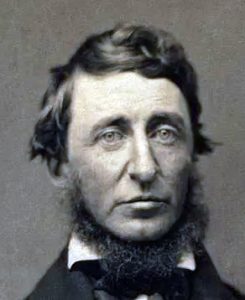
- (Courtesy of New England Historical Society) Henry David Thoreau
-
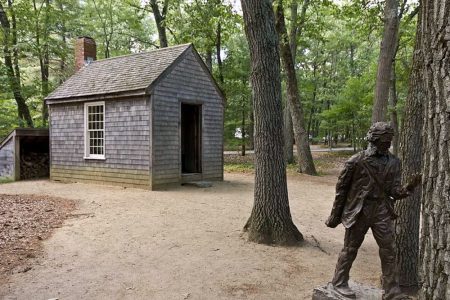
- (Courtesy of New England Historical Society) A statue of Henry David Thoreau in front of a replica of the cabin on Walden Pond in which he lived for two years, when, as he famously wrote, “I went to the woods.”
-

- Dean Shalhoup