Hey Main Street Bottleneck: Where are you now that we could really use your services?
Suddenly one recent night, the light bulb clicked on.
There I was, watching via the always-trusty Nashua GTV link the longer of two back-to-back sessions of the joint aldermanic Committee on Infrastructure and the Planning and Economic Development Committee, when it came to me: All we need to do is resurrect the historic downtown Nashua anomaly, replicate it, say, 8 or 10 times, and the “barriers or no barriers” debate swirling around the latest version of the expanded outdoor dining proposal will be solved once and for all.
I jest, of course, but I bet I’m not the only Nashuan of a certain age and generation who is involved in, or at least following the developments of, the expanded outdoor dining (heretofore “EOD” for brevity purposes) saga whose thoughts at some point turned to memories of the so-called Main Street Bottleneck.
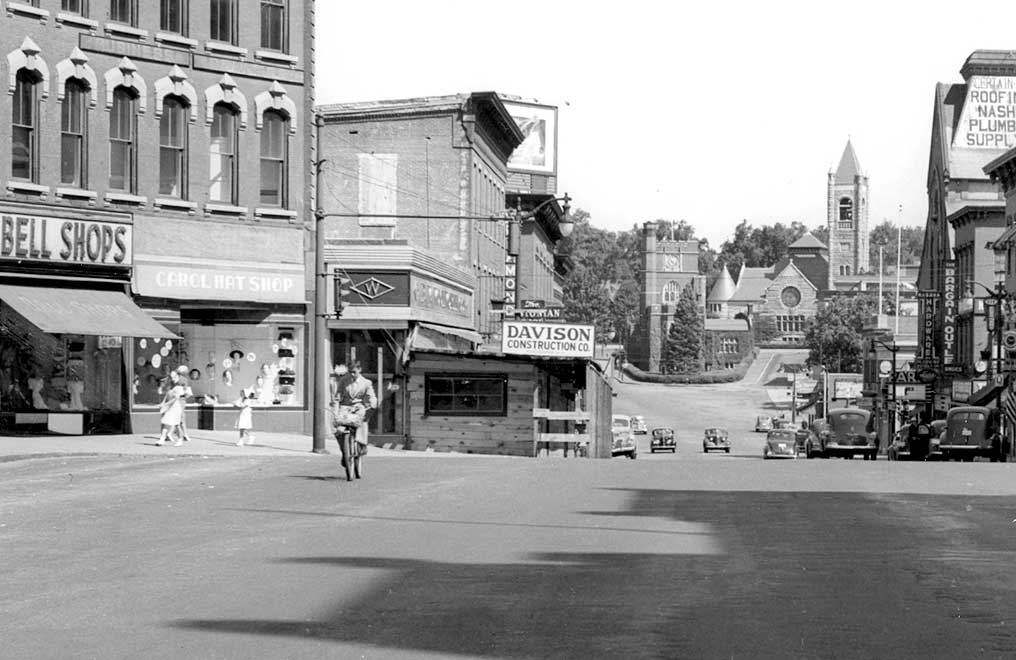
The stretch of Main Street affected by this little curved peninsula of sidewalk, which jutted out of the west side of Main Sreet, wasn’t very long, running south from Water Street about halfway to Factory Street.
But as more and more Greater Nashuans began trading their bus passes for automobiles, a trend that got going in earnest once the boys began coming home from war, what was once a very tolerable, minor inconvenience was quickly becoming a source of increasing frustration for regular downtown drivers.
Not surprisingly, it didn’t take long for these local motorists to bring their beef to City Hall, and while locating the agendas and minutes of meetings held on the topic would likely be too time-consuming an undertaking, I’d bet some of what was said back then would sound quite familiar today.
If you’re involved in today’s EOD discussions in one way or another or are a conscientious observer, the process may sometimes seem like a long, drawn out series of lengthy discussions on the most minor minutae.
But consider this: According to what I could dig up from various bits of research, the back-and-forth over what could be called The Battle of the Bottleneck dragged on and on and on for an entire decade.
Historically, the buildings that made up the bottleneck were in place for decades before they became known as “the bottleneck.”
Their frontages were actually fairly “even” with those of their neighbors to the north and south until the 1920s, but that began to change in the wake of the massive December 1924 fire that destroyed the old, wooden Main Street Bridge and damaged several nearby buildings.
City fathers (there weren’t any “city mothers” yet) decided to build the bridge back better, and in doing so put the new structure in the international spotlight.
Dedicated in 1925, the new span – the original version of the one that stands today – was quite wide, earning the title “the widest bridge for its length in the world.”
It was in fact quite a bit wider than the section of Main Street from the bridge southward, forcing southbound traffic to briefly merge into one lane for 200 or so feet, until the street went back to two southbound lanes.
Hence the brief narrowing of Main Street that was coined the bottleneck.
As the 1950s wore on, and Greater Nashua’s automobile ownership skyrocketed, city leaders found themselves under increasing pressure to do something about the bottleneck – that “something” being “tear the darn thing down.”
“Finally,” more than a few motorists likely muttered through a sigh as they watched crews from a firm called Davison Construction Company set up their rigs and begin swinging the demolition ball back and forth.
By the end of summer 1958, the bottleneck was no more, relegated to the pages of Nashua history.
Dean Shalhoup’s column appears weekly in The Sunday Telegraph. He may be reached at 594-1256 or dshalhoup@nashuatelegraph.com.