Infrastructure projects from Biden legislation to total $2B in NH
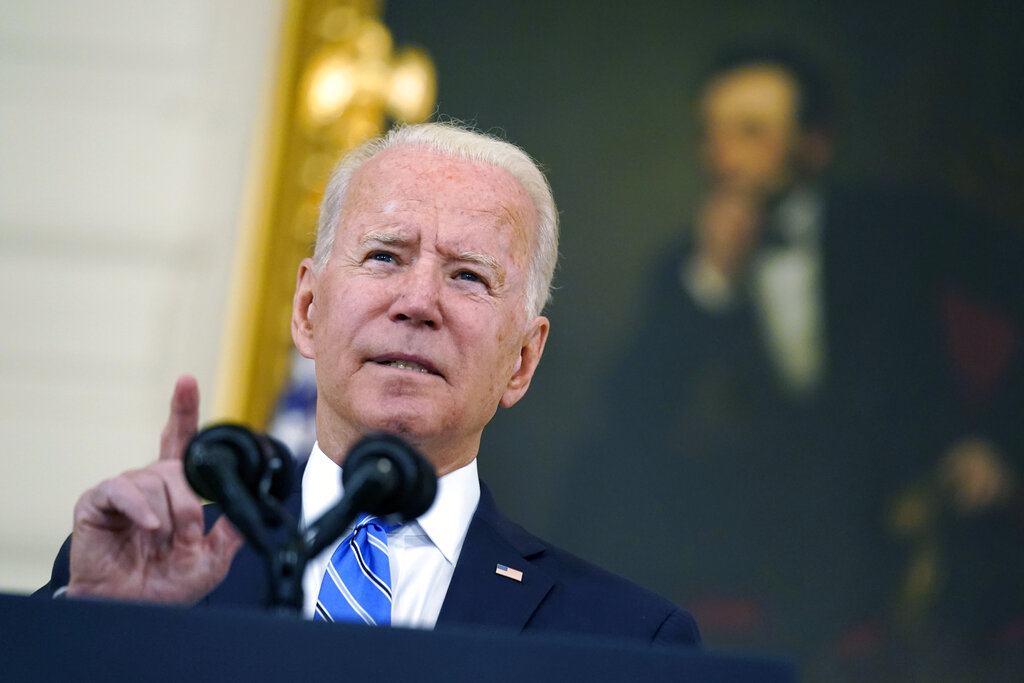
In this July 19, 2021 photo, President Joe Biden speaks about the economy and his infrastructure agenda in the State Dining Room of the White House, in Washington. A new poll from The Associated Press-NORC Center for Public Affairs Research finds that 54% of Americans judge the economy to be in poor shape. That's compared with 45% who say conditions are good. (AP Photo/Andrew Harnik)
It took months of collaboration and politicking to pass the $1.2 trillion bipartisan infrastructure bill that President Joe Biden signed in November.
Now, the goal is to get local projects up and running with the federal assistance the White House touted during the president’s visit to New Hampshire one day after signing the legislation. The state, according to White House estimates, has been allotted more than $2 billion for projects ranging from repairing bridges to extending broadband capability to rural areas that are now without it.
Biden’s November visit included a stop at the creaky Pemigewasset Bridge in Woodstock, for which long-needed repairs will be aided by the total of $225 million designated for New Hampshire bridges.
New Hampshire U.S. Senators Jeanne Shaheen (D) and Maggie Hassan (D) held a forum Friday at Saint Anselm College for members of the New Hampshire Commerce Corridor, a group including Chambers of Commerce for Nashua, Hudson, Merrimack-Souhegan Valley, Manchester, Concord, Derry and Salem.
All of these areas are appropriately getting lots of attention from both sides of the aisle because we are all hearing how important this is to our businesses, how important this is to our quality of life,” Hassan said, citing her particular interest in high-speed internet and work on ports, dams and waterways.
“I still remember the mayor of Berlin saying, ‘High speed internet – that’s like a super-highway for us. If you can do that it just opens up all these possibilities’ ” Hassan said.
Portsmouth, she said, will use more than $1.5 million to upgrade its harbor.
“It’s really important for facilitating the flow of goods from and through New Hampshire and impacts our supply chain, Hassan said. “Because of the infrastructure law the harbor will receive more that $1.5 million to help improve the safety and efficiency of the waterways, including (an enlargement of) that turn basin for bigger ships.”
Shaheen mentioned the bill’s allocation of $66 billion in mass transit projects, specifically mentioning the long-discussed possibility of passenger service from Concord to Boston.
“I know rail is of particular interest to the Commerce Corridor Chamber,” she said. “There is $66 billion dollars. It’s the biggest investment in mass transit ever.”
Hassan said there are two options to help fund a passenger program in the state – linking it to funds that are being allocated for Amtrak, the other through the Capital Investment Grant program, which helps subsidize commuter rail, light rail, heavy rail and bus transit projects.
Part of working out the bipartisan infrastructure deal, Hassan said, “was making sure that smaller projects, like our capital corridor project, would qualify for that.
“It’s a pretty exciting time, particularly for all the advocates in this part of the state who have been working on that for so long. That would be a real game-changer for New Hampshire.”
On a transportation topic that has the entire nation grumbling, when asked about the skyrocketing costs of gas and oil, Shaheen suggested that the oil companies have limited their production to keep prices artificially high. Allegations of collusion between the oil companies should be investigated, she said.
“We know they have the capacity to produce more. The United States is the biggest resource for gas and oil in the world,” Shaheen said. “We need to do more to keep the pressure on them.”
Shaheen said she has been working with the Municipal Association throughout the state “to make sure people understand when the grant opportunities come out so they’ll know where to go to get the information and what is required.”
Affordable housing, and the increasingly limited options for home buyers in the southern part of the state, may get some help from projects funded by the bill.
Hassan said clean-water projects will make housing in some towns more attractive to buys, as will enlarging the reach for broadband internet access.
“This is the issue that I probably hear most about from business leaders and communities throughout the state. It’s an issue I heard about before the pandemic, it’s an issue I’m hearing now.
“The infrastructure bill has a number of provisions that are really, really important when it comes to being able to expand our housing stock.”