‘Shantytown:’ History of ‘tie plant’ neighborhood opens a portal into housing discrimination problem

Dean Shalhoup
Editor’s note: In conjunction with Black History Month, today’s column, and the one that will run next Sunday, are focusing on the history, and experiences, of Nashua’s African-American residents, mainly in the second half of the 20th century.
•••
‘Shantytown:’ The ‘tie plant’ neighborhood whose condemnation would open a portal into Nashua’s post-World War II housing discrimination problem
If you moved to Nashua in the mid-20th century, were willing and able to work hard, didn’t mind the persistent odor of coal tar pitch wafting heavily in the air, and were fond of receiving a reasonably fair paycheck each week, you’d likely be given directions to the big, bustling wood-preserving plant up at the end of Hills Ferry Road.
Especially, that is, if you were an African-American man.
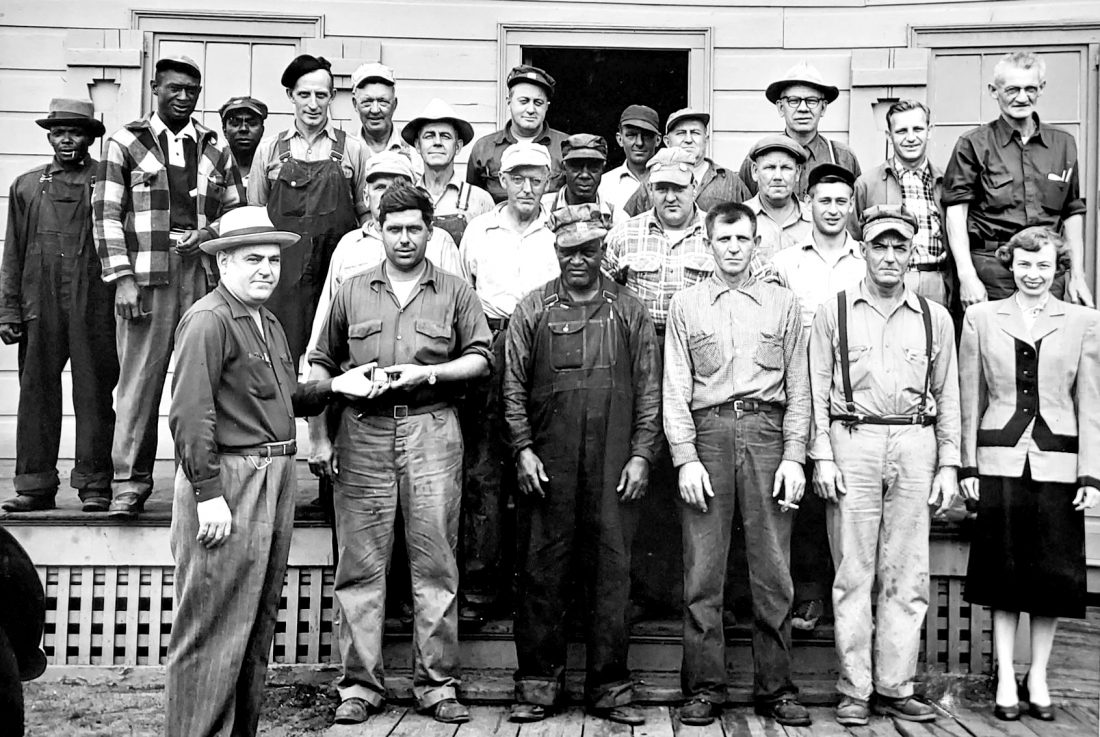
(Photo courtesy of Nashua Historical Society) This photo, likely taken between the late 1940s to early 1960s, shows what appears to be the presentation of an award to an employee of the former Koppers wood-preserving plant. The plant employed a number of African-American men, many of whom lived with their families in shacks erected on the Koppers property until they were condemned in the late 1950s and later torn down. The man at left with the white hat presenting the employee with the award may be Arthur Radcliffe, Koppers plant superintendent in the 50s.
Because, upon putting your name in for the next opening, you’d almost certainly learn from your soon-to-be co-workers that the job came with an almost unheard-of perk: You, and your family, if you had one, could live in a little village on the campus of the multi-acre treatment plant – and pay no rent.
The inhabitants called Koppers and their small village, simply, “the tie plant,” a nickname derived from the fact that a major part of Koppers’ business was milling and preserving with thick, tarry creosote the wooden railroad ties that keep the rails in place.
Another nickname the year-round encampment picked up along the way – “Shantytown” – was probably introduced in news stories, which were brief and few until spring 1957.
“‘Shantytown’ to be condemned” shouted the headline – in all capital letters – on the top story on the front page of the May 2 Nashua Telegraph.
The fairly brief story would be the first of many reported in the Telegraph over the next decade, tracing the rather pokey condemnation process, the eventual follow-through, and then, in the summer of 1967, former Telegraph reporter Barry Palmer’s lengthy, interview-rich account of the largely unforseen, and surely unindended, fallout from the razing of the deteriorating buildings that three- to four dozen people called home.
That the vast majority of those living on the Koppers campus were African-American – in a city of 30,000-35,000 people of whom maybe 100-200 were African-American at the time – the story of “Shantytown” and how the aftermath of its condemnation forced city officials, Nashua property owners, and many Nashuans in general to take a long, hard look at the widespread, yet subtle, problem of race discrimination and prejudice is a story well-suited for anytime, really, but especially for Black History Month.
The late Bishop Estee Newman was probably Shantytown’s best known resident. Newman, a spritual man who, along with his wife, Ida were among Nashua’s first African American residents when they arrved in 1941, worked and lived at Koppers for more than a dozen years – while building a family that would eventually grow to 14 children, 54 grandchildren, and an astonishing 134 great-grandchildren.
A tribute to Newman, who died in the 1990s at age 88, will appear in this space next Sunday, Feb. 27, the third of three essays in observance of Black History Month.
When Nashua Fire Prevention Capt. Herbert Duprey issued the order to condemn Shantytown, Koppers’ parent company in Pittsburgh agreed to begin making arrangements to evacuate the residents and do what they could to help them find another place to live.
Plant superintendent Arthur Radcliffe, according to the Telegraph, gave the families until July 1 to relocate.
The deadline came and went. Just one family had found housing.
Reality was sinking in.
“Well, we can’t turn them out in the cold,” Radcliffe was quoted as saying, evidently figuratively, given it was July.
Radcliffe publicly reiterated his intent to follow the fire inspector’s order. “The buildings will be disposed of once quarters are found for the families that occupy them,” he told the Telegraph.
It must have dawned on Radcliffe that a relocation process he figured would take a couple of weeks, maybe a month tops, suddenly hit an obstacle he never saw coming.
“They tell us they have places to rent but when we get there the apartments are already rented,” is what the families told Radcliffe, in so many words, each time they went out apartment hunting.
The vast majority of those apartments had not been already rented, of course; but the prospect of renting to an African-American family was even more daunting to most landlords than leaving the place vacant and sacrificing the rent income.
It’s not clear how long it took to relocate everyone from Shantytown. But there’s no question that the process opened plenty of eyes around town.
In several cases, according to Telegraph accounts over the next two or three years, members of the local clergy stepped in on behalf of their African-American neighbors – whether they were members of their congregation or not.
The Telegraph even drew praise for reporting on the subject, specifically an October 1960 account penned by then-city editor Ray Murphy that traced the “long, fruitless hunt … to find a house for an (African-American) draftsman” undertaken by the Rev. J. Wright Williamson of the First Congregational Church.
Williamson, testifying before the former New Hampshire Advisory Council on Discrimination, told council members that “real estate men in (Nashua) were reluctant to sell a house” to the man, who held the position of head draftsman at a large Nashua electronics firm.
The minister said he “expected no trouble” in finding the man, who was married with two children, a house, “but he ran into a stern wall of refusal” when realtors learned the house was for an African-American family.
He didn’t give up. It took more than 30 phone calls and the help of a bunch of clergymen friends, but they finally found the family a home.
Then there was the case, or cases, actually, of Harry Rogers, the owner of the former Imelda and Harry’s, the dry-cleaning business familiar to longtime Nashuans.
Williamson, the First Church pastor, said at the council hearing he had made more than 100 phone calls on behalf of one of Rogers’ key employees, a presser who wanted to move his family to Nashua, but was forced to commute from Boston each day because nobody in Nashua would rent or sell him a house or apartment.
Likewise for an African-American professional tailor whom Rogers employed. For 18 months, Williamson said, he and Rogers had been trying to find housing in Nashua for the tailor and his family, to no avail.
Eventually the tailor gave up the commute and got work in Boston, costing Rogers his best tailor.
And, more than likely, costing Nashuans yet another opportunity to befriend a new neighbor.
Next week: Bishop Estee Newman: A Tribute.
When a young coal miner and cotton farmer from the South arrived in Nashua at the outset of World War II, he did what came naturally: He began ministering to any and all wherever he saw a need, all the while walking door-to-door collecting whatever change folks could spare toward sustaining his modest “church without walls.”
Dean Shalhoup’s column appears weekly in The Sunday Telegraph. He may be reached at 594-1256 or dshalhoup@nashuatelegraph.com.
-

- Dean Shalhoup
-
- (Photo courtesy of Nashua Historical Society) This photo, likely taken between the late 1940s to early 1960s, shows what appears to be the presentation of an award to an employee of the former Koppers wood-preserving plant. The plant employed a number of African-American men, many of whom lived with their families in shacks erected on the Koppers property until they were condemned in the late 1950s and later torn down. The man at left with the white hat presenting the employee with the award may be Arthur Radcliffe, Koppers plant superintendent in the 50s.