Two months after their harrowing journey through rain, the Hendrick family boards the Packard

Dean Shalhoup
With their ill-fated Easter Sunday journey through heavy rain and ankle-deep mud now just a speck in the rearview mirror, George and Nellie Hendrick and 13-year-old Marion were more than ready for what Marion called “our longest trip so far in our single-cylinder Packard.”
Today’s essay is the next-to-last installment in what I call my “summer reading” series, which entails a fun, and at times fascinating, account of what it was like to travel 40, 50 or 60 miles from home by auto around the turn of the 20th century.
Fifty years after young Marion and her parents set out on a series of trips in George’s new Packard, Marion, by then in her mid-60s and living in East Kingston, wrote up her memories of those trips and sent them to our predecessor-in-name The Nashua Telegraph.
The late Fred Dobens, then a Telegraph columnist and editor, evidently found Marion’s recollections quite amusing and entertaining, so he printed some of her essays under a “guest columnist” banner.
In previous installments, I picked and chose certain quotes and did a lot of paraphrasing, but this segment. at once a history and geography lesson, is written so well it needs no improvement and thus, appears virtually verbatim.
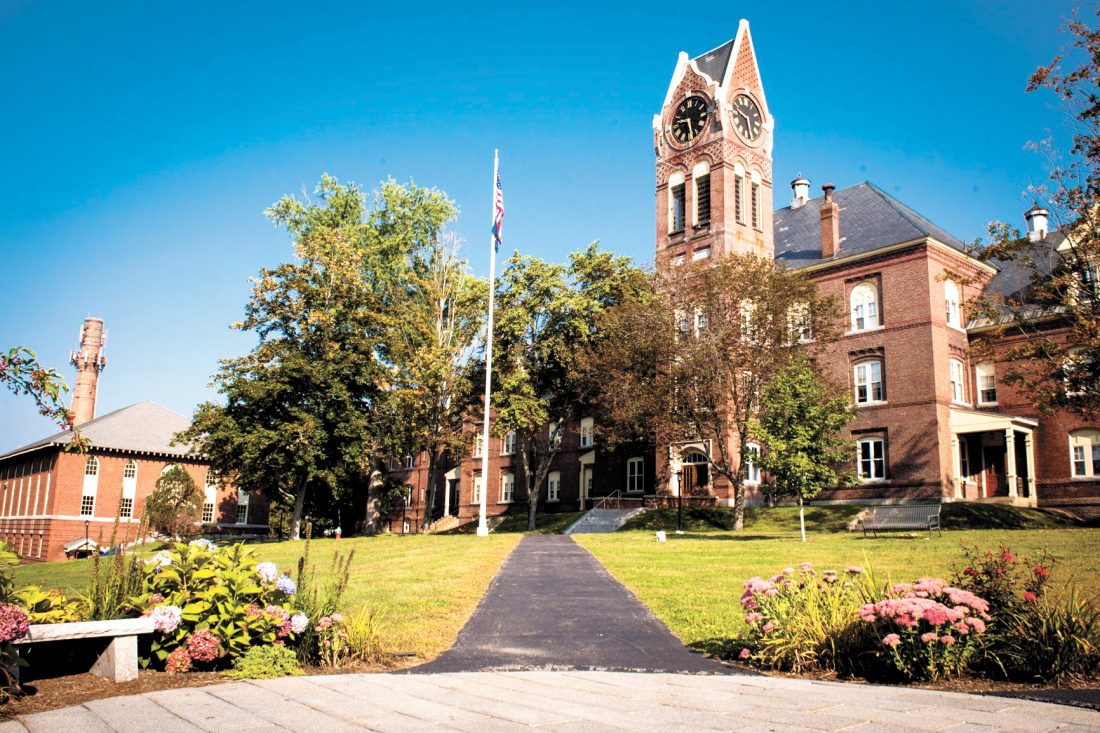
This recent photo of the main part of the Tilton Academy campus shows a clock tower that is probably the one Marion Hendrick saw when she and her parents arrived at the prep school for a tour in June 1903.
It takes us on the journey Marion and her parents made in mid-June 1903, beginning with the reason why her parents wanted her to enroll in a boarding school for grades 9-12 – besides the fact the Hendricks were quite well-off and sending your kids to boarding school was what rich people did then, and still do now.
Come the day of the excursion, “the family was up with first light” because of the length of the trip.
She explains: “I had been reported to be up river, when I was supposed to be somewhere else. I had even been seen on the tiny island where the two branches of the Nashua River join, below Mine Falls.”
Therefore, she writes, “my folks wanted to have me where my adventures would be supervised, and I was too thrilled for words at the idea of going to a boarding school.”
Marion wrote that her friend, Tena Burke, had been accepted at the Rogers Hall School for Girls in Lowell, “but none of that for me. I wanted to be a ‘co-ed.’
So this day, the Hendricks were off to Tilton, where they had been invited to attend Tilton Academy’s commencement and tour the school.
Tilton would be the fifth boarding school the Hendricks “inspected,” as Marion called it. They’d previously visited Pinkerton, Sanborn, Dean and Cushing academies.
Today, jumping in the car and driving 50-something miles in about an hour would be about as remarkable as seeing the sun come up. But vehicular travel was a little more challenging, not to mention time consuming, almost 120 years ago.
“We put up a lunch, Dad inspected the tires, strained gasoline into the tank through a chamois-lined funnel, and just as the sun came up, I climbed into the trap seat with the lunch basket and we were off down Wellington Street.”
She noted that Elliott Street had yet to be laid out, and was still part of a cow pasture owned by a man named Bohanan, or Bohonon, depending on the source.
“Beyond the trolley tracks at the Watson Farm (then adjacent to, and now part of, Greeley Park), Concord Street was a dirt-topped, rutted road. Pennichuck Hill was a series of bars of dirt formed to drain water to the roadside in heavy rains to the torrents wouldn’t gully the hill.
“The narrow bridge over the brook was quite near the water, so Dad threw the clutch into low gear to chug up the ‘thank-you-marms’ on the steep rise beyond.”
Earlier I described these “thank-you-marm” things as sort of like moguls are to skiiers, or outsized speed bumps are to today’s drivers. (To simulate what it was like, just drive down Factory Street).
“The dusty road curved sharply here and there, the hills were steep, and the deep ruts alternated with sandy stretches.
“Vehicles were few – farmers driving to town in democrat wagons or Goddard buggies, haycarts with with fragrant loads, a peddler’s wagon or a bakery or provisions cart.
“No motor traffic at all.
“When we reached the bridge over the Merrimack (River) at Manchester, Dad thought he’d keep on the west side of the river, (but) soon the road petered out into a sandy, wood road through scrub pines.
“Dad said, ‘hop down and ask at that house if we can get to Concord this way.’ I knocked on the side of the weatherbeaten Cape Codder and a tiny, calico-clad figure came to the door, wiping her dripping hands on her apron.
“‘Will this road take us to Concord?’ I inquired. Instead of answering, she pulled her steel-rimmed spectacles down from her gray hair, planted her hands on her hips and, looking past me at the Packard, drawled ‘Well, now, ain’t that a real handy thing.’
“I turned my back and exploded with laughter. That was probably the first motor car she had ever seen. She told us we’d better go through Manchester, so we turned around and crossed over the bridge along the cobbled streets by the canal.
“Twenty miles per hour, coasting down and chugging up hills, brought us to Concord. We went into a restaurant for doughnuts and coffee and to stretch our legs, and to whisk off some of the accumulated dust” on their clothes and the Packard’s seats.
“Then we were off to Penacook and points north.
“Some miles beyond the bridge over the Contoocook (River) we came upon a fine stand of buildings, and met a man as broad as he was long, trudging along the road with two big buckets hanging from a wooden yoke over his shoulders.
“Dad stopped, and our noses told us that pig rations were in those buckets. Mother asked, ‘what place is this?’
A squeaky voice came out of that vast bulk: ‘This here’s the County Farm.’
“Just as we came to Franklin, we pulled over at a granite watering trough … Dad put some fresh water in the (radiator) and filled our mugs with the cool water trickling from the hillside. How wonderful that water tasted.
“We dusted off our clothes, washed the New Hampshire soil from our faces, and opened the lunch basket.
“We drove into Tilton at noon, over a railroad overpass, up a steep hill and onto the Elm-shaded campus.
“There, crowning the hilltop with ivy-covered walls, its clock tower rising above the elms, stood Tilton – ever after, the school of my heart.”
Next: The Hendricks step out of the dusty, road-weary Packard and into a whirlwind tour of the Tilton Academy campus. How did that go, and was Marion as enthusiastic at tour’s end as she was upon arrival?
Dean Shalhoup’s column appears weekly in The Sunday Telegraph. He may be reached at 594-1256 or dshalhoup@nashuatelegraph.com.
-

- Dean Shalhoup
-
- This recent photo of the main part of the Tilton Academy campus shows a clock tower that is probably the one Marion Hendrick saw when she and her parents arrived at the prep school for a tour in June 1903.