Auto repair, circa 1903: A pair of torn overalls does the trick for George Hendrick’s single-cylinder Packard

Dean Shalhoup
This week’s essay picks up where last week’s left off in following the trials and occasional tribulations that 13-year-old Marion Hendrick and her father, well-known city jeweler George W. Hendrick, encountered as they boldly set out on motoring adventures nearly unheard of some 120 years ago.
A quick recap: Marion, later Marion Hendrick Ray, grew up on Wellington Street around the turn of the 20th century, the only child of George and Nellie Hendrick.
In the early- to mid-1950s, Marion, widowed and retired, had taken to journaling, and at some point decided to share some of her essays with the late, longtime Nashua Telegraph editor Fred Dobens, whose trademark column, “Around the Town,” appeared several times a week.
On occasion, Dobens – wisely, I might add – printed Marion’s essays in his space, evidently recognizing her flair for colorful, expressive writing.
Many of her compositions, Dobens wrote in prefacing one that ran in April 1954, “concern the trials and tribulations of those hardy pioneer Nashuans who were the first to drive cars and who helped make the present-day automobile possible.”
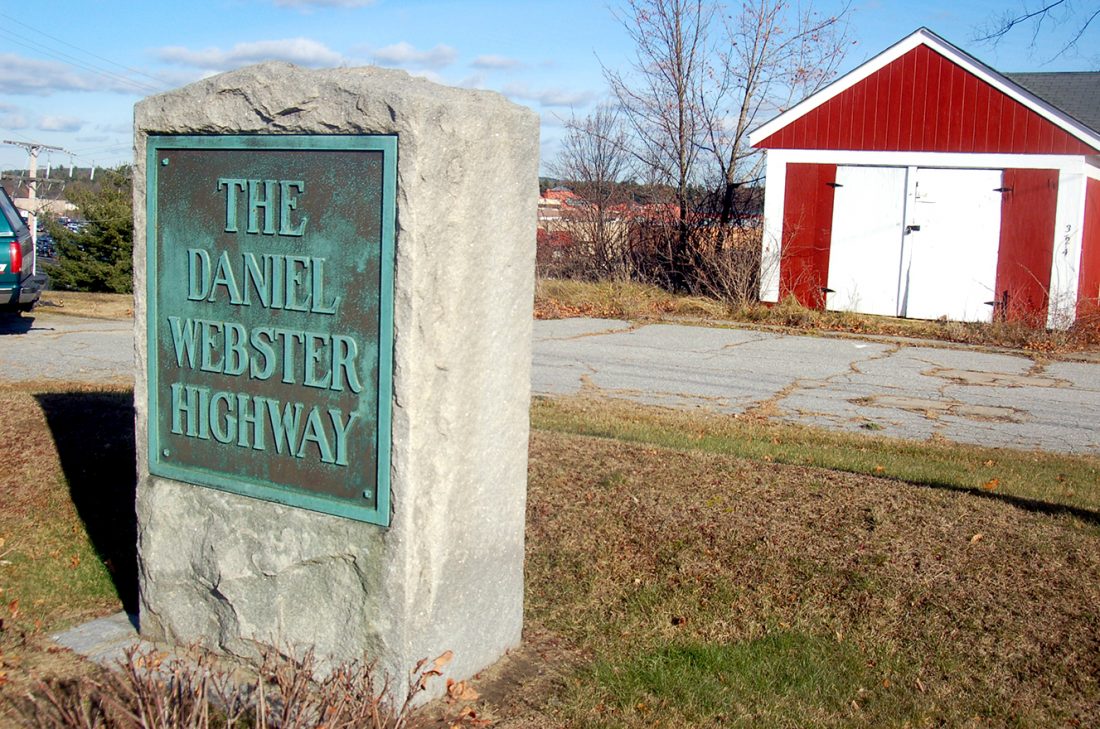
A bronze plaque affixed to a granite monument and an old farm building are adjacent to the New Hampshire-Massachusetts state line, where George and Marion Hendrick ventured by automobile nearly 120 years ago. (Telegraph file photo)
So I decided, in the spirit of light summertime reading, to follow Fred’s lead and occasionally share some of Marion’s eloquent, illustrative prose in this space over the next few weeks.
In February 1903, Marion, with her dad George at the wheel of his new Packard, were making their way to an auto shop in what she referred to as “Chelmsford Center” to get the car painted.
Bouncing and rattling over the rutted, unpaved road that’s now the Daniel Webster Highway, they had just crossed into Massachusetts when, Marion wrote, “the trouble started.”
The engine “skipped and stopped … dad looked her over, opened up the front, a curved sort of chest holding six dry cell batteries to supply the spark and a tank of water to cool the engine.”
The wiring to the batteries had jiggled loose, a simple fix that George made and the two continued on.
This is where Marion used the term “thank-you-marm,” to which I referred briefly in last week’s essay.
Thank goodness for Google. Had I written this 30 years ago, I’d still be at the library clawing my way through encyclopedias.
Also written “thank-you-ma’am,” “thank-you-mum,” “thank-you-mom” and a few other versions, the term was coined in the horse-and-buggy days and refers to a dip, gully, hollow or large rut in a road that, according to a couple of sources, caused passengers to bow, as if to say “thank-you-ma’am” or something similar.
(It sounds a lot like driving down Factory Street today).
It was a series of those “thank-you-marms” that knocked loose the wiring six more times, according to Marion.
The final time it happened, the Packard silently coasted to a stop somewhere in Tyngsborough, just down the road from a blacksmith’s shop, she wrote.
George walked up to the small building to ask for help, and soon “the smith came out wearing a broad grin, (carrying) a pair of torn, greasy overalls.
“He wedged the overalls in beside the dry cells to make them stay put,” Marion wrote.
“Dad cranked, the engine roared, the smith backed hastily away, still grinning toothily, and we went all the way to the paint shop at Chelmsford Center without interruption,” she wrote.
Marion didn’t say how she and her father, after dropping off the Packard at the paint shop, got back home to 18 Wellington St., which, as part of a street re-numbering project a couple of decades later became 80 Wellington St.
She did observe, however, that her dad’s Packard “was probably the only car in the history of automobiles put into commission after a breakdown with the help of an unoccupied pair of overalls.”
The paint shop did a great job, Marion wrote. Just before Easter Sunday 1903, the gleaming Packard came home to Nashua, and the new garage her father had built.
They soon decided that Easter would be a great day for their next motoring excursion, and Marion excitedly marked it on the calendar.
Next week: “All went well until we reached the state line – and a huge mud puddle:” An excursion suddenly becomes an adventure.
Dean Shalhoup’s column appears weekly in The Sunday Telegraph. He may be reached at 594-1256 or dshalhoup@nashuatelegraph.com.
-

- Dean Shalhoup
-
- A bronze plaque affixed to a granite monument and an old farm building are adjacent to the New Hampshire-Massachusetts state line, where George and Marion Hendrick ventured by automobile nearly 120 years ago. (Telegraph file photo)