The road trip, circa 1903: The journey, an adventure; the destination, a crap shoot
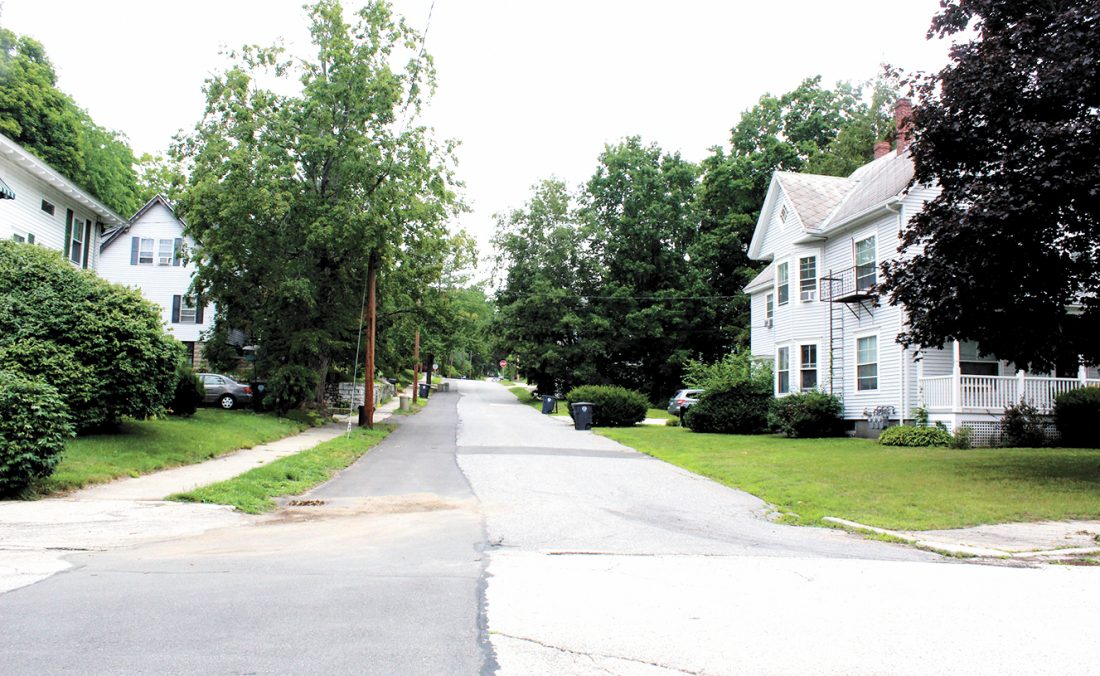
Telegraph photo by DEAN SHALHOUP The section of Wellington Street between Hall Avenue, in the foreground, and Stark Street, in the background, that turn-of-the-century resident Marion Hendrick Ray said turned into "a sea of yellow mud" each springtime. (Telegraph photo by DEAN SHALHOUP)
I must be getting close to knowing pretty much everything there is to know about everything.
Or so I thought, for a few fleeting seconds anyway.
And just where did I get that idea, one might wonder. I’m glad you asked.
I now know, for instance, what a “democrat wagon” is. And now I can tell anyone who asks what a “Goddard buggy” is.
Even more exciting is knowing that Nashua’s Elliott Street was once a narrow, muddy path through Mr. Bohonon’s cow pasture.

Dean Shalhoup
Longtime reporter, columnist and photographer, is back doing what he does best ñ chronicling the people and history of Nashua. Reaching 40 years with The Telegraph in September, Deanís insights have a large, appreciative following.
Equally as thrilling, I must say, is earning the right to push back my cured-leather recliner, light a cigar and rub my belly in the satisfaction of knowing what a “thank-you-marm” is.
Heck, I even know what “Watteau” means, in case the conversation turns to high-end fashion cherished by rich, young women.
I can also boast of knowing what a “trap seat” is, not to mention how a brave auto passenger would get into one and, once settled, what kind of view he or she would have.
I know, too, that another pleasant North End Nashua street – Wellington – was prone to transforming itself into “a sea of yellow mud” come springtime.
And who besides me knows that once upon a time, a place called the Horace Holden carriage house stood on one of the corners of Concord and Courtland streets?
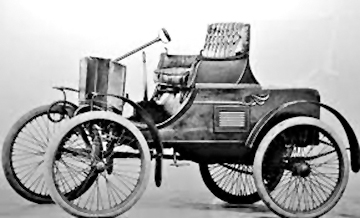
This early 20th-century model single-cylinder Packard is similar to the one that Marion Hendrick Ray's father, George Hendrick, owned in 1903.
And who would know, besides me, of course, that a good-sized strip of land on the Manchester Street side of Greeley Park was once known as the Watson Farm?
Come the early 20th century, the Greeleys acquired the land from the aging Nannie Watson and added it to the acreage they would donate to the city as the gem of a public park it is today.
So given my history as not-the-most-studious-student in the classroom, I must have had quite the conscientious and patient teacher to have absorbed so much knowledge.
Marion Hendrick Ray wasn’t a teacher by trade, but it was through reading some of her essays about what growing up in a turn-of-the-20th-century Nashua entailed that transformed me, albeit 50-something years too late, into an eager-to-learn, model pupil (that’s what they called students back in the “eyes front and pay attention, Mr. Shalhoup” era).
What Marion did for a living after graduating from prestigious Tilton Academy in 1907 initially centered around the arts, specifically poetry.
Later, following her marriage to G. Everett Ray, the couple owned and operated a small farm and greenhouse “for many years,” according to the obituary that appeared in The Telegraph upon her death in March 1969.
Whatever else Marion Hendrick Ray accomplished in her nearly 80 years, she was a superb storyteller and an even better writer. I know this thanks to the late, longtime Telegraph editor and columnist Fred Dobens, who occasionally devoted his allotted space to Marion’s most enjoyable, and informative, essays.
So I decided, in the spirit of light summertime reading, to follow Fred’s lead and occasionally share some of Marion’s eloquent, illustrative prose in this space over the next few weeks.
Since most of the contributions I’ve found so far from Marion revolve around transportation, let’s start with the day in February 1903 that her father “took delivery” of a “second-hand, single-cylinder Packard automobile” from a Boston car dealer called Tinker Brothers.
The motor was in good shape, according to Marion, but the body needed a paint job, so her father, who by the way was well-known jeweler George W. Hendrick, made arrangements with a body shop in Chelmsford, Massachusetts to get the work done.
This is where the “sea of yellow mud” reference comes in. According to Marion, her family lived at 18 Wellington St. during her formative years. The house must have been between Hall Avenue and Stark Street, a short-ish block that today includes 12, 16 and 22 Wellington – but no 18.
Apparently, it was on that slight incline toward Stark Street where the “sea of yellow mud” formed, and although it was only February, the yellow tide was already coming in.
So George Hendrick left his new vehicle overnight at the aforementioned Horace Holden carriage house.
The next day, the minute school was out, Hendrick picked up his daughter and the two set out for Chelmsford in their newly acquired single-cylinder Packard.
Marion, 13 at the time, “munched on sandwiches mother had sent along” as her driver-dad wrestled the machine past the trolley tracks near the Smith farm and onto “the Lowell Road” – today’s Daniel Webster Highway.
There, “we sped up a little … going 20 mph, at least,” Marion wrote. Her father “shifted into low (gear) every time we met a farm wagon or buggy, whose driver always pulled as far into the bushes or field as possible – with the horses’ heads turned away by right rein.”
Father and daughter bounced and rattled on. Soon the state line came into view, but a pretty sharp incline stood between the Packard and Massachusetts.
“What a roar, riding in low gear,” Marion wrote, describing the effort the Packard was putting forth at the hand of her father.
“Then the trouble started.”
Next: A pair of torn, greasy overalls – and a blacksmith with a big, wide grin – save the day.
Dean Shalhoup’s column appears weekly in The Sunday Telegraph. He may be reached at 594-1256 or dshalhoup@nashuatelegraph.com.
-
- Telegraph photo by DEAN SHALHOUP The section of Wellington Street between Hall Avenue, in the foreground, and Stark Street, in the background, that turn-of-the-century resident Marion Hendrick Ray said turned into “a sea of yellow mud” each springtime. (Telegraph photo by DEAN SHALHOUP)
-

-
Dean Shalhoup
Longtime reporter, columnist and photographer, is back doing what he does best ñ chronicling the people and history of Nashua. Reaching 40 years with The Telegraph in September, Deanís insights have a large, appreciative following.
-
- This early 20th-century model single-cylinder Packard is similar to the one that Marion Hendrick Ray’s father, George Hendrick, owned in 1903.