State issues cyanobacteria advisory for Robinson Pond in Hudson
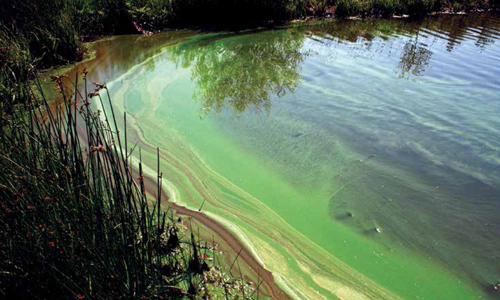
CONCORD – A cyanobacteria advisory went into effect Tuesday for Hudson’s Robinson Pond, state Department of Environmental Services officials announced.
A “cyanobacteria bloom” appears as green and yellow streaks on the surface of the water.
The advisory will remain in effect until DES officials can confirm that cell concentrations of the bloom have subsided, officials said.
Samples collected Tuesday contained cyanobacteria – a combination of microcystis, woronichinia and dolichospermum – in concentrations of 780,000 cells per milliliter (ml), which is more than 10 times the 70,000 cells per milliliter concentration at which officials issue advisories.
As a result, NHDES officials have issued a cyanobacteria bloom advisory for those who use Robinson Pond for recreation.
The advisory is not based on a toxin evaluation, but is intended as a precautionary measure for short term exposure.
Surface blooms can rapidly change and accumulate in various locations around a body of water.
Officials suggest users of Robinson Pond continue to monitor shorelines for changing conditions, and advises users to avoid contact with the water in areas experiencing elevated cyanobacteria cell conditions, also known as a bloom.
It’s also advisable to keep pets out of any body of water that is experiencing a bloom.
Cyanobacteria are natural components of water bodies worldwide, though blooms and surface scums may form when excess nutrients are available to the water.
Some cyanobacteria produce toxins that are stored within the cells and released upon cell death. Such toxins can cause both acute and chronic health effects to people and pets that range in severity.
Acute health effects include irritation of skin and mucous membranes, tingling, numbness, nausea, vomiting, seizures and diarrhea.
Chronic effects may include liver and central nervous system damage.
The DES urges users to be cautious of lake water that has a surface scum, changes colors, or appears to have green streaks or blue-green flecks aggregating along the shore.
Officials therefore urge anyone who notices anything resembling cyanobacteria to refrain from wading, swimming, or drinking the water, keep all pets out of the water, and promptly contact NHDES at 848-8094 or hab@des.nh.gov.
Updates on cyanobacteria advisories can be found at http://www4.des.state.nh.us/WaterShed_BeachMaps/WaterShed_BeachMaps.aspx.
For more information about cyanobacteria and to view photos of a bloom, go to the NHDES Beach Program website and search “harmful algal blooms.”
Dean Shalhoup may be reached at 594-1256 or dshalhoup@nashuatelegraph.com.