Union Hook & Ladder Co. No. 1 comes to life on the pages of its circa 1875 ‘record and roll book’

Dean Shalhoup
Longtime reporter, columnist and photographer, is back doing what he does best ñ chronicling the people and history of Nashua. Reaching 40 years with The Telegraph in September, Deanís insights have a large, appreciative following.
On July 5, 1875, “Union Hook & Ladder Co. No. 1 was called out this morning at 12:10 a.m. by an alarm of fire, caused by the burning of Israel Hunt’s house, No. 6-8 Canal St.
“Machine worked. Time out, 2 1/4 hours. Number of men out, 23. Returned to engine house … and on motion, voted to suspend the by-laws insofar as to pass over our monthly meeting July 6.
“No other business coming before the company … adjourned after calling the roll.
“A true record, attest, Charles C. H. Jones, clerk.”
And on Sept. 29, 1876, “Union Hook & Ladder Co. No. 1 was called out by an alarm of fire this evening at 8 o’clock (for) the burning of the Flather Brothers Machine Shop on Crown St. Machine worked. Number of men out, 17. Time out, 4 hours 15 minutes. Returned to Engine House and adjourned after calling the roll.
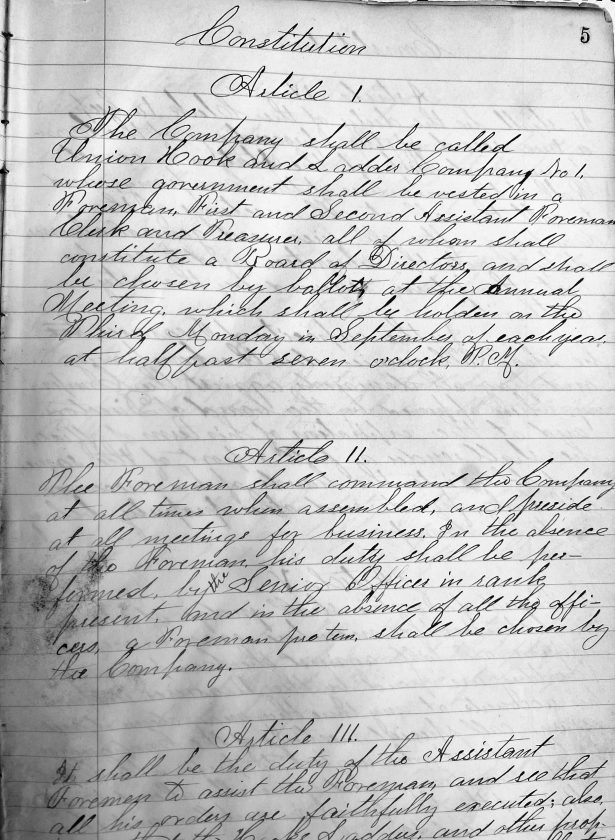
Courtesy photo The articles that made up the constitution of Nashua's 1870s Union Hook & Ladder Co. No. 1 occupy the first several pages of the 300-plus page log book that city Fire Marshal Adam Pouliot donated to the Nashua Historical Society. (Courtesy photo)
“A true record, attest, O. L. Smith, clerk.”
How do I know all of this? No, I don’t think I was here in a previous life, enjoying a different kind of life dedicated to the local fire service as it was some 150 or so years ago.
I know all this – and tons more – about this little snapshot of time in Nashua’s history thanks to city Fire Marshal Adam Pouliot, who last week delivered to us at the Nashua Historical Society a giant, 300-plus page written record of several years in the life of Union Hook & Ladder Company No. 1.
As does pretty much anything of historical value, the book, titled “Record and Roll Book of Union Hook and Ladder Co. No. 1, Nashua, N.H., Oct. 1st, 1874,” tells us a lot about the procedures, traditions and the day-to-day operations that firefighters, then called firemen, practiced in the era of hand tubs, hose wagons, steamers, boilers and so-called hook and ladder rigs, so-named for the obvious – they carried the ladders that the men of the company set and climbed to fight fires and rescue people through windows – and the fact the men also toted huge hooks and ropes to pull combustible materials out of the fire’s path.
Today the hooks are smaller, typically used to peel apart areas to get at hidden hot spots during what’s called the overhaul process.
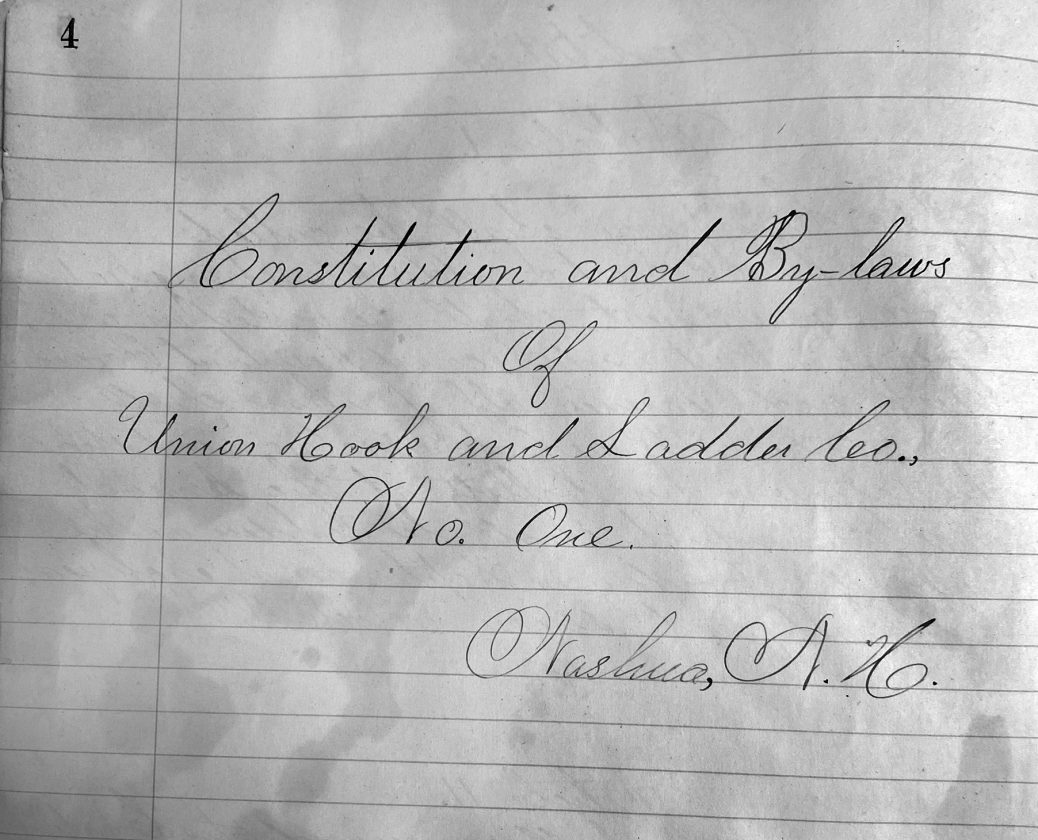
Courtesy photo Flowery, nearly perfect cursive writing was popular among record-keepers of the 19th and early 20th century. This example introduces the reader to the constitution for Nashua's 1870s Union Hook & Ladder Co. No. 1. (Courtesy photo)
I discovered on my journey through the mainly brittle pages of this relic that the scribes – those members of the company with the best handwriting, who were often given the title of company clerk – began this book, and probably all the other record books, with the company’s Articles of Constitution, followed by its by-laws.
Each of the five articles listed certain responsibilities and those responsible for carrying them out. The company was overseen by a several-member board of directors.
The clerk, for instance, was tasked with scheduling company meetings, and notifying members promptly of any special or emergency meetings.
Interestingly, one of the sections of Article I held that “the roll shall be called at the opening and closing of all meetings, and after all fires and general alarms.”
It must have been a housekeeping thing, because I can’t imagine the company’s officers would wait until they returned to the station from a fire to make sure all members were OK and accounted for.
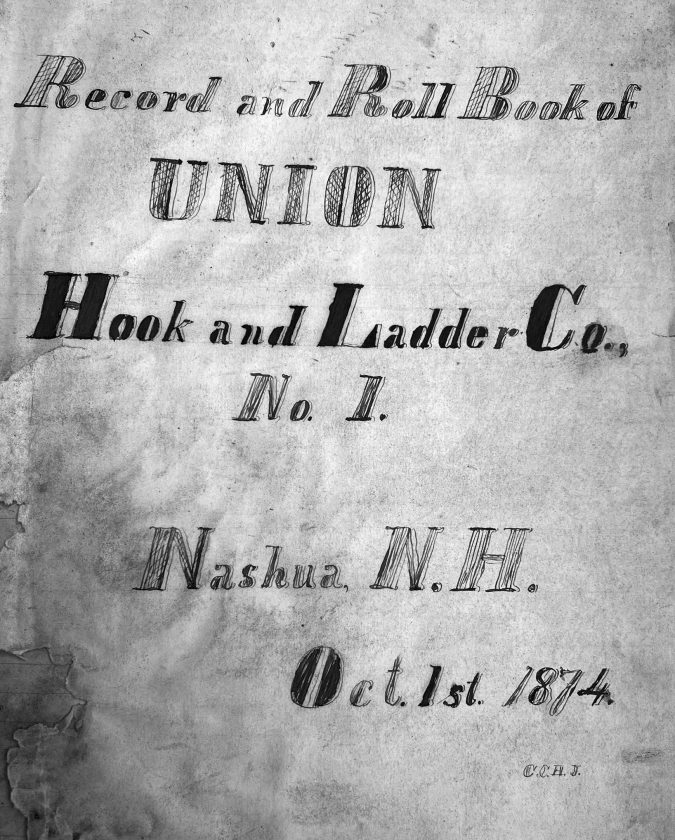
Courtesy photo The cover page of the 1870s record and roll book for Nashua's Union Hook & Ladder Co. No. 1. (Courtesy photo)
Once all the administrative matters were entered in the book, the clerks focused on entering the minutes of the company’s seemingly brief meetings. These entries were interspersed with the reports from each fire call, which were recorded in chronological order.
It might seem bizarre by today’s standards, but back in the day, it wasn’t uncommon for members of a city or town’s fire department to make up as much as 20%, even 25%, of its total population.
Take Nashua for instance. At the time this log book was created, Nashua’s population was around 12,000, and I count roughly 150 names listed as members of Union Hook & Ladder Co. No. 1 alone.
Of course, in those days just being a member didn’t mean you responded to every call or fought every fire. With such a large membership, enough men usually showed up to deal with the situation at hand.
They were tin smiths, cabinet makers, painters and mill workers; teamsters, shuttle makers, bobbin makers, wood turners, peddlers, shoemakers and saddlers.
Most all were in their 20s; there was a smattering of 30-somethings and just a half-dozen were in their 40s.
Finally, of all the entries I was able to decipher, this one’s my favorite.
“On the 9th of Sept. 1876, Union Hook & Ladder Co. No. 1 was called out this evening by an alarm of fire, caused by a bright light reflected on the clouds in the southern sky and the yelling of hoodlums on Main Street.
“Machine not worked. Time out 15 minutes … machine returned to engine house … .”
Well, a guess would be that someone happened to glimpse the setting sun as it cast an odd glow of orange, and perhaps red, on the horizon, and thought sure something big was burning off in the distance.
But the hoodlums yelling? Maybe whatever they were yelling sounded quite a bit like “fire!”
Dean Shalhoup’s column appears weekly in The Sunday Telegraph. He may be reached at 594-1256 or dshalhoup@nashuatelegraph.com.
-

-
Dean Shalhoup
Longtime reporter, columnist and photographer, is back doing what he does best ñ chronicling the people and history of Nashua. Reaching 40 years with The Telegraph in September, Deanís insights have a large, appreciative following.
-
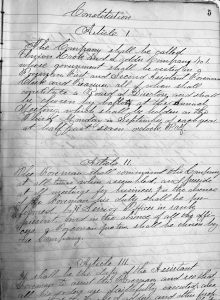
- Courtesy photo The articles that made up the constitution of Nashua’s 1870s Union Hook & Ladder Co. No. 1 occupy the first several pages of the 300-plus page log book that city Fire Marshal Adam Pouliot donated to the Nashua Historical Society. (Courtesy photo)
-
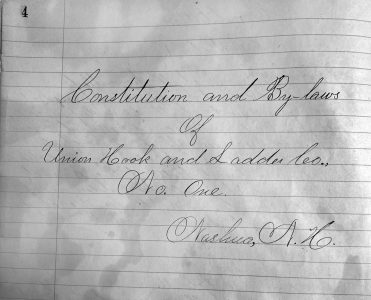
- Courtesy photo Flowery, nearly perfect cursive writing was popular among record-keepers of the 19th and early 20th century. This example introduces the reader to the constitution for Nashua’s 1870s Union Hook & Ladder Co. No. 1. (Courtesy photo)
-
- Courtesy photo The cover page of the 1870s record and roll book for Nashua’s Union Hook & Ladder Co. No. 1. (Courtesy photo)