Donchess, City Health nurses discuss COVID spike

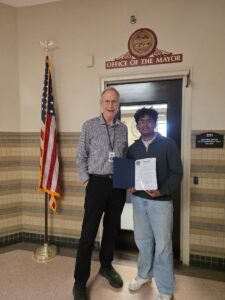
Staff photo by Don Himsel Mayor elect James Donchess at home the day after winning the seat over Chris Williams.
NASHUA – As the city has seen an increase in COVID-19 cases, Nashua Mayor Jim Donchess, who recently recovered from the coronavirus, urged residents to be vigilant in their efforts to contain the spread of the disease.
“I had COVID in September,” he said. “I had fairly significant flu symptoms for a period of three or four days, and then I began to feel better and recovered.”
City of Nashua communications specialist Jane Goodman said the rise in cases in Greater Nashua can be attributed to a number of factors.
“The biggest thing is that businesses have been open for a while and people are spending more time indoors,” she said. “People are not taking as many precautions, and they have COVID fatigue.”
Donchess agreed, saying that with a spike in cases on the national level, Nashua is experiencing a minute fraction of cases, but as he suggested, one case is too many.
“There were over 100,000 new cases documented in the United States last week and 1,200 people died,” he said. “I think it is weather related. And I’m sure that it has to do with COVID fatigue as well.”
Goodman said the city expected increased COVID-19 cases in the fall but perhaps, not quite this quickly.
“We didn’t’ expect that,” she said of the timing. “But here we are, and we attribute this to people getting out more or being inside as the weather gets cooler.”
Vigilance is imperative as the cold weather arrives. Goodman urged people to follow protocol, wear a mask and wash their hands.
“And please, stay at home if you’re sick,” she said, “And if you have symptoms, don’t take it lightly – you should have yourself tested. Anything could be a sign right now – sore throat, runny nose, dry cough, even these mild symptoms can be a sign of COVID-19.”
Goodman stressed the people need to pay attention to how they’re feeling.
“Don’t just pop a Sudafed to mask those symptoms,” she said.
The city of Nashua offers testing on Tuesdays from 3-5 p.m. at the Elm Street Garage. Appointments are necessary. Goodman said they have been busy, and have had walk-in patients as well.
“We usually schedule about 140 tests, and then we have roughly 60 people come in as walk-ins, and a fair number of no-shows,” she said. “But I anticipate that we’ll be back to where we were last week.”
Many residents ask the question, as to whether the rise in positive COVID cases is a result of additional testing.
“Obviously, the more people that get tested, the more cases that we’re going to see,” said city of Nashua epidemiologist Angela Consentino. “But what we use to balance that out is the percent positivity rate. That gives a good idea about the number of people tested who are positive and that indicates a true spread in the community.”
In terms of flattening the curve, Consentino noted that back in the spring, the percent positivity rate was at 17%.
“Right now, we’re floating between 2 and 4%,” Consentino said. “Anything over 5% is considered moderate transmission, and anything over 10% is considered substantial transmission.”
The crux of COVID-19 transmission comes down to the number of contacts per every case.
“If a positive case goes into a restaurant and that restaurant is not well ventilated and is at high capacity, people are going to be at risk,” Consentino explained. “And there are going to be a lot of contacts for that case.”
If a business is well ventilated and following protocol, both Consentino and Goodman agreed it reduces the risk.
With the increased contact tracing, the city is prepared for the rapid increase in new cases.
Donchess said he is “definitely concerned.”
“We don’t want the numbers to go up,” he added. “We’ve been closely working with our health professional, doctors, the board of health and the science of this, because I think that’s what our citizens want and deserve. And they’ve been saying for months that there would be more cases once the weather turned.”
“That’s why people get flu shots in the fall,” he said. “To try to stave off the winter onslaught.”
With outbreaks at restaurants and churches, Donchess said the city is trying to limit transmission and is equally focused on contact tracing.
“We have more than a hundred contacts at this point,” he said. “And the health department is doing a great job in keeping up with them. And they have some volunteers helping as well.”
Donchess said the concentration with testing is on people who either have been exposed or who have symptoms.
“We don’t want to be testing people who just want a negative test in order to go on vacation,” he said. “We’re hoping that lower-income people, folks who have symptoms, we’re hoping that people who can’t get a test and need one urgently will be the one signing up for the clinic.”