Revisiting ‘High Rock,’ once Nashua’s most compact, yet dynamic, industrial center

Dean Shalhoup
Longtime reporter, columnist and photographer, is back doing what he does best ñ chronicling the people and history of Nashua. Reaching 40 years with The Telegraph in September, Deanís insights have a large, appreciative following.
As near as I can figure, the little downtown Nashua district of yesteryear that someone, somewhere along the way, dubbed “High Rock,” sat between Main, West Pearl, Chestnut and Water streets – give or take a lane or alley or two.
Down the center of High Rock ran High Street, I surmised from old Telegraph reports on the district, a roughly square shaped neighborhood known variously as a humming industrial center, mercantile Mecca, pleasant residential area with a bustling social scene – and a smelly, disease “super spreader” with back alleys rife with human excrement and old barns and tumbledown tenements, their basements rotting from a toxic stew of putrid, standing water and animal waste.
To be fair, such swings between nice-place-to-live-work-and-play and I-wouldn’t-be-caught-dead-living-there weren’t uncommon in cities of all sizes back in the mid- to late-19th century up through the post World War II era, a period when new, and better, regulation of public utilities and stricter building and housing codes began creating more civilized, safer neighborhoods nationwide.
While digging recently for references to High Rock, mainly out of curiosity whether I could find something that more clearly defined its boundaries, I came across some Telegraph stories about High Rock that simply cried out for sharing.
I found a lot of these little gems, enough, in fact, to do a two-parter on the subject.
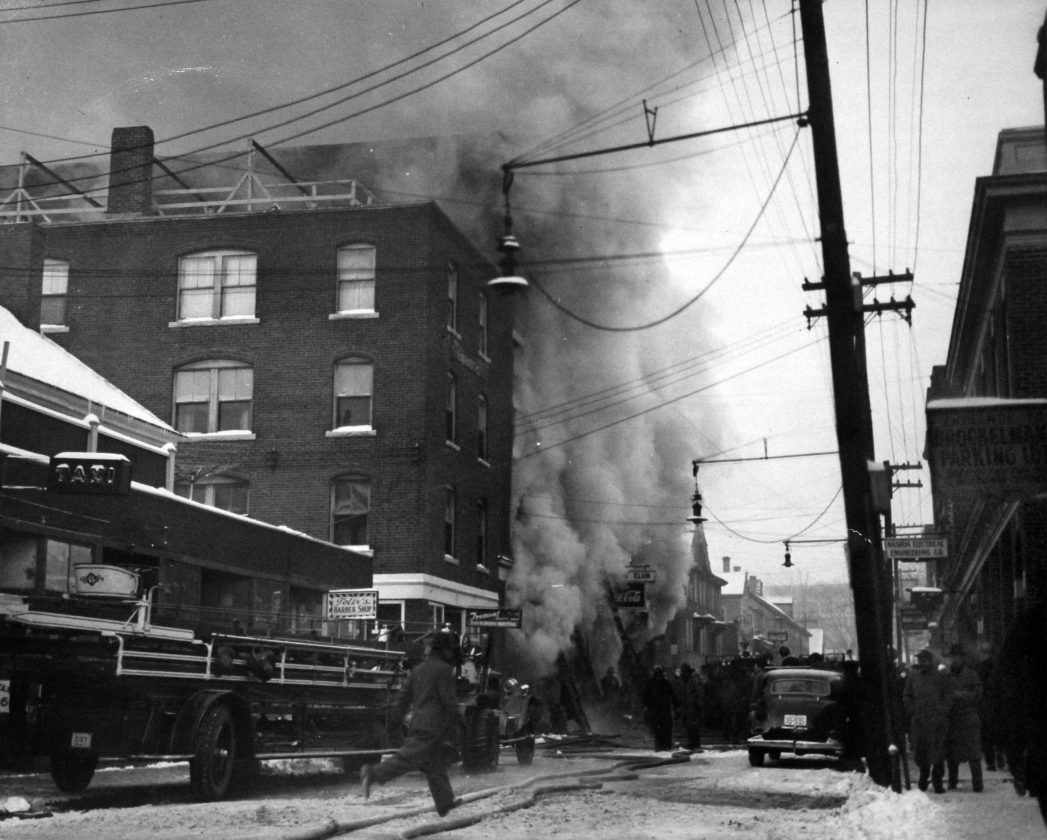
COURTESY PHOTO The former O'Donnell Hall on High Street, shown at the height of a general alarm fire in December 1945, was part of the High Rock community. Few buildings remain on High Street today.
So this week we’ll explore the High Rock of the latter 19th century through the dawn of the 20th century, a largely prosperous period for the small, tight-knit neighborhood that, unfortunately, wouldn’t last.
High Rock’s earliest years can be traced to a decade or two before the Civil War, around the time Nashua became a city in 1836. A giant, sprawling textile manufacturing complex had recently gone into operation, offering plenty of jobs for those who wanted to work in a factory rather than on the farm.
It was a period in which a future Nashua notable named Gen. Charles W. Stevens grew up.
About a century ago, an elderly Stevens shared with a Telegraph reporter some of his recollections of High Rock’s earlier days, such as his childhood home being a “double house” that “burned flat” and became the site of O’Donnell Hall.
O’Donnell itself burned down in December 1945. All that’s left along the south side of High Street is the taxi stand, the end of the Lafayette Club hall and the School Street city parking lot.
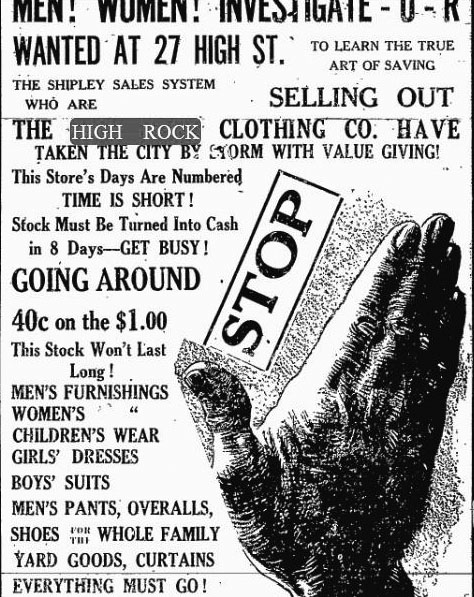
The High Rock Clothing Company was one of numerous businesses that operated in the High Rock neighborhood, an area on either side of High Street just west of Main Street.
Anyway, back to the past. Stevens told the Telegraph that in the 1880s or 90s, a “fine residential section” was being considered for an area he described as “the rock and Chestnut Street,” which seems to suggest there was in fact an actual “high rock” that gave the area its name.
In parlance both common and acceptable a century ago, Stevens noted that the “fine housing” didn’t come to be, as the present buildings were “occupied in several instances by colored people as well as by working men,” and that when “the colored families moved away (the area) became the residence section of people of Irish extraction.”
Later, as we now know, Polish and Lithuanian immigrants settled in the area, and soon, many of Nashua’s Greek immigrants began populating High Rock. Members of their fast-growing community soon took up residence along several streets to the south of West Pearl Street, which in Nashua’s pre-Walnut Street Oval, pre-Bronstein Apartments days continued through to Palm Street.
For a time, Nashua’s Niagara Fire Company was housed on High Street, Stevens told the Telegraph, recalling the station house as a popular social gathering place for residents.
Stevens either wasn’t aware of, or he chose not to mention, the unsavory conditions that befell High Rock in the latter years of the 19th century, creating a most unpleasant situation that finally came to a head in 1899.
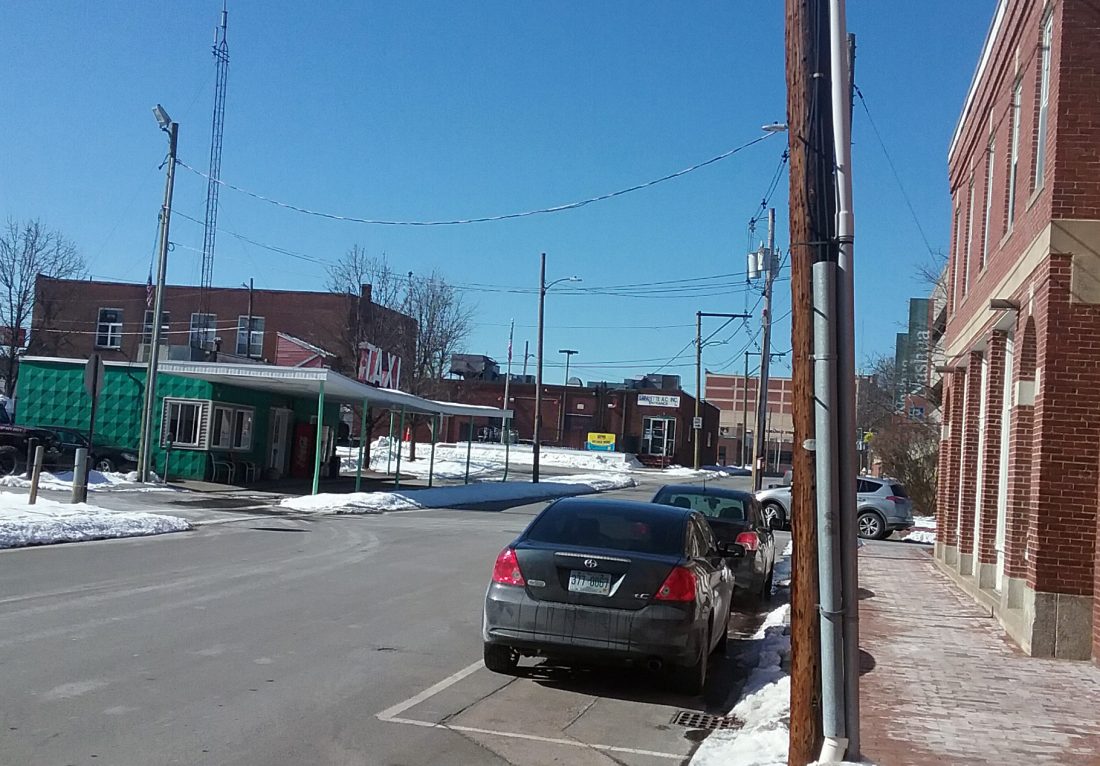
Telegraph file photo by DEAN SHALHOUP Parking lots dominate High Street these days, unlike a century ago when the area, called High Rock, featured industrial, retail and residential buildings. The photo was taken earlier this year.
Unkempt tenements were deteriorating, turning a once nice neighborhood into an urban slum. Worse, people were getting sick, many of them feeding the region’s ongoing malaria epidemic.
Workmen shoveled excrement from cellars into alleys, where the resulting piles waited to be removed by large carts – which in most cases never came.
What was happening, according to the Telegraph, was that many of the tenement owners decided to connect their buildings to the city sewer system, then hire crews to shovel out and dismantle the “vaults” and “closets” – polite names for outhouses.
Talk about the worst job in the world. It’s no wonder the owners had trouble finding men to do the job right. The result is predictable: The “vaults,” most of them still half full of waste, just sat there unused and ignored, stinking up the neighborhood.
Contributing to the “very strong, vile odor” in the area were the remaining vaults still in use outside, or in the basements of, the tenements that hadn’t yet hooked up to the city sewer.
It appears from reading the Telegraph stories that a reporter joined city officials on a walking tour of High Rock to inspect the conditions they’d heard so much about.
Along the way, the reporter wrote, he stopped to talk with workmen in the process of cleaning out the pit under one of the old barns on School Street. The men were “loud in the denunciation of the condition that had been allowed to exist so long,” he wrote.
The men “placed much of the blame on the Board of Health,” apparently without realizing how little power the board actually had, the reporter fairly editorialized.
He continued down that road, opining that “it is more and more apparent that if this city is to have perfect sanitary conditions it will be necessary to adopt a system of sanitary inspection … and give someone the power to remedy all abuses … .”
He called for “public opinion” to “be aroused” in order to pressure those who own the unsanitary tenements to “change the conditions that exist.
“The quicker this is done the better it will be for the poor people who make their homes” in the High Rock area.
Next week: Turning the corner toward a cleaner, safer High Rock neighborhood, plus the “sensational” police raid of 1902 that “created intense excitement” throughout High Rock.
Dean Shalhoup’s column appears weekly in The Sunday Telegraph. He may be reached at 594-1256 or dshalhoup@nashuatelegraph.com.
-

-
Dean Shalhoup
Longtime reporter, columnist and photographer, is back doing what he does best ñ chronicling the people and history of Nashua. Reaching 40 years with The Telegraph in September, Deanís insights have a large, appreciative following.
-
- COURTESY PHOTO The former O’Donnell Hall on High Street, shown at the height of a general alarm fire in December 1945, was part of the High Rock community. Few buildings remain on High Street today.
-
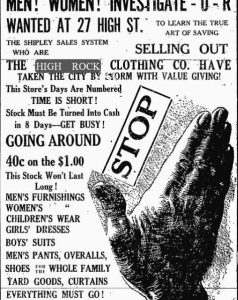
- The High Rock Clothing Company was one of numerous businesses that operated in the High Rock neighborhood, an area on either side of High Street just west of Main Street.
-
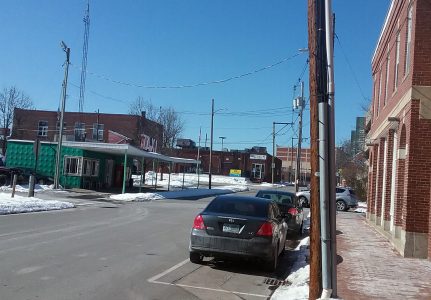
- Telegraph file photo by DEAN SHALHOUP Parking lots dominate High Street these days, unlike a century ago when the area, called High Rock, featured industrial, retail and residential buildings. The photo was taken earlier this year.