St. Joe’s mask innovations improve patient safety
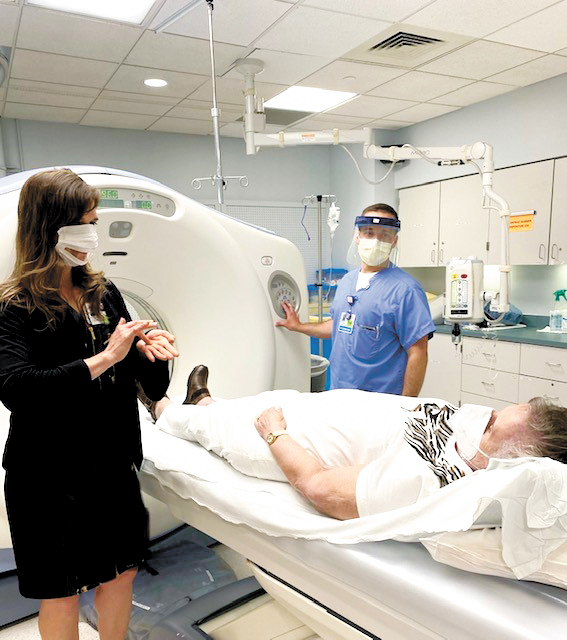
Wearing a clear mask, Rosemary Ford communicates via sign language with a patient at St. Joseph Hospital in Nashua.
NASHUA – While the safety of both their patients and staff members remains a top priority as they reopen services throughout the hospital and primary care clinics, the additional safety measures undertaken by the team at St. Joseph Hospital have presented unforeseen challenges when it comes to communicating with patients and family members.
“Having to wear a mask during all patient interactions has been difficult” said Jeanne Kennedy, clinical director of emergency services and Milford Urgent Care. “When both the patient and the caregiver are wearing a mask, particularly for patients who are deaf or hard of hearing, our voices sound muffled and it eliminates the ability of the patient to read our lips and/or facial expressions and vice-versa.”
One of the innovative ways St. Joe’s is helping to meet the communication needs of patients is through the use of clear masks. Clear masks are not new to healthcare but there are only a few companies that produce FDA backed masks, such as the Safe and Clear, Communicator mask (seen below). Unfortunately, most health care entities do not carry large quantities of these masks due to the cost, and they are very difficult to come by at this time.
Fortunately for patients at St. Joe’s, Rosemary Ford, their director of interpreter services, identified this as a potential obstacle early on in the Pandemic. “For Deaf patients who identify American Sign Language (ASL) as their primary language, a mask can be a great barrier while seeking healthcare. ASL is a visual, gestural, three-dimensional language that relies heavily on facial expressions and body movements as part of its grammatical structure. By blocking the facial expressions of the interpreter, the language can become skewed causing misunderstanding and preventing meaningful access”
This led Rosemary to place a limited order of clear masks for hospital and practice usage well before it became a serious problem.
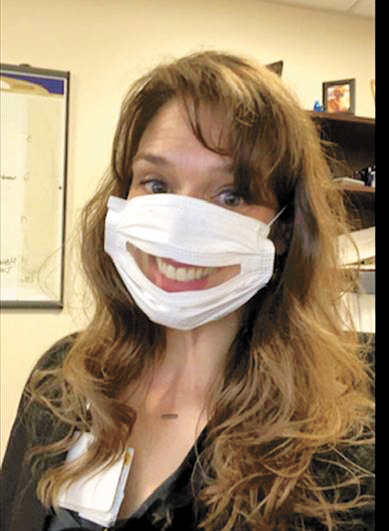
Rosemary Ford is director of interpreter services at St. Joseph Hospital in Nashua.
“Communication and visual expressions go hand and hand” says Rosemary. “In the case of an interpreter, not only are they interpreting meaning between provider and the patient but they are providing cultural mediation and interpreting non-verbal cues. These masks have played a vital role maintaining that level of connection during COVID.” However, clear masks have not only benefitted the deaf and hard of hearing community members. They’ve also been used with patients receiving speech therapy, patients who are being counseled due to trauma/assault, and pediatric patients to name a few.
“Our departments goal is to provide meaningful access to all patients that we encounter and to use appropriate resources that match our patients’ needs to they can achieve a success healthcare encounter.”
Similar to the clear masks, Jeanne Kennedy and the Emergency Department team are also finding innovative solutions to communicate with patients. “For our deaf and hard of hearing patients we have a “tool kit” in the emergency department that was put together with the assistance of our Interpretive Services team. It includes a variety of devices and materials available to us and designed to assist in communicating with these patients. “Pocket talkers” are often used for the hard of hearing and serve to amplify the sound of our voice. For those who use sign language we have an ipad and can immediately reach a certified American sign language (ASL) interpreter.”
—
Tim McMahon is the director of marketing and business development for St. Joseph Hospital in Nashua.
-
- Wearing a clear mask, Rosemary Ford communicates via sign language with a patient at St. Joseph Hospital in Nashua.
-
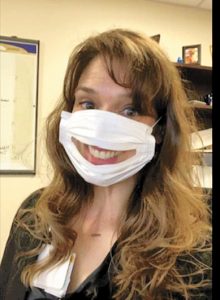
- Rosemary Ford is director of interpreter services at St. Joseph Hospital in Nashua.