Panel discusses Right-to-Know laws at NCC
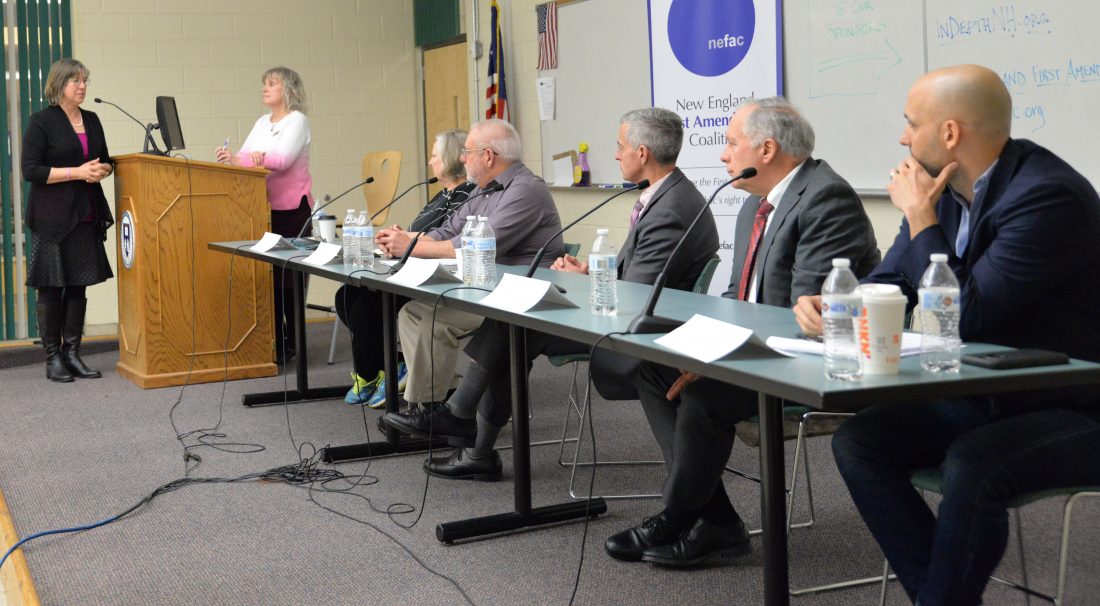
NASHUA – A panel of speakers gathered Tuesday to offer their perspectives on the importance of the public’s right to know.
The event acts as a kick off to next week’s annual Sunshine Week, which runs from March 15-21.
A five-person panel came together at Nashua Community College to help educate and take questions from the public on New Hampshire’s Right-to-Know law RSA 91-A. The panel was comprised of Nancy West, founder of the New Hampshire Center for Public Interest Journalism, which publishes InDepthNH.org; Dean Shalhoup, senior staff writer with The Telegraph; retired Merrimack Police Chief Mark Doyle, who now serves as director of Emergency Services and Communication; former longtime libel lawyer Rick Gagliuso, who represents media outlets statewide; and Legal Director at American Civil Liberties Union of New Hampshire Gilles Bissonnettee.
All five brought their own unique perspectives to the table during the event titled, “How Transparent is New Hampshire Government and Why It Matters.” Panelist spent roughly two hours touching upon things such as the process of how RTK requests has evolved over time, the importance of open and transparent government for both journalists and the general public, the benefits that come with having the ability to access information through RTK requests, privacy and exemption related issues and more. Each panelist had plenty to say on the matter, but also found time to field questions from those sitting in the audience.
“Whenever the government creates a document, I believe it is a public record unless there is a real exemption and a real legitimate reason why it isn’t public,” West said.
In her 30-plus years of reporting, she has witnessed the atmosphere around RTK’s change. West said as money dried up, it became harder for newspapers to have a staff attorney that could handle not only different RTK requests, but also to deal with reporters if there was perhaps a particularly sensitive story.
Gagliuso said that throughout the 1980s and into the 1990s, there was some struggle to get various agencies to pay attention to the state’s RTK law and comply with it. Gagliuso said the 1990s into the 2000s was the hayday for enforcing the law. However, as the internet began taking over in the years moving forward, newspapers had less revenue available to bring forward these RTK cases in court. As far as today goes, Gagliuso said his sense is that there has been a resurgence and that he believes times are generally pretty good for RTK. He also said his general sense is that things have improved a lot.
However, Gagliuso made a suggestion to further improve the RTK law, pointing out what he describes as a huge flaw in the way it exists today. Right now, if an individual prevails in a lawsuit to uncover records, for example, they are not entitled to recover attorney fees, even if they win, unless they show the agency involved knew or should have known that what they were doing was in violation of the law. Gagliuso said this is a really high hurdle to get over.
“I wish that the laws were different,” he said. “I wish that if you prevail in a suit under the Right-to-Know law you were entitled to recover attorneys’ fees because, frankly, you are at that point advocating for the public’s interest in public proceedings and public records.”
Gagliuso said that, in his view, the agency should reimburse the individual for the expense of bringing the lawsuit forward, with the belief that the agency ought to be paying for it.
“That’s not the way the law reads right now, and so there’s a, in my view, a deterrent built into the Right-to-Know law to bring lawsuits that I think needs to change,” Gagliuso said.
Bissonnettee said he agrees with Gagliuso on this, citing how he believes this would be a huge beneficial change to the RTK law if there were mandatory fee shifting. Bissonnettee said when that is in the back of the mind of a government agency, they are more likely to make a decision in favor of disclosure.
“That’s why I actually think if we were to make that change it would actually be incredibly more beneficial and create, really, a more transparent New Hampshire,” Bissonnettee said.
West said she hears a lot of people say they do not have staff trained to understand the RTK law. However, she said she also does not see a lot of those same agencies offering training. She believes if that agency had to pay legal fees, that the money would be better spent training people in different agencies as to what the public’s right to know is.
“Of course I agree with Rick and Gilles that if we were able to get attorneys fees when we won a case that would be a great deterrent in the future for agencies to withhold documents,” West said.
The forum was sponsored by InDepthNH and the New England First Amendment Coalition.