New program aims to help children affected by opioids
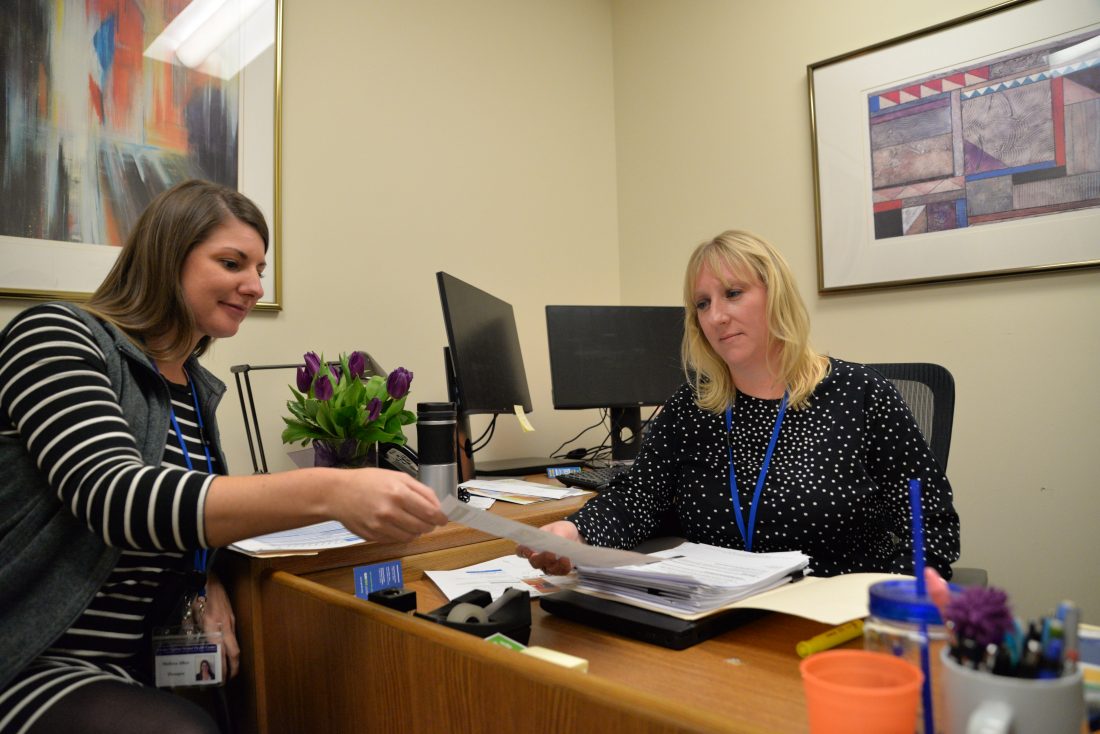
Telegraph photo by ADAM URQUHART Director of Acute Care Services Jessica Gagnon sits behind a desk showing therapist Missy Allen some paperwork at Greater Nashua Mental Health.
By ADAM URQUHART
Staff Writer
NASHUA – As various organizations in the city work to tackle the troubles rising from the opioid epidemic, Greater Nashua Mental Health Center officials are launching a new program to assist children caught in the chaos.
As awareness around Adverse Childhood Experiences (ACEs) continues gaining traction, GNMH, Revive Recovery Center and the Nashua Police Department are now embarking on a collaborative effort to provide early intervention when it comes to an ACE experienced as a result of an opioid-related situation. If police respond to an opioid-related overdose and encounter a child, those families will now have an option to reduce the impact of the ACE.
ACEs include a range of experiences, including physical, emotion and sexual abuse, as well as physical or emotional neglect, mental illness, substance dependence, incarceration, parental separation or divorce, or domestic violence. ACEs are quite common, with 67% of the population having had at least one ACE and 12% having four or more. These experiences can lead to an increased risk for negative health outcomes, with ACEs having a strong relationship with health, social and behavioral problems throughout an individual’s life. Children exposed to high doses of adversity are also more likely to engage in high risk behaviors.
“We’re getting some data from AMR (American Medical Response) and the Doorway suggesting these folks that are seeking treatment and are receiving emergency care – they have children, whether they’re in their custody, or in child protection, or have lost their parental rights, there are children involved and we want to intervene as early as possible,” Gagnon said.
With grant funding from the New Hampshire Department of Health and Human Services and its division for behavioral health, GNMH’s Child, Adolescent and Family Services aims to launch an ACEs Mobile Response Team for children up to the age of 18 and their families impacted by an opioid misuse event.
The grant is arriving during the course of a two-year period in the amount of $300,000. There are 10 mental health centers across the New Hampshire, each focusing on a specific area of the state. Community and Development Coordinator Donna Albertelli Collins said two agencies were selected to receive funding, and that the Mental Health Center of Greater Manchester also received funds in the same amount.
“Our overarching mission is to provide evidence-based, culturally responsive services to children and families who’ve experienced traumatic stress as it relates to opioid use in the home,” Director of Acute Care Services Jessica Gagnon said. “The community partnerships created in this project play an important role in obviously breaking the cycle of adverse childhood experiences and producing positive outcomes.”
Gagnon believes the ability to intervene at the time of the first ACE would have a significant impact in preventing further ACEs from occurring. Through this program, the response team will have five clinicians from GNMH available 24/7 and five recovery coaches from Revive. Two individuals – one from GNMH and one from Revive – will respond within an hour to a call from law enforcement to arrive at the home of a child or child and provide supportive services when there has been an opioid-use event that is traumatic. However, Albertelli Collins said if a family member tells an officer they do not want them to call the team, officers will have pocket cards to provide them with an explanation of the service.
Within 24 hours, team members will return to the home or have those people involved go to an office to begin getting them engaged in services. Revive will work with GNMH’s side in this, and they also provide a lot of supports and services as well.
Gagnon said the police would call GNMH to the home, and they would start with a warm introduction and give the family information on how these services can be helpful and not harmful. While officers work to stabilize the situation, the two-person team would respond to the home to ensure things are stable, and then provide introductions and make sure all the basic needs in the moment are met.
After gathering all of those facts, they would then move toward facilitating an understanding of what happened, and encouraging the expression of emotions and normalizing that this is a natural response to this sort of an event. Gagnon said this consists of being able to attribute emotions and reactions specifically to the event so that they do not internalize it as a personal weakness, and understand that these emotions are very valid.
The next piece to this model is exploring coping skills and work toward problem solving to solve what can be done to cope with the situation. The last part is a recovery plan. After assessing safety, referrals can be made using a number of screening tools.
Revive Recovery Center Executive Director Jess Parnell said many of those at Revive have that experience with ACEs. With that understanding in mind, they are going to be connecting families with recovery resources in the community, such as meeting at Revive, for example.
“Our main goal is showing parents that recovery is possible,” Parnell said. “I think overall, we’re going to be seeing some good outcomes in our community because we recognize that adverse childhood experiences affect the overall health and well-being of an individual for the rest of their lives.”
Parnell said one of the biggest things people have been identifying at Revive with those they work with is if a child is involved with a parent experiencing substance use disorder, that child needs recovery just as much as that parent or the parents do.
“We’re really excited to have the opportunity to build on this relationship and make our community a healthier place for ever one,” Parnell said.
Training will take place Jan. 30 with Nashua police officers. The program is targeted to launch on Jan. 31.
Adam Urquhart may be contacted at 594-1206, or at aurquhart@nashuatelegraph.com.