The day Carol blew into town
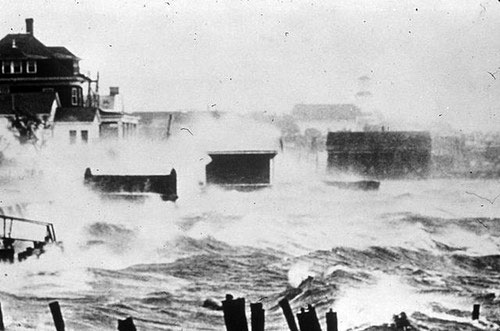
Scenes like this were common along New England's seacoast when Hurricane Carol struck the region 65 years ago this week.
Already known by millions as a boisterous, rather rude visitor, the kind who brings chaos, disrupts lives and breaks things then brazenly skips town, Carol was clearly not welcome in Greater Nashua.
Undaunted, Hurricane Carol nevertheless came as promised, arriving 65 years ago Saturday and wreaking the kind of havoc she’d already bestowed upon much of the Eastern Seaboard, including claiming 72 lives (none, fortunately, in Greater Nashua), causing $462 million (roughly $4.4 billion today) in damage and leaving more than 1 million people without power and phone service, in some cases for up to two weeks.
Carol was born on Aug. 25, 1954 and she rapidly came of age in the tropics as August was preparing to give way to September. I was around when Carol spun her way up the East Coast, crossed Long Island, barreled into Old Saybrook, Connecticut, and lashed her way north right through Nashua.
But I hadn’t been around for very long, and can’t say I remember what I was doing. But I know what I was doing because I was told by the adults in the room: I was snoozing blissfully in my crib, which was strategically placed midway down an interior hallway where any potential shattering glass or roof-penetrating tree branches could get to me. I was sleeping in a crib because that’s what most 3 1/2-month-olds do, mostly during the day so they can stay awake at night and drive sleep-deprived parents nuts by hollering for one thing or another.
Speaking of parents, Pop was out and about during at least parts of Carol’s visit, faithfully executing his duties as a still fairly new member of The Telegraph staff; he was coming up on his second anniversary at the then-Nashua Telegraph.
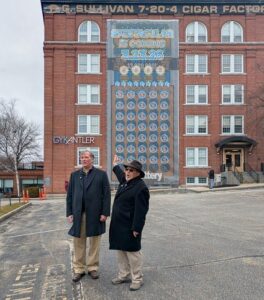
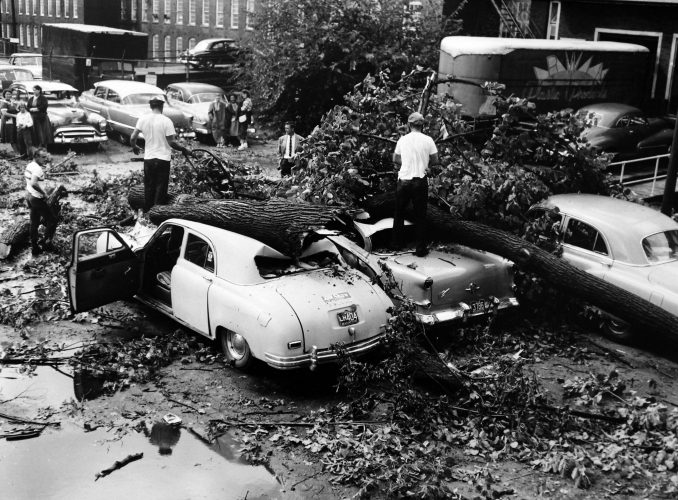
Some of those photos are still around, including perhaps the most familiar one showing several parked cars crushed by topped trees in the lot of what is now Clocktower Place apartments; the big brick building housed Nashua Plastics at the time.
Interestingly, in perusing editions of The Telegraph from the time, I found only short, below-the-fold stories – we in the newspaper world call them briefs – in the days leading up to Carol’s arrival.
But that was the norm 65 years ago, something that comes to mind for many of us baby boomers when we watch, with heads slowly shaking back and forth, the breathless local-TV meteorologists shouting “danger, danger,” like the “Lost in Space” robot when forecasting thunderstorms or snowstorms they warn could affect civilization as we know it.
Finally, starting Tuesday, Aug. 31, The Telegraph upped its coverage considerably, leading that day’s Page One with news that preparations were well underway.
“Hurricane Expected to Hit New England Late Today.” “Stores, Factories are Closed Down” … “Winds Blow Down Limbs — Telephones and Electric Service Out,” the editors headlined stories in the Aug. 31 Telegraph.
“The situation was growing worse with the passing minutes,” a reporter wrote, referring to the increasing winds, heavy rain and ongoing loss of services.
That was the situation as of noontime or so, The Telegraph being an afternoon paper at the time.
Even mail carriers were called back to the post office. Department of Public Works crews “were scattered all over the city” in response to reports of flooded streets and other infrastructure issues.
I imagine The Telegraph newsroom — four reporters and two editors strong at the time — working well into the night and coming in early the next morning to compile stories and photos for the Wednesday edition.
The storm hit home for Telegraphers: “One of the beautiful willows along the riverbank in the rear of the Telegraph building was uprooted in the storm … .”
The owner of an unnamed local store told The Telegraph he’d just received six dozen candles he’d ordered to get a jump on the holiday season. “By nightfall, all of them had been sold.”
Prominent local resident Alan Barker, son of Walter Barker, found debris piled up in front of his North Hampton cottage. His boat, the “Susabelle B,” rode out the storm “in fine shape,” Barker told the Telegraph.
Likewise, Nashuan Roy McIntosh’s boat, berthed at Rye Harbor, escaped undamaged, although it did break loose from its mooring.
In Wilton, the apple crop was “hard hit,” growers reported, estimating that Carol’s winds “prematurely harvested” about one half of their crop. Must have been a banner year for apple cider, though.
As night fell, darkness enveloped most of Nashua, “with the exception of the greater part of Main Street.” The situation “was extremely bad” in Nashua and surrounding towns, an electric utility spokesman told The Telegraph.
Winds propelled objects across streets and into buildings, smashing more than a few windows in places like the Philip Morris store, Leed’s, Nashua Auto Co., Dionne Brothers Furniture, and Sterios Pleakas’s coffee house on West Pearl Street.
TV antennas came down all over the place, sometimes ripping out roof shingles, like at Albert Biron’s house on Edgeville Street (it was off Burke Street), where two chimneys were also felled by the winds.
“A good portion of the west end of the city was submerged,” The Telegraph reported. At the time, all of the area west of Pine Street, beginning at the Pine, Ledge and Central streets intersection, was known as the west end.
Eaton Street and Grand Avenue, according to residents, were underwater. “One Ledge Street resident, clad in shorts, acted as a human lighthouse -flagging down vehicles approaching the flooded area,” The Telegraph reported.
Carol’s hours were numbered, according to weather historians, even as she lashed Greater Nashua. By late the night of Aug. 31, she had transitioned into an extratropical cyclone, and was nothing more than a fairly heavy rainstorm as her remnants crossed into Canada.
Her highest sustained winds hit 115 mph just before she struck New York and New England.
By the numbers, in New England Hurricane Carol was responsible for 65 deaths and 1,000 injuries. About 150,000 people were left without electricity and telephone service. An estimated 1,545 houses were destroyed and another 9,720 damaged.
Well, OK, now that Carol is relegated to the history books forever, I guess I’ll be nice and wish her a happy 65th birthday.
Scenes like this were common along New England’s seacoast when Hurricane Carol struck the region 65 years ago this week.
Courtesy of NASHUA HISTORICAL SOCIETY
Trees and large branches felled by Hurricane Carol 65 years ago this week crushed several vehicles parked in the city’s Millyard, near where Clocktower Place apartments are today. Carol left similar damage, along with flooding, in many areas of New England. The photo is from the historical society’s Mike Shalhoup Collection.
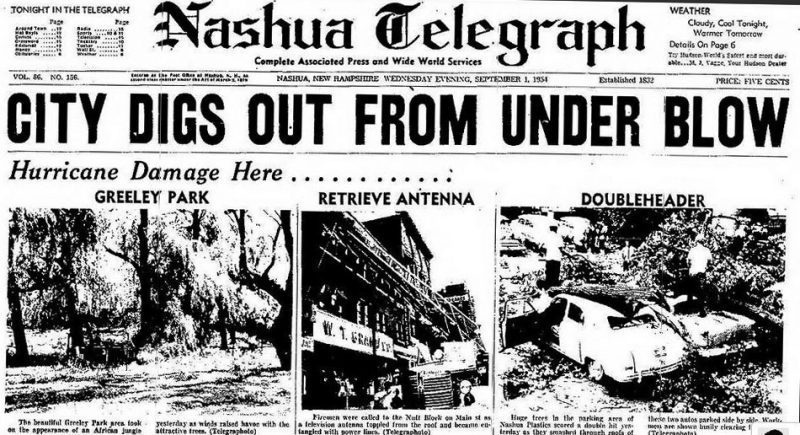
Stories and photos about the aftermath of Hurricane Carol covered Page One and several other pages of the Sept. 1, 1954 Telegraph. Carol struck the region 65 years ago this week.
Dean Shalhoup’s column appears Sundays in The Telegraph. He may be reached at 594-1256, dshalhoup@nashuatelegraph.com or@Telegraph_DeanS.