Tick tips: Tick season ramps up in Northeast
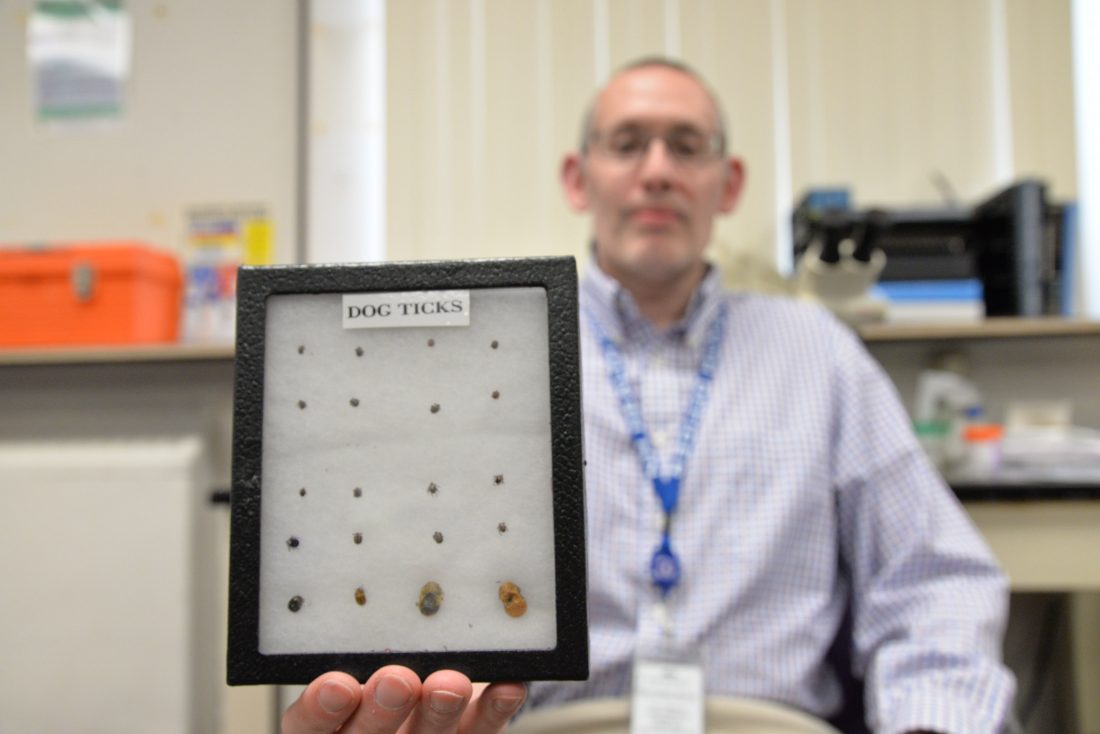
Telegraph photo: ADAM URQUHART Health officer and laboratory director at the city’s Division of Public Health & Community Services Ren Beaudoin shows off a collection of dog ticks.
NASHUA – Tick season is creeping into full swing, and states in the Northeast have the highest risk for Lyme disease.
Despite having the ability to carry and transmit multiple parasites, bacteria or viruses at the same time, there are plenty of ways to prevent any health issues. Aside from the commonly known disease from tick bites, Lyme disease, which is bacteria, ticks can also carry other bacteria that causes anaplasmosis, and parasites like the Babesiosis. However, Ren Beaudoin of the Nashua Division of Public Health & Community Services said that generally speaking, time is on our side when it comes to the transmission. He said the ticks have to be biting, actively feeding for about 24 – 48 hours before they’re able to transmit Lyme or Anaplasmosis, for example. However, of all the ticks out there, he said deer ticks are the ones that carry Lyme.
“In the north east, we are pretty high Risk for Lyme disease,” Beaudoin said. “We do have the black-legged tick, or the deer tick, which is extremely prevalent.”
As health officer and laboratory director with the division, Beaudoin it’s pretty early, and that data on Lyme usually trickles down from the state level and comes out as the season goes on. However, he was able to provide the most recent data on hand, where it shows incidence rates in Nashua being significantly lower compared to the rates in the Greater Nashua Public Health Region, Hillsborough County and the state as a whole over the five year period from 2010-2014. According to the 2017 Community Health Assessment booklet found at the division, the Greater Nashua Public Health Region had 200 new cases of Lyme disease in 2014, of which 41 were in Nashua, and accounting for 14 percent of the 1,416 new cases in New Hampshire.
“In the grand scheme of things, our rates, they’re high – higher than most other areas in the U.S.,” Beaudoin said.
While the Northeastern states have the worst rates of Lyme disease in the country, he said once the warmer weather rolls around, these pests become more prevalent. Ticks can be active year round, but tend to be less active in the cold months when there is a lot of snow cover. At that time, they slow down and go into hiding. Moreover, ticks will be in full swing until around the first freeze, or sometime in middle to late fall.
In the meantime, there are a number of ways people can protect themselves, children and pets. Beaudoin said pets are crucial, and that pet owners are at a higher risk of having a tick crawl onto them because pets can bring them into their home. He said a lot of people do not think of that. He also said that it is common, and has had a lot of people bring in ticks to the Division lately.
Moreover, there are various different products available for pets such as topicals and chewables. He recommends people talk with their veterinarians about chewable options.
Moreover, if a tick is found, he said to pluck it off, recommending people place it in a vial of isopropyl alcohol to ensure the bug is killed. He said ticks are very hard to kill and due to their hard shell and cannot be squished.
“Tick borne illness for dogs can be crippling, just like humans,” Beaudoin said.
He said if people are outside hiking in the woods or working in a garden, to use EPA registered bug sprays. He said an EPA verified product has been tested and manufacturers’ statements are true. He said a lot of sprays out there that don’t have that verification have not been tested, and that the claims may not be valid.
Aside from the sprays available, he said there are also clothing sprays available. Other preventative steps include laundering clothes after coming in from the outdoors, such as when returning from hikes, and doing tick checks to make sure no tiny hitchhikers attached to ones clothing or skin.
Dog ticks can be a little bigger, about twice the size, as deer ticks, but do not carry Lyme disease. The larval deer ticks are not so much a concern for Beaudoin, as they have not had a chance to acquire Lyme just yet. It’s the nymphs and adults that pose concerns.
“The nymphs are pretty small, so you really do have to look for them,” Beaudoin said. “The adult ticks, you’re looking at about the size of a ‘D’ on a dime.”
Moreover, if someone is unsure if they have found a dog tick, deer tick or any other strange specimen, Beaudoin said people can always bring bugs down to the Division, located at 18 Mulberry St., and have it looked at and identified.
“It’s important for people to know these things are out there, but we can do things to go outside and have fun,” Beaudoin said. “I think that’s the biggest thing, is that none of this stuff should ever stop us from going outside and enjoying nature. If we take the right steps, we can really keep ourselves, our children and our pets safe.”